Lucedale still clearing Hurricane Zeta debris more than seven months later
More than seven months after Hurricane Zeta, Lucedale is still waiting on Mississippi's transportation department to finish clearing storm debris.
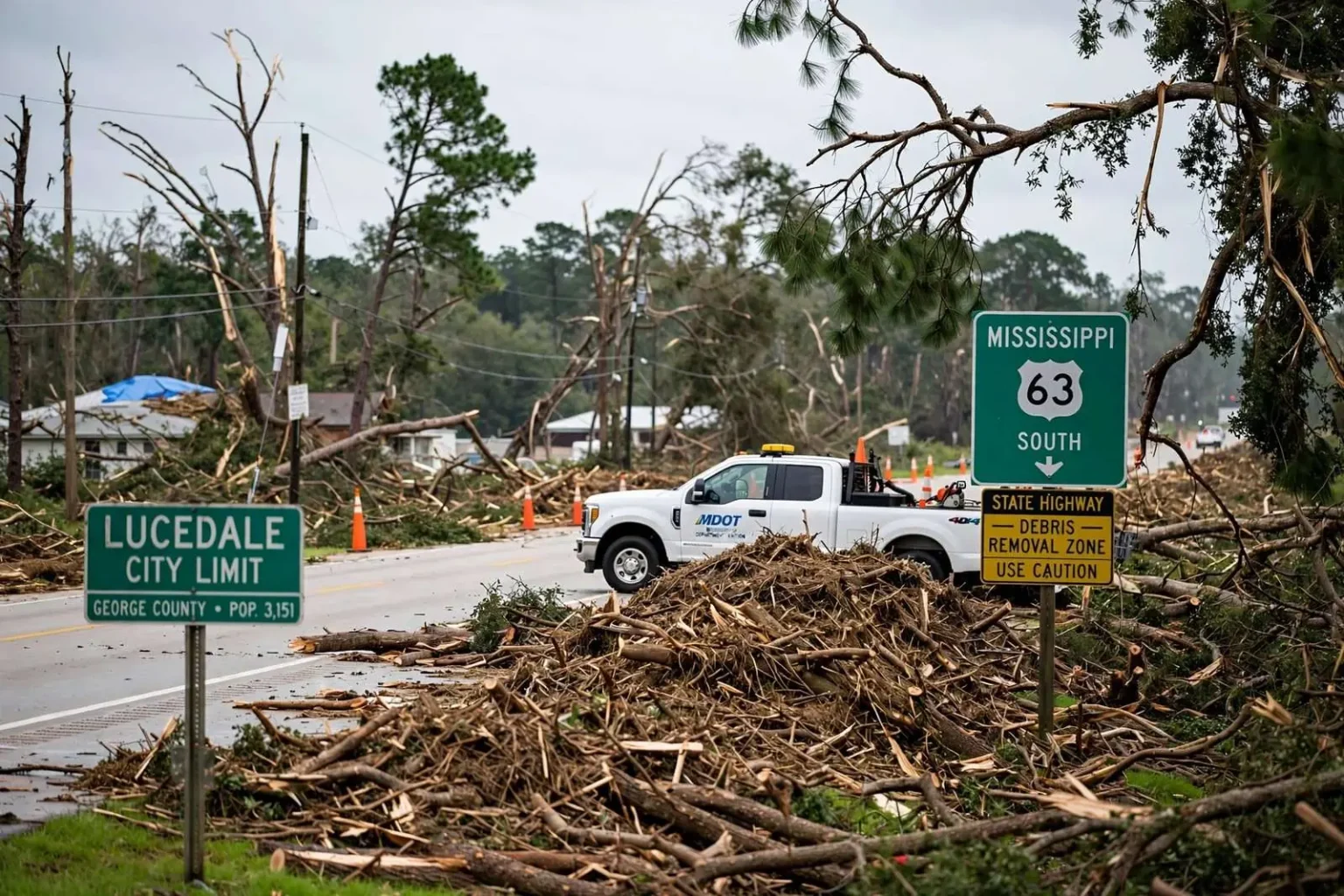
LUCEDALE, Miss. — The city of Lucedale says it is still working to clear debris more than seven months after Hurricane Zeta ravaged parts of the Gulf Coast. Lucedale was hit particularly hard by the storm, and city leaders say recovery has taken time. The inland bedroom community, best known as the seat of George County, found itself dealing with storm damage more severe than residents of some coastal towns closer to the water.
Mayor Darwin Nelson said the city had most of its debris picked up by December, but is still waiting on the Mississippi Department of Transportation to finish cleanup along state highways. The distinction matters in Mississippi, where cleanup responsibilities are split: cities and counties handle local streets and roads, while the state transportation department answers for the highways that pass through them. In Lucedale’s case, that division of labor has left the city watching and waiting while work continues on the state routes that carry most of its traffic.
“Zeta did smack us really hard, as a matter of fact, I’ve heard folks comment they thought Zeta hit us worse than what Katrina did,” Nelson said. The comparison to Katrina, the 2005 storm that remains the benchmark for Gulf Coast disasters, says much about how Lucedale experienced Zeta’s passage. Residents who lived through both storms have judged the more recent hurricane — a smaller system by most measures — as the harder hit for their community.
Nelson said the city has waited so long for MDOT that it has considered doing the work itself, but would not be reimbursed for the cost. The reimbursement question is the crux of post-storm cleanup everywhere on the Gulf Coast: work on state rights-of-way is eligible for reimbursement through federal disaster programs, but only for the agency responsible for that roadway. If the city stepped in and cleared state highways on its own, the expense would fall on Lucedale’s budget rather than the disaster funding stream.
MDOT said debris removal will be complete by the end of August. The timeline, more than seven months after the storm and stretching toward the height of a new hurricane season, illustrates the slow pace that storm debris cleanup can take even long after the headlines move on.
How Zeta hit the Pine Belt
Hurricane Zeta came ashore in Louisiana in late October 2020 and cut a fast-moving path across southeast Mississippi, losing little of its punch as it moved inland. Fast-moving landfalling hurricanes often do their worst damage well past the coast, because the core of the storm stays organized over land. Communities along and north of the coastal counties — Gulfport, Hattiesburg and towns across the Pine Belt — recorded widespread tree damage and power outages as Zeta raced through.
Lucedale sits in George County, north of Pascagoula and west of the Alabama line, along the corridors that Zeta’s eye crossed as it moved northeast. The city’s tree canopy and older residential streets were exposed to hours of tropical-storm and hurricane-force winds, and falling trees became the dominant form of damage. For inland communities like Lucedale, a hurricane’s aftermath is measured less in storm surge and more in timber down across yards, roads and power lines.
The comparison residents drew to Katrina reflects that reality. During Katrina in 2005, Lucedale and George County served as a refuge for coastal evacuees and suffered damage of their own from a far larger storm. Zeta, though smaller, delivered a concentrated blow to the city, knocking down trees, snapping limbs across roadways and leaving months of debris in its wake — enough that residents who survived both storms judged Zeta the worse experience locally.
Why cleanup takes so long
Storm debris removal is a logistical undertaking that surprises most people who have never watched it happen. After a hurricane, municipalities must first clear roads for emergency access, then organize the systematic collection of vegetative debris, construction and demolition material and household hazardous waste — each type kept separate for disposal. Hauling contractors, approved through emergency procurement rules, run trucks through neighborhoods for weeks and months, and every load must be documented for the federal reimbursement that eventually pays for the work.
The volumes involved are hard to overstate. A single inland hurricane can down enough trees to bury a small city’s rights-of-way under tons of limbs, trunks and stumps. Debris must be hauled to temporary staging sites, ground up or burned under environmental permits, and every load documented. Contractors, haulers and disposal sites across the entire disaster zone compete for the same resources, which stretches timelines when a storm like Zeta damages a wide swath of the Gulf Coast at once.
The split between city and state responsibility adds friction to the process. Residents generally do not distinguish between a city street and a state highway when they see debris sitting along the roadside; they simply expect it to disappear. When the responsible agencies differ, citizens see a town that looks abandoned even though the city has done its own share of the work. Nelson’s account of waiting on MDOT reflects a frustration common in small towns crossed by state highways after a disaster.
What MDOT’s timeline means
MDOT’s commitment to have debris removal complete by the end of August gives Lucedale a finish line more than seven months after the storm. State crews and contractors working state highways must clear rights-of-way, remove hanging limbs and cut leaning trees that threaten the roadway — work that is more involved than simply pushing debris to the shoulder. The state’s highway system through George County includes the routes that connect Lucedale to U.S. 98 and the coastal counties, corridors that carried Zeta’s damage deep into the county.
The end-of-August target also lands just as the Atlantic hurricane season reaches its historical peak. Gulf Coast communities clearing one storm’s debris in late August do so with the knowledge that a new system could arrive with little warning, adding fresh debris to limbs still awaiting pickup. The overlap is one of the quiet risks of a slow recovery cycle on the Gulf Coast, where the recovery from one hurricane can overlap with the next.
For Lucedale residents, the completion of state highway work will close out a chapter that began in October 2020. The city’s own streets were largely cleared by December, according to the mayor, and the remaining work belongs to the state. When MDOT finishes, the last physical trace of Zeta in the public right-of-way will finally be gone.
Looking back on a slow recovery
The seven-month timeline is not unusual for the Gulf Coast, and that may be the most instructive part of Lucedale’s experience. Hurricanes produce debris on a scale that overwhelms normal maintenance budgets and schedules, and even well-run recovery operations take months to work through the piles. The reimbursement rules, contractor availability and environmental requirements that make the process accountable also make it slow.
Nelson’s willingness to speak about the city’s frustration — including its consideration of doing the state’s work itself — puts a public face on a dilemma many small towns have faced. Cities that step outside the reimbursement rules absorb costs that can strain a small budget for years; cities that wait live with the appearance of neglect. There is no painless option, only the choice between patience and expense.
As August closes, Lucedale will watch to see whether the state’s promise holds. The city has done what it could do on its own streets, most of it completed by December, and the remainder of the cleanup now rests with MDOT and its contractors. Seven months after Zeta “smacked” the city hard enough that its residents rank it above Katrina, the last of the storm’s debris is finally scheduled to come off the highways — and a Mississippi town that took a hurricane’s worst will get its roads fully back.
What MDOT’s timeline means
MDOT’s commitment to have debris removal complete by the end of August gives Lucedale a finish line more than seven months after the storm. State crews and contractors working state highways must clear rights-of-way, remove hanging limbs and cut leaning trees that threaten the roadway — work that is more involved than simply pushing debris to the shoulder. The state’s highway system through George County includes the routes that connect Lucedale to U.S. 98 and the coastal counties, corridors that carried Zeta’s damage deep into the county.
The end-of-August target also lands just as the Atlantic hurricane season reaches its historical peak. Gulf Coast communities clearing one storm’s debris in late August do so with the knowledge that a new system could arrive with little warning, adding fresh debris to limbs still awaiting pickup. The overlap is one of the quiet risks of a slow recovery cycle on the Gulf Coast, where the recovery from one hurricane can overlap with the next.
For Lucedale residents, the completion of state highway work will close out a chapter that began in October 2020. The city’s own streets were largely cleared by December, according to the mayor, and the remaining work belongs to the state. When MDOT finishes, the last physical trace of Zeta in the public right-of-way will finally be gone.
Looking back on a slow recovery
The seven-month timeline is not unusual for the Gulf Coast, and that may be the most instructive part of Lucedale’s experience. Hurricanes produce debris on a scale that overwhelms normal maintenance budgets and schedules, and even well-run recovery operations take months to work through the piles. The reimbursement rules, contractor availability and environmental requirements that make the process accountable also make it slow.
Nelson’s willingness to speak about the city’s frustration — including its consideration of doing the state’s work itself, unreimbursed — puts a public face on a dilemma many small towns have faced. Cities that step outside the reimbursement rules absorb costs that can strain a small budget for years; cities that wait live with the appearance of neglect. There is no painless option, only the choice between patience and expense.
As August closes, Lucedale will watch to see whether the state’s promise holds. The city has done what it could do on its own streets, most of it completed by December, and the remainder of the cleanup now rests with MDOT and its contractors. Seven months after Zeta “smacked” the city hard enough that its residents rank it above Katrina, the last of the storm’s debris is finally scheduled to come off the highways — and a Mississippi town that took a hurricane’s worst will get its roads fully back.