Lunatix & Co. Brings Wearable Art by Local Designers to Dauphin and Springhill
A profile of Lunatix & Co., Courtney Matthews' downtown Mobile boutique of handmade, upcycled fashion and jewelry by more than 20 local artists.
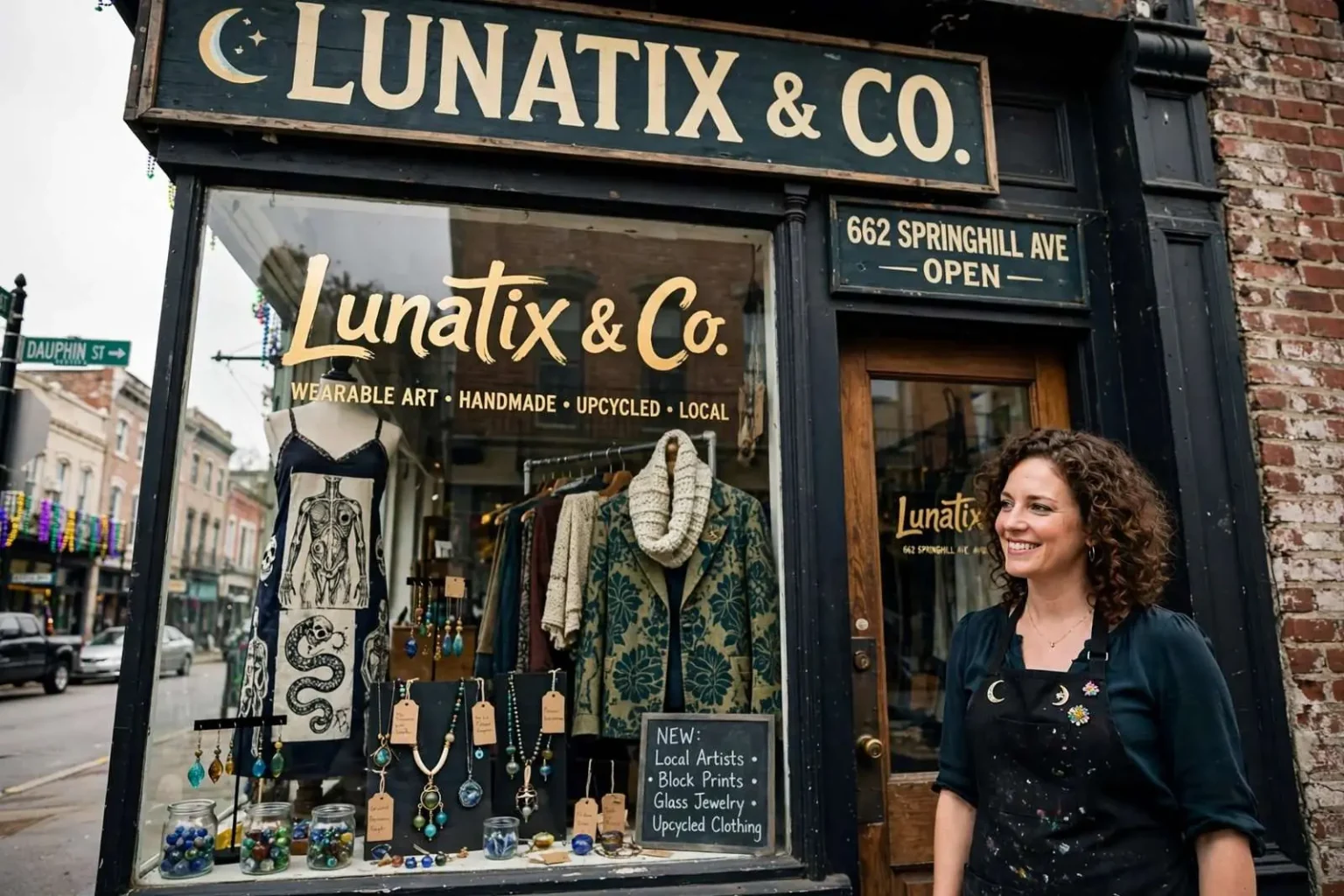
Downtown Mobile gained a one-of-a-kind retail destination in early 2011 with Lunatix & Co., a boutique at 662 Springhill Ave. near Dauphin Street that sells handmade, upcycled and wearable art created almost entirely by local artists. The shop opened at a moment when downtown Mobile’s revival was gaining real momentum — the Dauphin Street entertainment corridor attracting steady weekend crowds, the historic core filling with new restaurants and bars — and it staked out a niche none of that growth had yet supplied: a retail space devoted to objects made by the city’s own artists, one rack and one display case at a time.
The store’s premise sets it apart from nearly everything else on the peninsula’s retail map. Where consignment shops resell and boutiques import, Lunatix & Co. builds its inventory from the work of makers who live in the area — block prints pulled by hand, garments sewn from vintage fabric, glass beads blown at a torch, jewelry assembled from materials that sometimes began life as something else entirely. Every purchase supports a local artist directly, and no two visits to the shop yield quite the same inventory.
The Force Behind Lunatix
Founder Courtney Matthews — known to friends as CoCo — is originally from the Mississippi Delta but has called Mobile home for more than half her life. A makeup artist of ten years’ standing, she works for Bobbi Brown cosmetics and does makeup for local magazines such as Mobile Bay Monthly and Mobile Bay Bride, along with photo shoots for fashion photographers like Toni Riales.
That background is more relevant to the shop than it might first appear. A decade of editorial and bridal makeup work means Matthews has spent years inside the region’s creative economy — on magazine sets, at weddings, in photographers’ studios — building exactly the network of artists, stylists, and designers a store like hers depends on. Opening Lunatix & Co. fulfilled a long-held dream of running a downtown shop devoted to wearable art by the artists she had come to know through the city’s arts and music scene.
Matthews described the Springhill location as deliberately small — a “mini” version of what she envisions, with plans to expand into a larger downtown space when the timing is right. The location also lets her makeup clients book appointments convenient to downtown events and Mardi Gras balls, a scheduling advantage during Carnival season, when downtown fills nightly with maskers, mystic societies, and the parade crowds that define Mobile’s signature season.
The strategy — small footprint, dense local inventory, professional services layered over retail — is a recognizable playbook for independent retail: keep overhead low, make the shop a place artists want to be stocked in, and let the makeup chair double as an appointment book and a marketing channel.
Who’s on the Shelves
The shop’s roster reads like a cross-section of Mobile’s maker community. Nikki Burkett prints detailed linoleum block art onto vintage and quality resale clothing, including limited-edition numbered velvet pieces and block-printed vintage ties — pieces that are individually imperfect in the way that signals genuine craft.
Rachel Wright hand-sews anatomical illustrations onto vintage slips and creates handcrafted dresses, tops and upcycled men’s T-shirts with sugar skull and snake motifs. Her work sits at the intersection of the city’s vintage-clothing culture and its tattoo-influenced visual aesthetic — garments that carry imagery borrowed from medical illustration and Mexican folk art traditions onto silhouettes that are often decades old.
Mandella Glass offers hand-blown beads, pendants and glass rings; Nelson Doty pairs the colors while his wife Kim Dang adds beading, and the duo also collaborate on bags. Torch-worked glass is among the most technically demanding crafts represented on the shelves — each bead and pendant shaped from molten glass at the torch, with the color work and finishing handled by different hands in the same studio.
Malana Anderson builds statement jewelry, including a necklace built around real bobcat jawbones wrapped in wiring and vintage beads. Jill Burkett knits scarves, hats and ear warmers from fine yarns, including a snow-owl-inspired snood — the kind of piece Gulf Coast winters, brief as they are, reward the wearer for owning.
Dozens more local creators round out the inventory — among them Sol Davis, Sarah Brewer, Elizabet Elliot, Ryan Jetten and Laura Berry — and Matthews said the store would stay focused on local artists, ideally all from Mobile. The commitment is a defining one for the shop’s identity: a store that stocks only local work functions simultaneously as a retailer, a gallery, and an ongoing exhibition of the city’s creative output, and it gives shoppers something no chain or online marketplace can replicate — the ability to buy a one-of-a-kind object made by someone they may well run into at a Dauphin Street show or a Mardi Gras ball.
The local-first policy also reflects the economics of the maker community itself. Artists working in small editions need retail outlets that will take a handful of pieces at a time, explain the work to customers, and pay attention to what sells. A shop built around dozens of local creators provides that, and in turn draws its character from the same community it stocks — the store’s look changes as the artists’ work does.
Makeup With a Lesson
Matthews also brings her professional makeup craft into the shop. Her chair-side approach mixes pampering with teaching, an approach she describes as sending clients home with skills rather than just looks. The instruction begins with the skin: proper skincare matched to the day’s skin condition, since makeup performs only as well as the surface beneath it — a humid Gulf Coast climate being no friend to either dry skin or an over-moisturized one.
From there, her techniques follow the sequence any professional application does, taught as she works. Pink or peach-based correctors go under concealer for dark circles, neutralizing the blue-purple undertones that concealers alone cannot cover. Foundation is blended outward from the T-zone, concentrating coverage where shine and redness collect and feathering it to nothing at the edges. Blush is matched to the natural color of flushed cheeks — the shade a client’s own face produces, rather than a color chosen from the palette — and placed where a real flush would land.
Eyes are layered light-to-dark for smoky looks, finished with smudge-proof liner and two coats of mascara on top lashes. The light-to-dark layering is the core lesson of the smoky eye: a light shade as the base and transition, a medium in the crease, a dark pressed into the lash line, so the gradient reads as depth rather than a bruise. The smudge-proof liner and the double coat on the top lashes are the insurance policy, in a climate where an evening outdoors will test any makeup’s endurance.
For professional photo shoots, she skips sunscreen because camera flash brightens the face — a detail borrowed from years of editorial and bridal work, where sunscreen’s reflective minerals turn into a pale cast the moment a flash fires. It is the kind of insider rule that separates amateur applications from camera-ready ones, and it typifies the teaching approach she brings to the chair.
A Piece of the Downtown Revival
Lunatix & Co. arrived as part of the broader wave of independent businesses that reshaped downtown Mobile in the early 2010s, when the areas around Dauphin Street began sustaining a mix of restaurants, bars, galleries, and shops that a decade earlier had struggled to stay open after five o’clock. The Springhill Avenue block, a short walk from the heart of the entertainment district, put the shop close to the foot traffic that revival generated while sitting just far enough off the busiest corner to keep rent manageable — the same calculus that most successful independent retailers in the district have followed.
The shop’s contribution to that revival ran in both directions. Downtown’s weekend crowds supplied customers; the shop supplied downtown with a destination that reinforced the district’s case that it could support creative retail, not just nightlife. For the artists whose work filled the shelves, it meant a standing retail presence in the middle of the city, steps from the parade routes during Carnival and the art walks that knit the district’s scene together.
Matthews’s expansion plans — the larger downtown space, when the timing is right — remain part of the shop’s story. Either way, the model is in place: a store where the city’s artists are the inventory, and where the makeup chair in the corner keeps a working artist’s skills in the same room as the community’s art.
What Upcycled and Wearable Art Mean Here
The shop’s categories — handmade, upcycled, wearable art — describe a spectrum rather than three separate inventories. Handmade pieces begin as raw material in an artist’s studio. Upcycled pieces begin as something that already existed: a vintage slip, a men’s T-shirt, a length of velvet, transformed by printing, sewing, or recombination into a garment that never existed before. Wearable art is the frame that holds both — objects whose function is to be worn and whose value is that they are one-of-a-kind, signed by the hand and the sensibility that made them.
In a retail landscape dominated by mass production, that positioning is the shop’s entire appeal. A customer at Lunatix & Co. is not choosing between identical factory runs; every piece on the floor has a maker, a method, and a story attached, and the staff can supply all three. For gift shopping — and for Mardi Gras season, when downtown fills with visitors looking for something with local character to take home — that difference is the product.