Man Arrested After Repeat Burglary at Catholic Student Center Near University of South Alabama
Mobile police arrested a man accused of burglarizing the Sacred Heart of Jesus Catholic Student Center near the University of South Alabama — again.
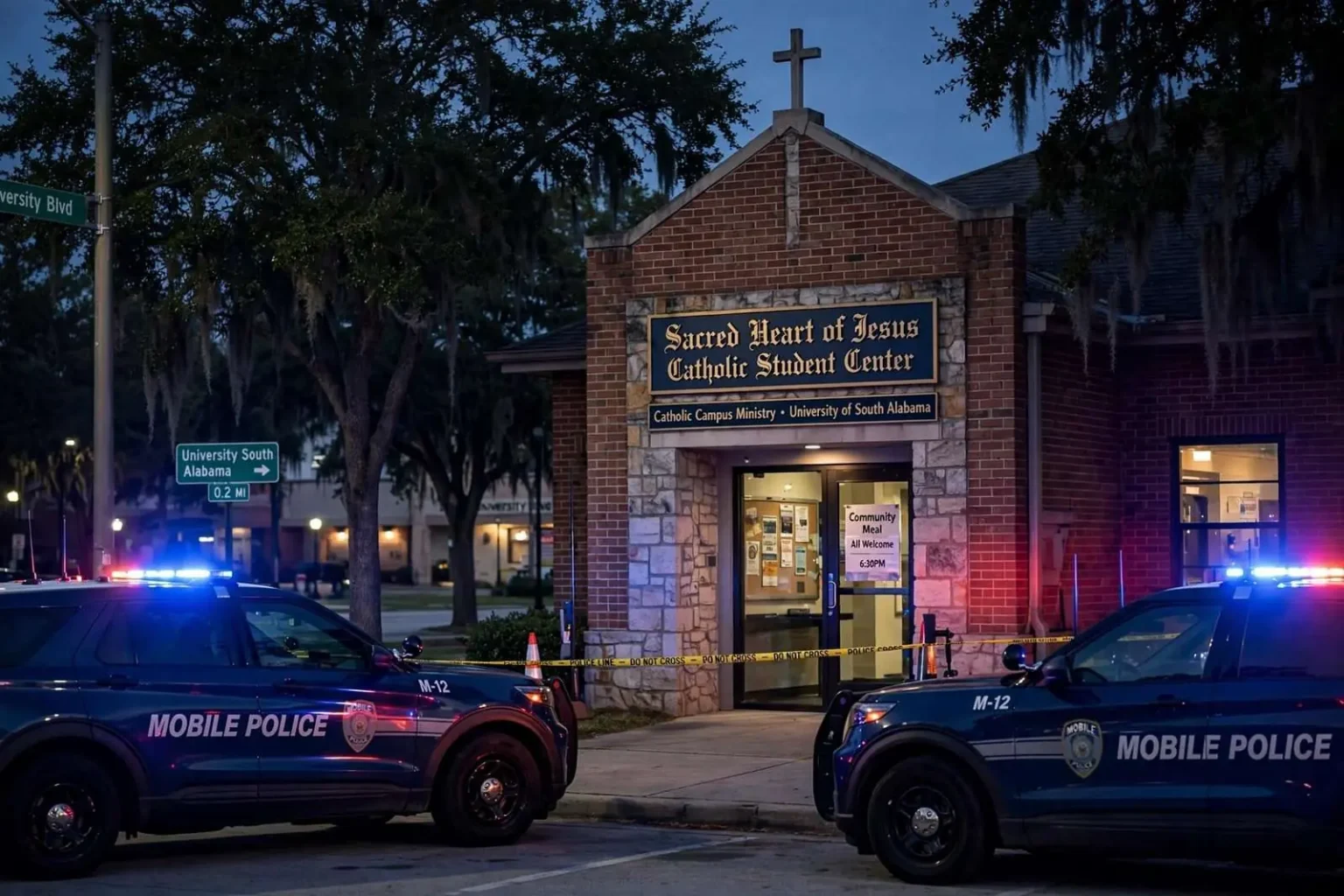
Mobile police caught a man inside a campus-area Catholic student center Monday evening — and say he had broken into the same building before. The burglary was reported around 7:25 p.m. July 25 at the Sacred Heart of Jesus Catholic Student Center, which sits adjacent to the University of South Alabama campus, setting off a response that ended with a suspect in custody before the evening was out.
Officers arriving on scene detained Christopher Thompson, 34, who was allegedly burglarizing the center while members were inside feeding parishioners. The detail that members of the center community were present and serving meals during the break-in added a troubling dimension to the incident, transforming it from a property crime reported after the fact into a confrontation interrupted in progress.
According to Mobile police, Thompson had burglarized the student center previously. He was arrested on the new charge as investigators documented the latest break-in, and the prior burglary gives prosecutors a pattern to consider as the case moves through the court system.
What the student center does
The Sacred Heart of Jesus Catholic Student Center occupies a position of quiet importance in the University of South Alabama’s orbit. Student centers like it serve as a parish and gathering point for Catholic students at the university, offering Mass, confession, Bible study, retreats and — as the events of Monday evening made clear — meals that reach beyond the student body to parishioners and community members in the surrounding neighborhoods.
The center’s location adjacent to the USA campus places it in one of Mobile’s busiest corridors, along University Boulevard near the sprawling campus of the city’s largest public university. The area around campus is a mix of student apartments, student-serving businesses, churches and long-established residential neighborhoods, and institutions like the student center function as community anchors there, staying open into the evening when many other facilities have closed.
That openness is part of what makes houses of worship and their affiliated facilities frequent targets for property crime. Doors that are unlocked for worshipers and volunteers, buildings that sit empty between scheduled activities and kitchens stocked for community meals all make religious facilities attractive to opportunistic thieves, and police departments nationwide have long urged congregations to balance welcome with security.
How the call unfolded
The sequence Monday evening was straightforward: a burglary in progress reported around 7:25 p.m., officers dispatched to the center, and a suspect located and detained on scene. A suspect taken into custody during the alleged offense is a considerably stronger case than one developed days later from surveillance footage, since officers witness the circumstances directly and can document the scene while it is undisturbed.
The presence of members inside feeding parishioners also meant there were witnesses to the incident itself, which typically strengthens the account of what happened and in what order. Investigators processing the latest break-in would document points of entry, any property taken or disturbed and the state of the building, building a record that complements the arrest made at the scene.
Burglary of a building — as opposed to theft from an unlocked car or a shoplifting case — is a felony in Alabama, and the classification can rise further based on the circumstances, including whether the building was occupied and whether the suspect has prior convictions. A repeat burglary of the same facility is also the kind of pattern that prosecutors weigh when deciding on charges, because it speaks to escalating behavior at a specific location rather than a one-time lapse.
The repeat-burglary problem
Police say Thompson had burglarized the student center previously, making the Sacred Heart of Jesus center an example of a well-documented phenomenon: a small number of offenders account for a disproportionate share of property crimes, and repeat offenders often return to locations they have already hit. There are practical reasons for the pattern. A suspect who has been inside a building knows its layout, knows when it is likely to be empty or occupied, knows where valuables are kept and knows which doors or windows failed the first time.
Police departments respond to that pattern in several ways. Patrol officers are briefed on locations with repeat incidents, and a prior call for service at an address changes how the next call there is handled — often with a faster response and greater caution. Detectives connect the dots between incidents, and any property recovered from the earlier burglary becomes evidence in the new case as well.
For the institution that is victimized, a repeat burglary carries costs beyond the stolen property. Repairs to damaged doors, windows and locks, insurance claims and deductibles, and the time spent inventorying what was taken all fall on the facility, and for a nonprofit campus ministry, those costs compete directly with the mission the building exists to serve. Congregations and campus ministries in Mobile and across the country have responded to the threat with measures such as improved exterior lighting, camera systems, access control on secondary doors and neighborhood watch relationships with nearby residents.
What happens next in the case
Thompson’s arrest on the new charge begins the legal process rather than ending it. Following an arrest in Mobile County, the case typically moves through an initial appearance before a magistrate, where bond is set, and then to the district attorney’s office for review of the charges. The prior burglary, if it resulted in a conviction, becomes part of Thompson’s record that prosecutors and judges consider at bond hearings and sentencing; if it was pending rather than resolved, it proceeds as its own case alongside the new one.
The timing of the arrest — while members were inside feeding parishioners — will also figure in how the case is presented. An alleged burglary committed while a building is occupied is treated differently under the law than one committed against an empty structure, and Mobile police noted the presence of the members inside as part of their account of the incident.
Police have not indicated what was taken in the latest break-in or the extent of any damage to the center, and the investigation into the July 25 incident continues as detectives complete the documentation of the scene. The Sacred Heart of Jesus Catholic Student Center, which sits adjacent to the University of South Alabama campus, continues its regular schedule of ministry and community meals, as it did the evening officers arrived and took a suspect into custody on its doorstep.
Campus-adjacent institutions occupy a particular place in a city’s crime picture. The blocks around the University of South Alabama blend a university population that turns over every semester with year-round residents, and the institutions that serve them — churches, student centers, clinics and nonprofit offices — often operate on schedules that differ from the businesses around them. A facility that hosts evening Masses, late-night study gatherings and community meals keeps its doors in use at hours when a typical office park is dark, which increases both its visibility and its exposure.
Police departments that serve campus areas, including the Mobile Police Department, generally work those dynamics through a combination of directed patrols, community relationships and rapid response to in-progress calls. The Monday evening response — from a 7:25 p.m. report of a burglary in progress to a suspect detained on scene — reflects the kind of outcome those resources are designed to produce when a caller reports a crime while it is happening rather than after the fact.
A broader look at burglary in Mobile
Burglary cases like this one fit into a category of crime that city and neighborhood leaders in Mobile track closely. Property crimes of this type are concentrated where opportunity is: buildings with predictable schedules, areas with foot traffic and blocks where a stranger arriving on foot or by car draws little attention. Campus edges, commercial corridors and older residential neighborhoods all experience their share, and Mobile police publish regular crime summaries that let residents and institutions see the trends on their own blocks.
The way a burglary is reported matters as much as the way it is investigated. Calls that come in while the crime is underway give officers a chance to catch a suspect in or near the building, as happened Monday; calls that come the next morning, after a broken window is discovered, start an investigation with hours of delay and a scene that weather and passersby have already altered. Police across the country use that distinction in their outreach, urging residents and institutions to report suspicious activity immediately rather than assuming someone else already has.
Guidance for congregations and nonprofits
Security specialists who work with houses of worship recommend a layered approach that starts with the building itself. Exterior lighting around all entries, trimmed landscaping that removes hiding spots near doors and windows, and cameras covering entrances and parking areas deter opportunistic offenders and provide evidence when deterrence fails. Interior measures — a log of who has keys, a checklist for locking secondary doors after events and a routine for securing the kitchen and office areas between activities — close the gaps that repeat offenders exploit.
Institutional leaders are also urged to build the relationship before the incident: introducing the facility to the officers who patrol the area, joining or forming a neighborhood watch that includes the surrounding blocks, and making sure the police department has current after-hours contact information for the person who holds the keys. Those connections shave minutes off the response when something goes wrong, and minutes are what separate an arrest on scene from a case that begins with an empty room.
The Sacred Heart of Jesus Catholic Student Center’s experience — a repeat break-in that ended with Christopher Thompson, 34, in custody the same evening — illustrates both halves of that picture: the exposure that comes with an open, welcoming facility, and the value of a prompt report that put Mobile police officers at the center within minutes of the 7:25 p.m. call on July 25.