
Man Dies After Going Underwater While Retrieving Lost Net in Mobile Bay Near McNally Park
Mobile police identified Alexis Cardona, 30, who drowned in Mobile Bay near McNally Park while trying to retrieve a lost cast net during a family fishing.
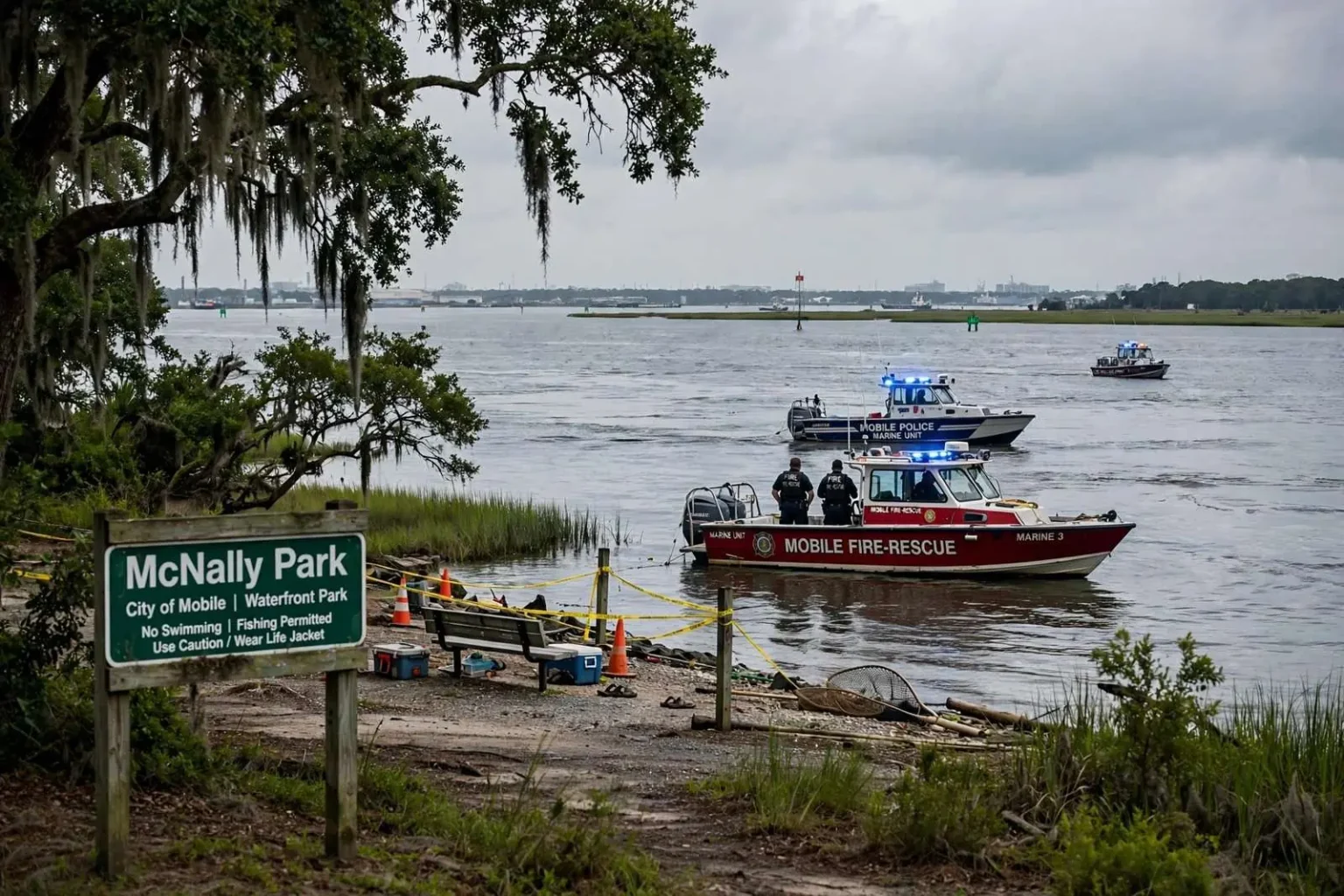
MOBILE, Ala. — A 30-year-old Mobile man drowned in Mobile Bay near McNally Park after he went into the water to retrieve a cast net that had been lost during a family fishing outing, according to the Mobile Police Department and Mobile Fire-Rescue Department. Police identified the man as Alexis Cardona.
Authorities said Cardona, described by officials as Hispanic, had been fishing from the area near the park with his partner and children when his cast net came off and drifted away. Family members told rescuers that when he swam out to recover the net, he never resurfaced. What began as an ordinary afternoon of fishing on the bay turned, in moments, into a recovery operation.
Witnesses on the scene dove into the water in an attempt to reach him, making several attempts before he was located. Their efforts — repeated dives by bystanders who knew the man was somewhere below the surface — reflect both the instinct to help in a moment of crisis and the genuine danger that the same waters pose to anyone who enters them unprepared. On Mobile Bay, as rescuers would soon demonstrate, even reaching a person who has gone under can be a slow and difficult task.
Emergency Response on the Bay
Mobile Fire-Rescue crews responded to the waterfront park, which sits on the bay near Pinto Pass north of downtown Mobile, and launched a search that lasted roughly an hour before his body was recovered. Three boats took part in the effort to locate him, sweeping the waters off the park while crews coordinated from the shoreline. The response brought together the marine capabilities that Mobile Fire-Rescue maintains for exactly this kind of incident on the city’s extensive waterfront.
Mobile Public Safety Director James Barber confirmed the drowning the evening of July 22, 2020. Police said officers would handle the investigation going forward once the recovery was complete, a routine division of responsibilities in water-related deaths within the city — fire-rescue handles the search and recovery, while police investigate the circumstances.
Officials did not indicate any suspicion of foul play, describing the incident as an apparent drowning. There was no indication that another person was involved or that anything beyond the water itself contributed to Cardona’s death. For the family members who had watched him swim out after the net, the sequence they described was devastating in its simplicity: a net drifted away, he went in after it, and he never came back up.
The Setting: McNally Park and Mobile Bay
McNally Park is one of Mobile’s waterfront public parks, drawing residents to its shoreline for fishing, picnicking, and views across the bay. The waters off the park, near Pinto Pass, sit along a working stretch of the bay north of downtown Mobile, where ship channel activity, tidal currents, and the natural contours of the shoreline combine in ways that are not always obvious from the bank. What looks like calm water on a summer afternoon can carry surprising strength a few yards offshore.
Mobile Bay itself presents a distinctive set of hazards for swimmers and wading anglers. The bay is broad and shallow in many places, but currents driven by tides and wind can move with real force, particularly near the passes and channel edges that connect the bay to the Gulf. Boat traffic adds another danger, since the same waters that attract recreational anglers also carry commercial vessels and recreational boaters whose operators may not easily spot a swimmer at the surface.
Sudden drop-offs near channel edges compound the risk. An angler standing comfortably in waist-deep water can, within a step or two, reach the edge of a channel where the bottom falls away sharply. Strong swimmers who encounter that transition — combined with a current pulling in a direction they did not expect — can find themselves exhausted within minutes, particularly in the warm months when a day on the water, sun exposure, and the physical effort of swimming against a current all take a cumulative toll.
Cast Net Fishing Along the Gulf Coast
Cast nets are a fixture of fishing culture along the Alabama and Mississippi Gulf Coast, used to catch baitfish and shrimp in shallow water near shore. Throwing one well takes practice: the fisherman gathers the net, swings it in a wide arc, and releases it so that it spreads into a circle on the water before sinking and being drawn closed. When a throw goes wrong, the net can catch on something below the surface or drift off with a current, and retrieving it means going into the water after it.
That retrieval is where the danger lives. A lost net is an investment — decent cast nets cost real money, and experienced anglers often handle the same net for years — but the urge to recover one pulls people into open water that they would never otherwise choose to swim in. Safety officials along the Gulf Coast have long warned that retrieving gear, whether a cast net, a fishing rod, or a drifting boat, is among the most common triggers for otherwise avoidable drownings.
The death underscored the hazards of swimming in Mobile Bay, where currents, boat traffic and sudden drop-offs near channel edges can quickly overwhelm even strong swimmers. Cardona was 30 years old, an adult going about a familiar coastal pastime with his family nearby — and the water still proved faster than the people watching from shore.
What Safety Officials Urge
Safety officials routinely urge anglers retrieving lost gear to wear a personal flotation device rather than enter the water unaided. A life jacket buys the time that a current or a sudden drop-off can take away, turning a moment of panic into a manageable wait for help. The advice applies doubly to anyone fishing alone or with children present, since a drowning in front of family members frequently tempts others into the water after the victim — multiplying the danger rather than reducing it.
Anyone who sees someone struggling in the water is encouraged to call 911 immediately and, if possible, throw a flotation device or rope rather than attempting a rescue swim. Water rescue professionals teach a simple hierarchy: reach, throw, row, and only then go. Bystanders who enter the water without flotation frequently become victims themselves, and the several attempts by witnesses on the scene at McNally Park — brave as they were — illustrate how difficult it is to reach a submerged person even with multiple strong swimmers and the will to try.
For children who witnessed the afternoon’s events, the loss is one that water safety advocates in coastal Alabama hope becomes a cautionary memory rather than a repeated pattern. Family fishing outings are part of the fabric of life on Mobile Bay, and the goal of safety campaigns is not to end them but to keep them from ending in tragedy — through life jackets, through sober judgment about when to let gear go, and through the willingness to call for help rather than swim after it.
Drownings on the Gulf Coast
Drownings in the Mobile Bay region follow a seasonal rhythm, with the warm months between late spring and early fall drawing the heaviest use of the water — and accounting for most of the region’s water-related deaths. Public safety agencies across Mobile and Baldwin counties respond each year to swimmers and waders who get past their depth, boaters who fall overboard, and anglers who go in after lost equipment. The victims are frequently men, frequently adults who considered themselves capable in the water, and frequently not wearing any flotation when they got into trouble.
Mobile Fire-Rescue maintains boat and dive capabilities precisely because the city’s geography demands it. Bounded by the bay to the south and cut by the Mobile River and Three Mile Creek, the city has water woven through nearly every part of its landscape. Searches like the one at McNally Park draw on that marine readiness, with multiple vessels on the water coordinating a grid over the area where the person was last seen.
The aftermath of such incidents follows a familiar course. Once a body is recovered, the scene shifts from rescue to investigation: police document the circumstances, interview witnesses, and determine whether anything beyond the water itself played a role. In this case, officials described an apparent drowning with no indication of foul play, closing the investigative question quickly while leaving a family with grief that no finding can soften.
A Family’s Loss
Cardona had been fishing with his partner and children when the net drifted away, meaning that his family watched the entire sequence unfold from shore. The people closest to him were also the first to raise the alarm and the first to try to reach him, and they remained on the scene as rescuers searched the water where he had disappeared. Incidents of this kind leave a lasting mark on the families involved, and on the bystanders and responders who were present.
For the community that uses McNally Park and the bay’s other shoreline access points, the drowning served as a hard reminder that the water off a familiar park is not a swimming pool. The bay’s conditions change with the tide and the wind, the bottom is uneven and unpredictable near the channels, and help — no matter how quickly it arrives — cannot reach a submerged person in the minutes that matter most. The safety officials who respond to these incidents repeat the same guidance each time: wear the life jacket, let the gear go, call 911, and throw something that floats. On Mobile Bay, that advice is the difference between a lost net and a lost life.


