Man Found Dead on Oyler Road in West Mobile Identified as Homicide Investigation Continues
The Mobile County Sheriff's Office identified Johnny Clark Soekhies as the man found dead on Oyler Road off Jeff Hamilton Road in West Mobile.
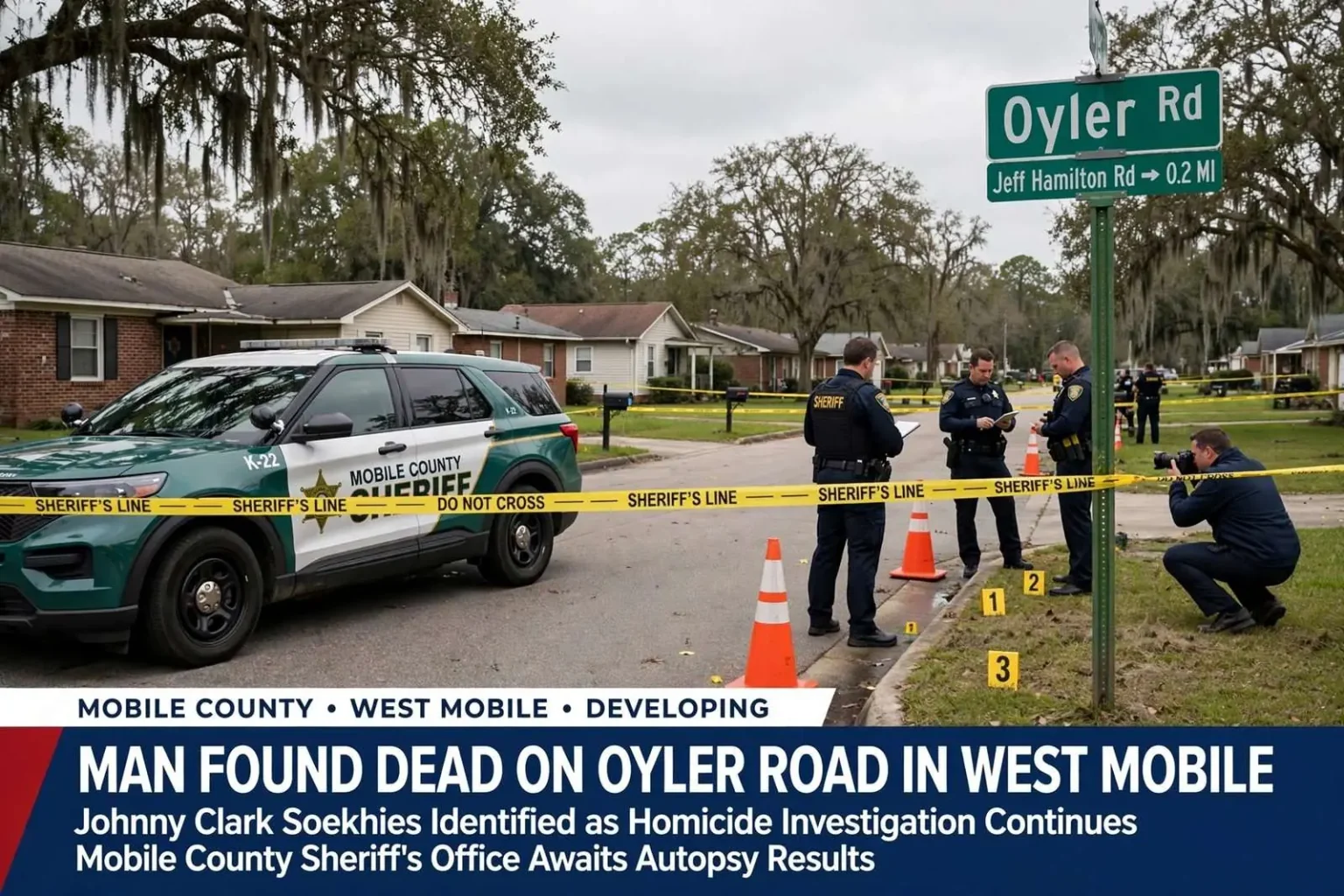
Mobile County sheriff’s deputies investigated a homicide after a man was found dead on Oyler Road, a street that sits just off Jeff Hamilton Road in West Mobile. The Mobile County Sheriff’s Office identified the victim as Johnny Clark Soekhies, and authorities said they were still working to determine the cause of death as the investigation got underway.
Deputies remained on scene for an extended period as investigators worked the case, processing the area and gathering whatever evidence the location would yield. The discovery of a body on a residential street in West Mobile drew attention from neighbors and passers-by, and deputies worked to piece together a timeline of how the man came to be there and what happened to him in his final hours.
Because the cause of death had not been determined when the case was announced, investigators were treating the death as a homicide pending the findings of the medical examiner’s office, which performs autopsies in cases of this kind. Those findings — along with evidence gathered at the scene and interviews with people who knew the victim or were in the area — will shape how the case develops and whether charges are eventually brought against anyone.
The Investigation Process in a Death Case
When a body is found and the circumstances are not immediately clear, the response follows a well-established sequence. Patrol deputies secure the scene first, establishing a perimeter and turning away onlookers so that nothing is disturbed. Detectives then take over, walking the scene, photographing everything in place, and documenting the position of the body and any objects around it. Investigators canvass the neighborhood, going door to door to ask residents whether they saw or heard anything unusual in the hours before the discovery.
The victim’s identity is confirmed through formal means, and the sheriff’s office then works to reconstruct his recent movements — where he lived, who he spent time with, where he was seen in his last known hours. That work involves interviews with family members, friends, and associates, along with checks of phone records, financial transactions, and any surveillance cameras in the area. Modern investigations lean heavily on camera networks; doorbell cameras and business surveillance systems in residential corridors like the Jeff Hamilton Road area often capture vehicles and people that investigators would otherwise never know about.
The medical examiner’s autopsy is the other pillar of the case. The examination determines the cause of death — whether from gunshot, blunt force, strangulation, or another mechanism — and can also establish the approximate time of death and whether the victim suffered defensive injuries. Until those findings come back, investigators keep an open mind about what they are dealing with, even while working the case as a homicide as a matter of procedure.
West Mobile and the Area Around Oyler Road
The area where the body was found sits in unincorporated Mobile County west of the city limits, a part of the county made up of residential subdivisions, older neighborhoods, and commercial strips along major roads like Jeff Hamilton Road. The Mobile County Sheriff’s Office provides primary law enforcement for these unincorporated areas, patrolling a large territory that wraps around the city of Mobile on its western and northern edges.
Sheriff’s deputies in this part of the county handle the full range of calls — burglaries, domestic disturbances, traffic crashes, and occasional violent crimes. Homicides in the unincorporated county are less common than within the city, but the sheriff’s office maintains an investigative division that handles them, drawing on its detectives as well as partnerships with the Mobile Police Department, the District Attorney’s office, and state and federal agencies when cases require it.
Residents of the neighborhoods around Oyler Road experienced the investigation up close: deputies blocking the street, detectives working the scene through the day, and the questions that follow when something like this happens on a road people drive daily. In cases like this, investigators depend on exactly that community — people who noticed an unfamiliar vehicle, heard an argument, or saw someone walking in the area at an unusual hour.
How the Public Can Help
The sheriff’s office asked anyone with information about the case to call 251-574-8633, the number for the department’s investigative units, or to submit an anonymous tip through the sheriff’s office website. Anonymous tips have become an increasingly valuable tool for investigators, because they allow people with knowledge of a crime — including those who fear retaliation or who do not want to be involved in a court case — to pass along what they know without identifying themselves.
Detectives stress that even details that seem insignificant to the person who holds them can matter. A description of a car that was parked on the street, the approximate time a loud noise was heard, a stranger seen walking through the neighborhood — each of those fragments can slot into a timeline and either advance an investigation or eliminate a theory. People often assume someone else has already reported what they saw; investigators say that assumption is one of the biggest obstacles to solving cases, and they would rather receive the same information twice than never receive it at all.
Families of homicide victims also depend on that flow of information. The period after a violent death leaves relatives grieving while the case remains unsolved, and the answers they eventually receive about what happened — and who was responsible — depend on witnesses coming forward. Law enforcement agencies across Mobile County work with victim advocates who support families through the process, from notification through any prosecution that follows.
What Happens If the Cause of Death Changes the Case
The determination that a death is a homicide comes from the medical examiner, and the autopsy findings can reshape an investigation. If the examination establishes a specific cause and manner of death, investigators can narrow their focus — a particular type of weapon, a particular mechanism of injury, or evidence the death occurred at a different time or place than assumed. Conversely, if the autopsy points toward an accident, a medical event, or a suicide, the investigation changes course and may be closed as a non-criminal matter.
This is why agencies describe cases in careful terms while the science is pending. Saying a death is being investigated as a homicide, with the cause of death still undetermined, is an accurate reflection of where the case stands: circumstances have raised suspicion, the formal findings are not yet in, and the investigation is proceeding on the assumption the law requires — that a crime may have occurred and that the evidence needs to be preserved and gathered now, before the scene changes.
If a suspect or suspects are eventually identified, the case would move to the District Attorney’s office for charging decisions, and the court process would follow — initial appearance, bond considerations, preliminary hearings, and ultimately indictment and trial or a negotiated resolution. Murder prosecutions in Alabama are among the most demanding cases courts handle, and they move on timelines measured in months and years rather than days.
A Community Watching and Waiting
For now, the case remains open, with detectives continuing to work leads and awaiting the medical examiner’s findings. The sheriff’s office has not announced any arrests or named any suspects, and updates will come from the department as the investigation develops and as officials are able to release information that does not compromise the case.
In the meantime, the request to the public stands: anyone with information about Johnny Clark Soekhies’ death, or about activity in the Oyler Road area that could be relevant, can call 251-574-8633 or leave an anonymous tip through the sheriff’s office website. Cases like this are rarely solved without community participation, and the details residents carry in their memories are often the difference between a case that is closed and one that grows cold.
The Mobile County Sheriff’s Office is one of the larger sheriff’s departments in Alabama, providing law enforcement across a county that spans more than 1,200 square miles of urban fringe, suburbs, farmland, and wetlands. Beyond patrol and investigations, the office runs the Metro Jail, provides courthouse security, serves civil papers, and operates school resource and community programs. Its investigators handle the major crimes that occur outside municipal limits, working cases that can stretch on for months as leads are developed and tested.
West Mobile has grown steadily over the past several decades, with residential development spreading outward along the corridors that radiate from the city. Neighborhoods off Jeff Hamilton Road, Schillinger Road, and the surrounding streets mix older homes with newer subdivisions, and commercial development follows the traffic. That growth pattern brings the routine challenges of any expanding suburban area — traffic, property crime, and the occasional violent incident that stands out precisely because it is uncommon in the area.
Sheriff’s officials consistently emphasize the role residents play in public safety across the county’s unincorporated communities. Neighborhood watch groups, community meetings, and direct communication with district deputies give residents channels to raise concerns before problems grow, and they give deputies local knowledge that helps when major cases arise. The Oyler Road investigation drew on that same relationship — with investigators asking the people who live and work nearby to share what they know.
The coming days will determine much about the direction of the case. The autopsy findings will clarify what happened to Johnny Clark Soekhies, and detectives will continue the canvassing, interviews, and evidence work that build toward identification of anyone responsible. As with every open investigation, the sheriff’s office balances the public’s need for information against the need to protect the integrity of the case, releasing what it can while the work continues behind the scenes.