
Man Questioned in Deadly Broad Street Convenience Store Shooting; Victim Identified
Mobile police identified Rodney James, 23, as the victim of a deadly Broad Street convenience store shooting. The case now goes before a grand jury.
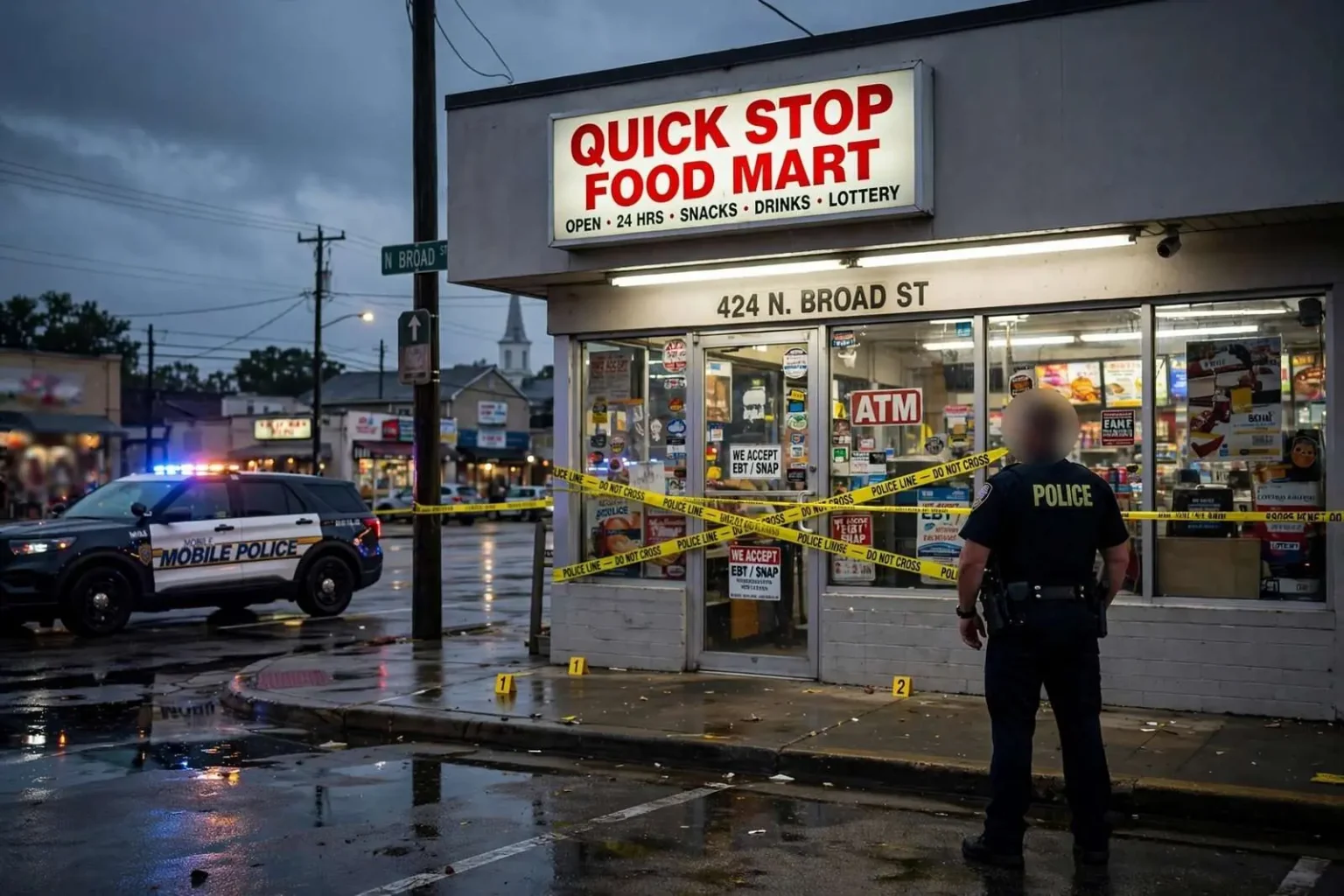
MOBILE — Mobile police have questioned a man in connection with a fatal shooting at a convenience store on North Broad Street, and investigators say the case will be handed to a grand jury to decide whether charges are filed. Police identified the victim as 23-year-old Rodney James.
Officers were called to the Quick Stop Food Mart at 424 N. Broad St. shortly before 7 p.m. Monday on a report of one person shot, according to the Mobile Police Department. The victim was taken to a hospital, where he later died of his injuries. The shooting unfolded at a store that sits along one of Mobile’s most heavily traveled north-south corridors, a stretch of Broad Street lined with businesses, churches and neighborhoods that straddle the line between downtown and the city’s midtown districts.
Homicide investigators took over the case once it became clear the wounds were fatal, a standard division of labor within the Mobile Police Department, whose major crimes unit handles killings across the city. Detectives began canvassing the area around the store for witnesses and surveillance footage from nearby businesses, a process that in similar cases has proven decisive in identifying suspects in commercial-corridor shootings.
Case headed to a grand jury
Investigators said they made contact with a 20-year-old man described by the department as the man involved in the shooting and questioned him. Rather than filing charges directly, police said the case will be turned over to a grand jury, which will determine whether an indictment is warranted. No charges had been filed as of the department’s update.
The grand jury route is a familiar feature of the Alabama justice system in homicide cases. In Mobile County, a grand jury of citizens hears the evidence prosecutors have assembled — witness statements, forensic findings, interviews and surveillance — and votes in secret on whether probable cause exists to indict. Prosecutors present the case, but defense attorneys are not present, and the panel’s deliberations are confidential. The process shifts the charging decision from law enforcement alone to a citizen body, which is why police departments in Alabama frequently announce that a case is “headed to a grand jury” even after a suspect has been identified and questioned.
That step also reflects the burden of proof involved. A murder charge arising from a shooting like this one carries severe potential penalties under Alabama law, and prosecutors generally want the strongest possible file before presenting it. Questions that remain unanswered at the initial stage — the precise circumstances of the encounter at the store, whether the shooter acted in self-defense, the relationship between the two men — are the kind of issues a grand jury presentation is designed to resolve.
Earlier in the investigation, police had asked for the public’s help identifying a man captured in a surveillance image released by the department. The release of store camera images has become routine practice in Mobile homicide investigations, and department officials credit tips from residents and business owners with helping close a substantial share of the city’s cases. Detectives did not immediately say whether the man questioned was the same person shown in the surveillance image.
Police say the killing was not Mardi Gras-related
Mobile police also said the homicide was not connected to Mardi Gras activities, addressing a question raised because the shooting occurred during the city’s carnival season. The timing was almost inevitable: Mobile’s Mardi Gras is the oldest organized carnival celebration in the United States, and the season stretches across weeks of parades, balls and street gatherings that draw large crowds into the city each winter.
Because carnival season brings tens of thousands of visitors into downtown Mobile on parade nights, any violence near the city center draws immediate attention, and police typically add patrols and special details around parade routes during those weeks. The department’s swift statement that the Broad Street killing was unrelated to Mardi Gras was aimed at separating the two in the public’s mind — the shooting occurred at a neighborhood convenience store well outside the parade footprint, and investigators found no carnival connection in the circumstances.
The Mobile County crime map logged the shooting at about 6:50 p.m. at the same North Broad Street address, a public database that maps reported crimes across the county and that investigators use to spot patterns in where and when violence occurs. The early-evening hour meant the store would have been in its after-work rush, with customers coming and going as the workday ended.
Anyone with information is asked to call Mobile police at 251-208-7211; callers may remain anonymous. Tips can mean the difference between a case that stalls and one that reaches a grand jury with a complete picture, and detectives urged anyone who was near the Quick Stop Food Mart that evening — whether or not they witnessed the shooting itself — to come forward.
The Quick Stop and the Broad Street corridor
North Broad Street runs north from the heart of Mobile through a corridor that has seen considerable change over the decades. Once a principal commercial artery linking downtown to the city’s northern neighborhoods, the street today carries a mix of longtime businesses, newer storefronts and residential streets feeding in from both sides. Convenience stores like the Quick Stop Food Mart serve as daily gathering points in such corridors, which is why violence at their doorsteps resonates so strongly with the surrounding neighborhoods.
For the people who live and work along Broad Street, a fatal shooting in the early evening raises familiar concerns about safety in commercial areas after dark. Community organizations across Mobile have worked in recent years to combine neighborhood watch efforts, increased street lighting and closer cooperation with the police department’s precinct-level officers to address exactly this kind of incident. Store owners along the corridor have also invested in camera systems, which is how surveillance images like the one police released in this case have become so central to early-stage investigations.
The department’s practice of releasing images and asking for public assistance reflects a broader reality in homicide work: most cases are solved through information provided by people in the community rather than by forensic breakthroughs. Detectives following the Broad Street shooting spent the hours after the killing re-interviewing store employees, collecting additional camera footage and tracing the movements of everyone involved in the moments before the first 911 call.
What happens next in the legal process
Should the grand jury return an indictment, the man questioned by detectives would face formal charges in Mobile County Circuit Court, where the case would move through arraignment, pretrial hearings and, if no plea agreement is reached, trial. That process typically takes many months, and outcomes depend heavily on the evidence assembled in the weeks immediately after the killing — the period when memories are freshest and physical evidence is most recoverable.
If the grand jury declines to indict, the case can be resubmitted if new evidence emerges, or prosecutors may decline to pursue charges. Alabama grand juries weigh both the strength of the evidence and the applicable law, including defenses such as self-defense, which juries and courts must consider in shooting cases regardless of where they occur. The secrecy of the process means the public may never learn the specific reasons for the panel’s decision.
For the family of Rodney James, the legal machinery will move slowly against a grief that does not. At 23, he was among the youngest adults lost to gun violence in the city, and his death adds a name to the toll that Mobile families and advocates confront each year. Victim advocates with the district attorney’s office and community groups stand ready to assist families of homicide victims with funeral costs, counseling referrals and guidance through the court process if charges are ultimately filed.
Police urged anyone who holds even fragmentary information — a vehicle seen leaving the store, an overheard conversation, a name mentioned in the neighborhood — to call investigators. Anonymous tips remain the lifeblood of cases like this one, and the department’s 251-208-7211 line accepts calls at all hours. The case now rests in the hands of Mobile County prosecutors, who will decide in the coming weeks what, if anything, a grand jury will be asked to consider.
The Broad Street investigation is also a reminder of how the geography of Mobile shapes police work. The city’s precinct system divides neighborhoods into patrol zones, and the detectives who inherit a case like this one draw on relationships built by the officers who walk those zones daily. Residents who know the rhythm of a commercial block — who belongs there, what vehicles are routine, what changed on a given evening — are often the only source for details that never appear on any camera.


