Man Shot at Americas Best Value Inn Near I-65 in Mobile
Mobile police investigated a Saturday-night shooting at Americas Best Value Inn near I-65; the victim's wounds were not life-threatening.
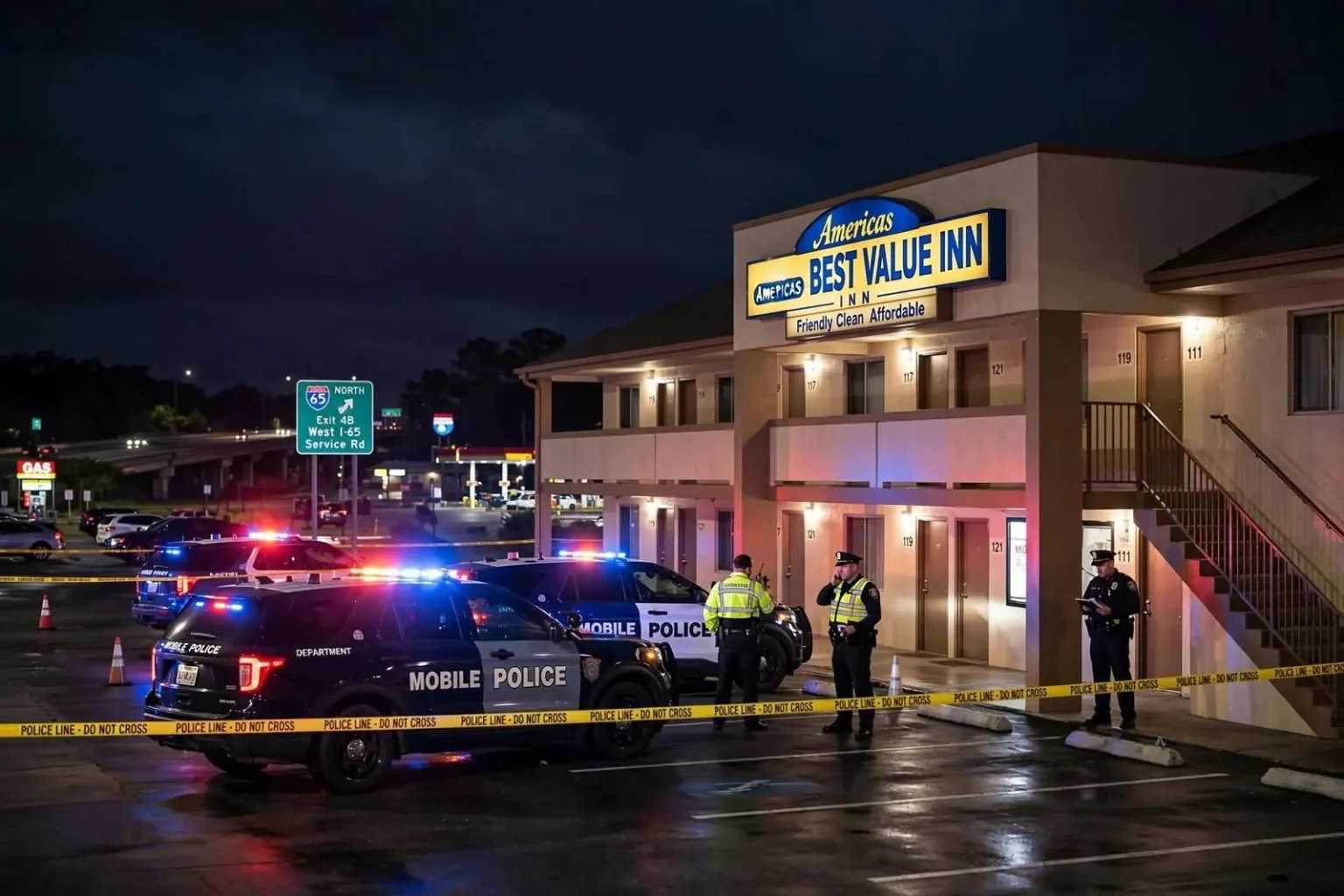
A man was shot Saturday night at the Americas Best Value Inn on West I-65 Service Road, and Mobile police had not taken anyone into custody. Officers with the Mobile Police Department responded to the motel just off Interstate 65 at about 8:37 p.m. after reports of gunfire at the property. When they arrived, they found a man who had been shot. Police said the victim’s injuries were not life-threatening, and he was transported for medical treatment.
Investigators did not release a description of a shooter and did not say what led to the gunfire. No suspect had been identified publicly in the hours after the shooting, and police said the investigation was ongoing, with additional details promised as detectives arrived and began canvassing the property for witnesses and video. Until that work is finished, the circumstances of the shooting — who fired, why, and whether the victim and shooter knew each other — remained unanswered questions for the people who were at the motel that night.
The scene along the service road
The motel sits along a service road that parallels Interstate 65, one of the main north-south arteries through Mobile. That stretch of the interstate carries commuter traffic by day and a steady flow of long-haul travelers at all hours, and the businesses that line the service road — motels, fast-food restaurants, gas stations — depend heavily on that passing traffic. On weekend nights, the area is at its busiest, with rooms rented to road-trippers, visiting workers, and families passing through the Gulf Coast.
That combination of transience and volume shapes how police work moves through a corridor like this. Guests arrive from other states and leave the next morning, which means witnesses can scatter quickly. Parking lots fill with vehicles whose owners have no connection to one another, so investigators must separate what belongs to a suspect from what belongs to an uninvolved traveler. Detectives working a motel shooting typically spend their first hours securing the room where the incident happened, then work outward: interviewing the front-desk staff, pulling registration records, and requesting surveillance footage from the motel and any neighboring businesses whose cameras face the lot.
The West I-65 Service Road corridor has long been a familiar address in Mobile police bulletins. Motels along interstate service roads in cities across the country account for a disproportionate share of late-night calls — disturbances, thefts from vehicles, and occasional violence — simply because so many strangers pass through them. For Mobile officers, a call to one of these properties on a Saturday night is routine in the sense that it is expected, though nothing about the outcome is ever taken for granted.
What “not life-threatening” means
Police characterized the victim’s injuries as not life-threatening, a classification that carries real weight in how a case unfolds. When a shooting victim is expected to survive, detectives generally have more time to work: the person can be interviewed once stabilized, and the investigation proceeds as an aggravated assault rather than a homicide. That distinction matters enormously to the trajectory of a case, both for the suspects ultimately charged and for the family of the person who was shot.
It also matters for the neighborhood’s sense of alarm. A fatal shooting at a motel near the interstate typically draws a prolonged scene presence, forensic units, and hours of road closures. A non-fatal shooting still brings patrol cars, an ambulance, and a cordon around the area where shell casings or other evidence may lie, but it allows the property to return to normal operation sooner. Guests arriving late that Saturday night would have encountered a parking lot with officers moving between rooms and vehicles, a scene familiar to anyone who has stayed near an interstate when something has gone wrong.
How the canvass works
In the hours after the shooting, detectives began canvassing the property for witnesses and video. That process is less dramatic than television portrayals suggest but decisive in most cases. Canvassers knock on every occupied room, asking the same questions in the same way: did you hear anything, see anyone, notice a vehicle leaving quickly. They note who refused to answer as carefully as who cooperated, because patterns in the refusals can be informative. Separately, another team gathers video — the motel’s own cameras, cameras on adjacent businesses, and sometimes doorbell or dash cameras from nearby residences.
Surveillance footage from a motel lot can establish the sequence of a shooting in a way witness accounts often cannot: when a vehicle arrived, which direction its occupants walked, how long the encounter lasted, and how the shooter left. In cases where no suspect description is immediately released, that footage is frequently the reason one eventually emerges. Mobile police, like departments across Alabama, routinely ask the public for patience during this phase, noting that what can be shared publicly is limited by what would compromise the investigation.
The search for a suspect
As of the initial reports, no one was in custody, and police had not said whether the shooter fled on foot or in a vehicle. The motel’s location complicates the search in one respect and aids it in another. Immediate access to Interstate 65 means a fleeing driver can be miles away within minutes, but it also means there are only so many interchanges and camera-covered routes by which to leave the area, and investigators coordinate with other agencies and review corridor footage accordingly.
Residents with information about the shooting can contribute through standard channels. Mobile Area CrimeStoppers accepts tips anonymously, and information that leads to an arrest can qualify for a reward. Police also urge people who hold relevant video — even short clips from a passing dash camera — to come forward, since fragments that seem unimportant in isolation often combine with other evidence to produce a timeline.
Gun violence and the motel corridor economy
Incidents like this one land on a business community that operates on thin margins. A shooting at a motel touches everything from that night’s occupancy to the property’s reputation in online reviews, and owners along service roads invest in lighting, cameras, and security patrols partly to prevent exactly this kind of event. Many national motel chains have adopted corporate security standards — exterior lighting minimums, camera coverage of entries and lots, incident reporting requirements — that reflect the realities of interstate-adjacent hospitality.
For the people who stay at these motels, the calculus is simpler. Travelers on a budget choose what is visible from the exit ramp, and on a Saturday night in Mobile the Americas Best Value Inn is one of the lights they see. Most weekends pass without incident: rooms are rented, families sleep, and the lot empties by morning. A shooting breaks that pattern and becomes the story of the corridor for a news cycle, before the traffic resumes and the attention moves on. For the victim and his family, of course, the incident does not move on so quickly — recovering from a gunshot wound, even a survivable one, can involve weeks of treatment, and the knowledge that a shooter remains free is a burden that police describe to victims’ families at every update.
What comes next in the investigation
The immediate police work in the days after such a shooting follows a well-worn sequence. Detectives complete the canvass and collect the video. Forensic technicians process the scene, from the room or lot where the shooting occurred to any vehicles recovered nearby. The victim, once medically able, is interviewed — often the single most important interview in the case. Investigators then begin developing persons of interest, running the names and descriptions that emerge through databases and informant channels.
Police said additional details would be released as the investigation progressed, a standard pledge that reflects both transparency obligations and tactical limits. In cases where a suspect is identified quickly, an arrest warrant follows, and the department typically announces the charge. Where identification takes longer, the case remains active indefinitely; detectives in Mobile carry cold cases for years, and advances in video analysis and forensic technology periodically revive investigations that had gone quiet.
Staying safe and informed along the corridor
For Mobile residents and travelers, the practical takeaways from a weekend motel shooting are the ones safety officials repeat after every such incident. Choose lodging with attention to the lot: good lighting, visible cameras, and a staffed front desk at night. Park near entrances and keep valuables out of sight. If you hear gunfire or witness an incident, get to a safe location first and call 911 with the best description you can manage — vehicles, direction of travel, and clothing descriptions are more useful to responding officers than reconstructed narratives.
The larger reality is that Interstate 65 stitches together the Gulf Coast’s economic life, and the service roads beside it will always host the travelers, workers, and late-night traffic that come with that role. Mobile police will continue to respond to those corridors on Saturday nights, and the overwhelming majority of those calls will end the way this one began: with a report of trouble, a fast response, and an investigation working quietly through the witnesses, the video, and the long paperwork of finding out what happened and who is responsible.