
Man Shot by Unknown Attacker at Mobile Auto Parts Store Early Saturday
Mobile police investigated an early-Saturday shooting at a Desirrah Drive auto parts store; the victim said an unknown man shot him and fled.
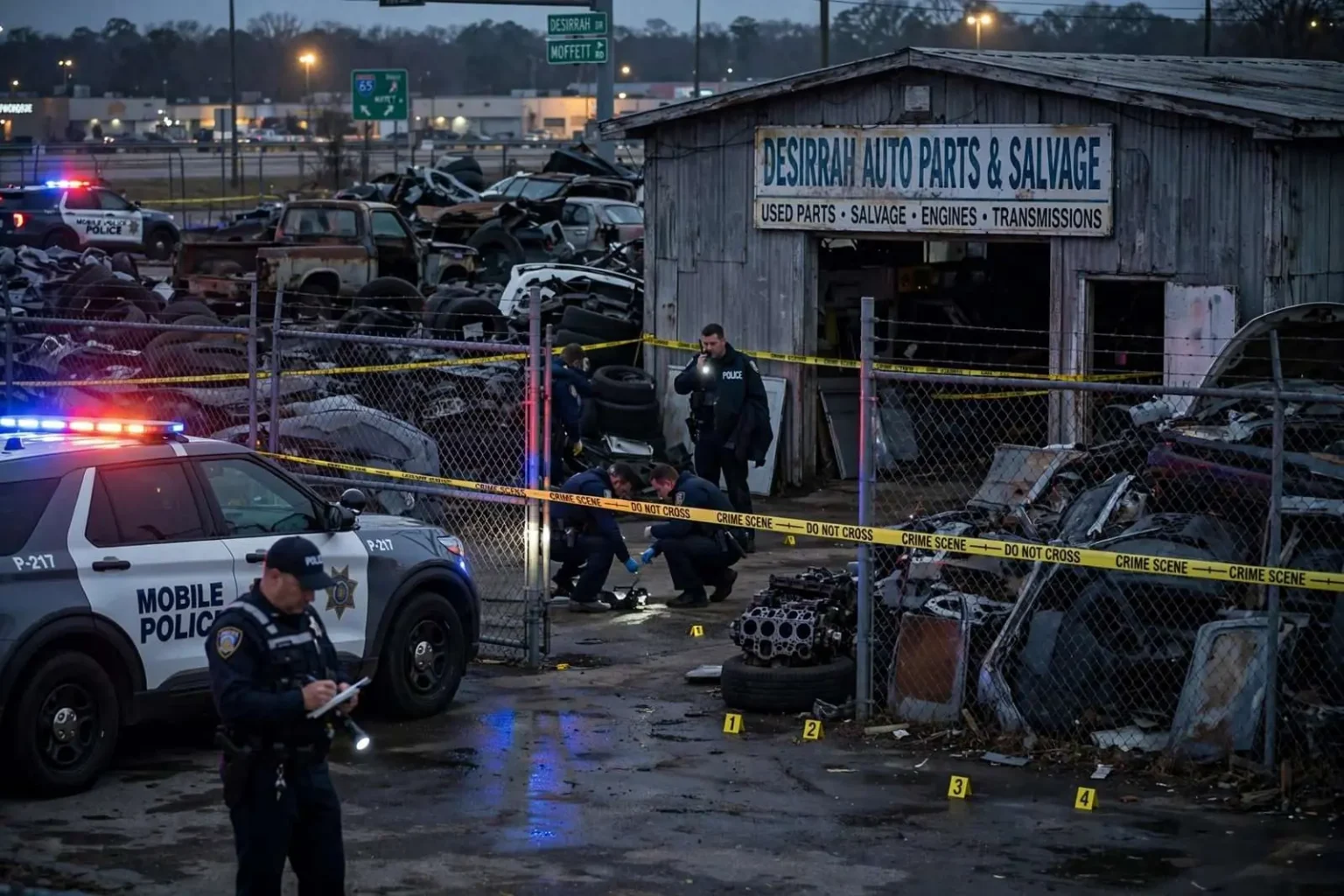
Mobile police responded to an early-morning shooting at a Desirrah Drive auto parts business, in the area of Moffett Road and Interstate 65, on a late-February Saturday. The call came in during the pre-dawn hours, a stretch of the weekend when most of the surrounding commercial corridor is dark and quiet and when officers working overnight shifts are often the first eyes on any scene. By the time units arrived, the immediate danger had passed, and the focus shifted quickly to locating a victim and securing whatever evidence the darkness had not erased.
Days later, investigators said the victim told police he was shot by an unknown man who fled the scene. That account, delivered after the initial confusion of the morning had settled, became the working frame for the case: a single shooter, unknown to investigators, who approached the victim at the business and left before anyone could stop him. Police did not describe a vehicle, a direction of travel, or a possible motive, and the details that typically anchor a manhunt — a name, a face, a description released to the public — were not available in the hours and days that followed.
The victim declined to be transported to a hospital but received medical treatment where he was found. Paramedics who respond to gunshot wounds generally urge patients to go to a trauma center, and the decision to stay on scene is one that medical crews document carefully. In this case, the man’s wounds were apparently such that he could be treated where he lay, and he did not leave in an ambulance. That choice removed one of the standard threads investigators rely on — a hospital record, a treating physician, a statement taken in a calmer setting — and left them working largely from the scene itself and from what the victim could tell them on the spot.
Few answers in the case
With no identified suspect and a victim who refused hospital care, the shooting left more questions than answers. Detectives had a location, a time frame, and an injured man’s account, but no arrest and, publicly at least, no theory they were willing to share. Police did not say whether the attack was random or targeted, a distinction that in practice shapes everything about how a case is worked — whether canvass teams knock on nearby doors looking for a stranger, or whether investigators pull records and histories connected to the business and the people around it.
The absence of an arrest announcement in the days after the shooting is not unusual in Mobile’s more difficult cases, but it underscores how little was ready for public consumption. When police believe a suspect is still in an area, they often say so plainly to warn residents. When they have a description, they circulate it. Silence, in this instance, suggested investigators had neither, and were holding what they did know close while they tried to corroborate the victim’s account through physical evidence and any witnesses who had not yet come forward.
The business, a salvage and used-parts operation, sits along a busy commercial stretch near the Moffett Road interchange. Salvage yards and used-parts lots occupy a particular niche in the local economy: they buy, sell, and strip vehicles and components, keep irregular hours compared with retail stores, and often have only a small crew on site at any given time. Yards like this one tend to attract steady drive-up traffic from mechanics and car owners hunting for parts, which means strangers coming and going are an ordinary part of the landscape — a fact that can complicate any effort to reconstruct who was there in the minutes before a shooting.
The corridor around Moffett Road and I-65
The area of Moffett Road and Interstate 65 is one of the busier crossroads in northern Mobile. Moffett Road, which carries U.S. Highway 45 out of the city toward Prichard and the communities beyond, intersects the interstate at a full interchange lined with gas stations, restaurants, motels, and the kinds of trade businesses that depend on highway traffic. Desirrah Drive sits in the tangle of access roads and side streets just off that interchange, where property is cheaper than along the main thoroughfare and where businesses that need lot space — auto dealers, salvage operators, truck yards — have historically clustered.
That geography matters for investigators. An interchange area offers fast access in and fast access out, with multiple routes connecting to Interstate 65 north toward Atmore and south into the heart of Mobile. Anyone leaving the scene after a shooting there could be miles away within minutes in any direction, and the volume of overnight traffic on the interstate itself means cameras and witnesses are scattered thin. Residential neighborhoods sit near enough to hear gunfire or see headlights, and canvassing those streets — for doorbell camera footage, for anyone awake at that hour — is typically among the first tasks detectives assign.
How the response unfolded
For the Mobile Police Department, a call of a person shot at a business in the pre-dawn hours sets a familiar sequence in motion. Patrol officers arrive first to locate the victim, render aid or flag medics in, and establish a perimeter. Once it is clear a suspect has fled, officers check nearby parking lots and roadways, and the department’s investigations bureau takes over the scene work: photographing the lot, collecting shell casings, pulling whatever surveillance the business or its neighbors maintain, and interviewing the victim while recollections are freshest.
The victim’s decision to decline transport narrowed some of those avenues. When a shooting survivor is admitted to a hospital, detectives can interview them over subsequent days, and medical records help establish the number and severity of wounds. Treating a patient on scene, at the family-run end of a salvage lot, gives investigators a cooperative victim but a shallower paper trail. That the man was still able to talk to police days later, and to describe being shot by an unknown man who fled, gave the case its only public narrative — and left open every question that narrative could not answer.
The challenges of an unknown-attacker case
Investigations in which the victim cannot name or describe the shooter are among the hardest detectives work. There is no criminal history to check, no relationship to map, no prior calls for service to review involving the two people. The case rises or falls on physical evidence and witnesses. Shell casings, if found, can be matched to a weapon in national databases. Footage from cameras at neighboring businesses along the Moffett Road corridor can establish timelines. And tips from the public — a person seen walking away, a car idling at an odd hour, a rumor moving through a nearby neighborhood — often end up mattering more than anything developed inside the department.
Police did not say whether the attack was random or targeted, and no arrest had been announced. That ambiguity hangs over the case for residents of the area as well. A random shooting at a business suggests an unpredictable danger that no owner can fully plan for; a targeted one suggests a dispute or transaction gone wrong that most bystanders would have no part of. Until investigators say otherwise, both possibilities remain open, and the department’s decision not to characterize the attack is itself a signal that the evidence does not yet support a firm conclusion.
Where the case stands
The shooting left the business operating under a cloud, and left neighbors on a commercial stretch that already sees its share of overnight police calls with one more unsolved act of violence to account for. Mobile, like comparably sized Gulf Coast cities, sees dozens of shootings a year, and the department’s clearance of them depends heavily on cooperation from victims and witnesses. Cases in which the victim survives and can speak, like this one, generally have better prospects than those in which no one will talk — but only if the account can be corroborated and the unknown attacker can be given a name.
For now, the public record in the case is brief: a Saturday morning before dawn, an auto parts business on Desirrah Drive, a wounded man treated where he was found, and a story from that man of an unknown shooter who ran. Investigators have not announced a person of interest, a vehicle, or a motive, and none of the standard public appeals — a sketch, a surveillance image, a described suspect — had been released in the days after the shooting.
How residents can help
Anyone with information was encouraged to contact Mobile police or CrimeStoppers. In cases like this, the smallest detail can matter: a car that did not belong in the lot, a stranger seen on Desirrah Drive in the hours before dawn, a conversation overheard afterward. CrimeStoppers allows tipsters to submit information anonymously and, in cases where an arrest results, to qualify for cash rewards without ever revealing their identity to investigators or to anyone else.
Residents and business owners along the Moffett Road corridor can also help simply by preserving what their cameras capture. Doorbell and security video routinely overwrites itself within days, and detectives canvassing interchange-area businesses depend on owners reviewing and retaining footage before it cycles away. For the family running the salvage operation on Desirrah Drive, and for the wounded man who declined the ambulance, the path to an answer runs through exactly that kind of neighborhood cooperation — someone who saw something, and is willing to say so.


