Man Shot in Arm at Home on Mobile’s Wolf Ridge Road
Mobile Police are investigating a shooting that wounded a man in the arm on Wolf Ridge Road in March 2022.
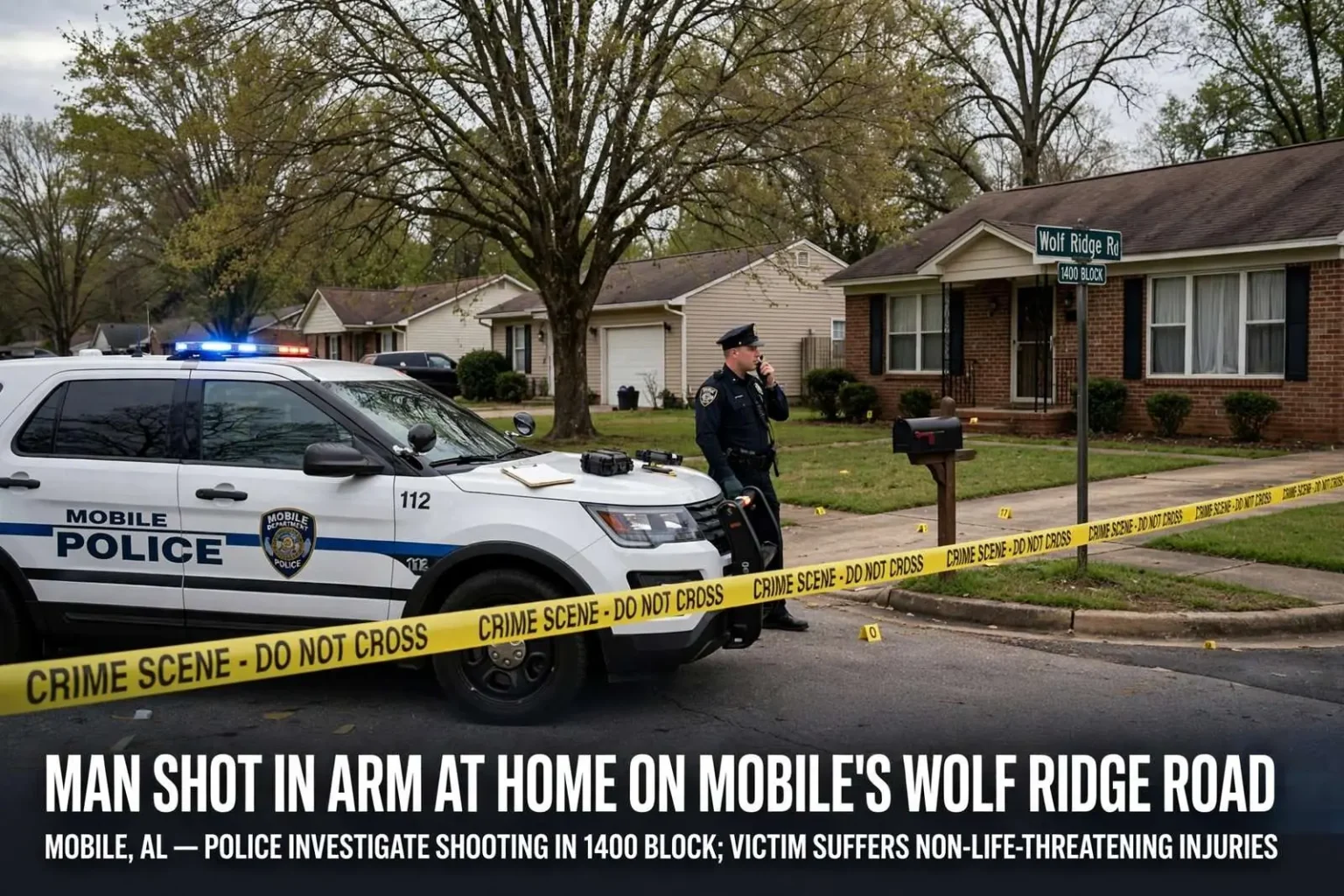
MOBILE, Ala. — A man was shot in the arm inside his own home on Wolf Ridge Road, and Mobile police are investigating the incident as a shooting that left the victim with non-life-threatening injuries.
Officers were called to the 1400 block of Wolf Ridge Road on Tuesday, March 15, after a report of a shooting, according to a Mobile Police Department news release. When they arrived, they found a man suffering from gunshot wounds.
The victim told officers he was inside the home when he heard gunshots coming from outside. He was struck in the arm and taken to a hospital with injuries that were not considered life-threatening.
The Mobile Police Department said the investigation into the shooting remains ongoing, and no arrest had been announced. Police also did not release a description of any suspect or vehicle, saying only that the man was wounded by gunfire that came from outside the residence where he was inside.
Incidents in which bullets strike homes and the people inside them are among the most troubling calls for police in any city, because they raise the possibility of indiscriminate gunfire rather than a targeted confrontation. Investigators work from the physical evidence at the scene — where rounds struck, from what direction, and what caliber — to determine whether a specific house was the intended target or whether the shots were fired elsewhere entirely.
Wolf Ridge Road and the neighborhood it runs through
Wolf Ridge Road runs through west Mobile, a corridor of residential subdivisions, apartment complexes and commercial strips not far from some of the city’s busiest retail districts. The 1400 block sits among modest single-family neighborhoods where a Tuesday-afternoon shooting is the exception rather than the rule, and where the arrival of patrol cars and crime-scene tape draws neighbors to porches and windows within minutes.
West Mobile has grown steadily for decades as the city’s population has shifted away from the older core, and the area around Wolf Ridge Road reflects that growth: schools, churches and chain businesses within a short drive, and streets that empty each morning as commuters head toward employment centers across the city. Violent crime in such neighborhoods tends to be episodic rather than chronic, which is part of why a single shooting generates so much attention.
Residents of the block spent the afternoon of March 15 watching investigators work the scene. Uniformed officers established a perimeter, and detectives began the patient work of canvassing for anyone who heard the shots, saw a vehicle or has a doorbell or security camera that might have caught something.
What investigators do after a non-fatal shooting
A shooting victim who survives is both a patient and, potentially, the investigation’s best witness. Detectives will interview the man once his medical condition allows, asking about the sound and direction of the gunfire, whether he noticed anyone in the area beforehand, and whether there is any history — a dispute, a threat, a recent conflict — that could explain why his house was hit.
At the scene, investigators document bullet holes and shell casings, recover any projectiles that lodged in the structure, and use the trajectory of the shots to establish where the shooter stood. That geometry matters: shots fired from a passing car suggest a different scenario than shots fired from a fixed position in the yard, and the evidence often distinguishes between them fairly quickly.
The department also checks whether the incident connects to other recent calls in the area — reports of shots fired earlier in the evening, an argument at a nearby address, or another shooting that might share a suspect. Non-fatal shootings are the cases most likely to be solved by pattern recognition, since shooters who fire into homes or from vehicles frequently repeat themselves.
Arm wounds and emergency treatment
A gunshot wound to the arm is serious but among the more survivable types of firearm injury, which is why the man’s injuries were classified as non-life-threatening. Treatment typically focuses on controlling bleeding, assessing damage to bone, nerves and blood vessels, and in some cases surgical repair followed by rehabilitation that can take weeks or months depending on the structures involved.
Emergency crews transporting a stable shooting patient to a hospital follow protocols designed for penetrating trauma, and Mobile’s hospital network handles such cases routinely. Once the victim’s condition is stabilized, detectives are usually able to speak with him, and his account — gunfire from outside, no warning — becomes the starting point for the case file.
Police did not release the victim’s name, which is common practice for surviving victims of violent crime unless charges are filed and the person becomes part of a public court record. The withholding also reflects a practical concern for the victim’s safety while the shooter remains unidentified.
How residents can help
Shootings that appear to have come from outside a home are exactly the kind of case where tips from neighbors decide whether an arrest happens. Someone on the block likely heard the shots, saw a car slow down or speed away, or has a camera that recorded a few seconds of useful footage, even if it did not seem important at the time.
Mobile police encourage anyone with information about the Wolf Ridge Road shooting to call the department, and the department’s partnerships with area Crime Stoppers programs allow tipsters to submit information anonymously and, in cases where an arrest results, to qualify for a cash reward. Investigators would rather receive a call that turns out to be nothing than miss the one fragment that breaks the case.
Doorbell cameras and home surveillance have changed the odds on cases like this. Detectives routinely knock on doors within a block of a shooting scene asking residents to review their footage, since a vehicle’s color, direction of travel or partial plate number seen by a camera is often enough to move the investigation forward.
Guns fired outside, people struck inside
The scenario the victim described — inside his home, hearing shots from outside — is a pattern police departments know well. Bullets fired into residential areas travel through walls and windows with ease, and homes on corners, near intersections or facing open lots take the most risk when someone fires a gun outdoors without regard for what lies beyond the target.
Whether the man was struck by shots meant for him, for someone else, or fired without any target at all is the central question of the investigation, and police were careful in their release not to characterize the shooting beyond the facts. The distinction matters for how the case is charged if an arrest is made, ranging from reckless conduct offenses to attempted murder.
The department said the investigation remains ongoing, and that is where the public record stands as of the March 15 release. For the people on the 1400 block of Wolf Ridge Road, the more immediate reality was closer to home: bullets had come through the ordinary safety of their street, a neighbor was wounded inside his own house, and the search for the person responsible had only just begun.
The search for who fired the shots
Until an arrest is announced, the case turns on the standard machinery of a Mobile homicide-and-violent-crime investigation, even without a homicide. Detectives assigned to the shooting will follow up on the canvas of the neighborhood, submit recovered evidence to the crime lab and wait on ballistic results that can sometimes link a weapon to other cases across the region.
The timeline for such investigations varies widely. Some are resolved within days when a witness or camera provides a clear lead; others sit unsolved for months until a tip arrives or the shooter surfaces in connection with another offense. Departments generally keep cases like this open indefinitely, and reviewers periodically revisit them as new information comes in.
For the victim, the investigation’s pace matters in practical ways. An arrest that leads to prosecution can support restitution for medical bills and lost wages, while an unsolved case leaves the household to absorb those costs and the lingering unease of knowing the shooter has not been found.
Police renewed their standing request for public help on March 15, and the department’s message to the neighborhood was the one it delivers after every shooting: someone knows something, and a phone call can be made without ever giving a name.
The March shooting also lands in the wider context of gun violence response in Mobile, where the department combines patrol, investigative and community-focused units in addressing shootings that do not end in death. Non-fatal shootings carry their own costs — hospital stays, recovery time from work, and the fear that settles over a block until the person responsible is caught — and police leaders have consistently argued that solving them quickly is the best prevention, since uncaught shooters tend to shoot again.
For now, the files in the case belong to detectives, and the department’s news release remains the public account: a report of shots fired in the 1400 block, a man wounded in the arm inside his home, a hospital trip with non-life-threatening injuries, and an investigation that continues.