Man Shot in the Chest on Murrell Lane, Mobile Police Investigating
Mobile police investigated a Tuesday-morning shooting on Murrell Lane; a 33-year-old man was shot in the chest and taken to the hospital.
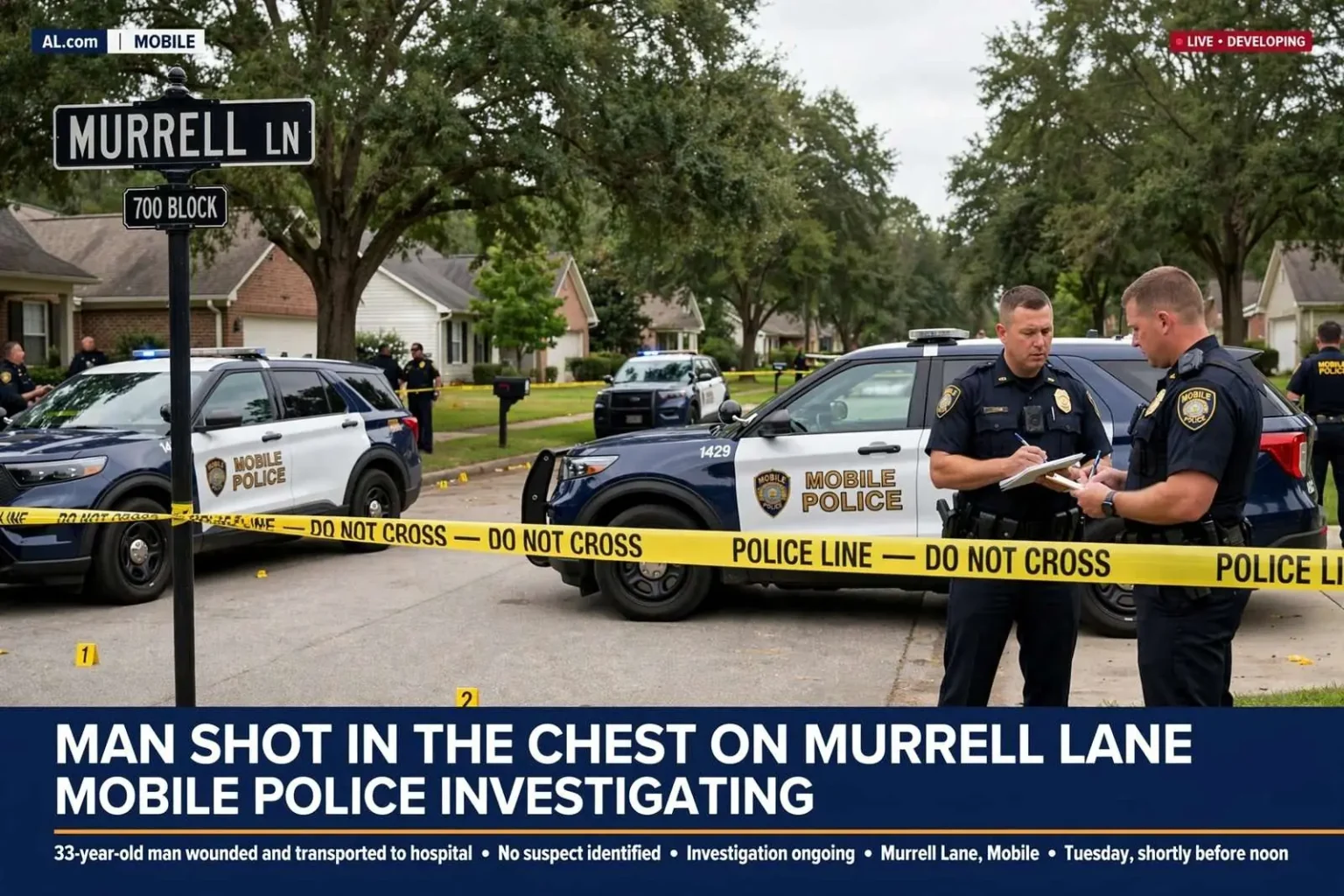
Mobile police are investigating a late-morning shooting on Murrell Lane that left a 33-year-old man wounded. Officers said the victim was shot in the chest and transported to a hospital. His condition was not immediately released as the case remained a developing story. The shooting was reported shortly before noon Tuesday in a residential section of Mobile. Police had not announced a suspect or a possible motive, and it was not clear whether the victim knew his shooter.
The midday report brought officers to a neighborhood more accustomed to ordinary weekday traffic than gunfire. A chest wound is among the most serious injuries a shooting victim can sustain, and the speed with which the man reached a hospital can matter enormously in his survival odds — trauma surgeons at Mobile’s hospitals treat gunshot patients around the clock, and outcomes in chest wounds often turn on how quickly responders get the victim into an ambulance and moving.
Investigators had not released the victim’s name, consistent with standard practice while family members are notified and while the medical picture is still uncertain. They had also not said whether the man was shot inside a home, in a yard, or on the street, and no description of a suspect had been made public by the time of the initial report. Those details typically emerge only when detectives are confident releasing them will not compromise the investigation.
How a shooting investigation unfolds
The first hours of a nonfatal shooting investigation follow a pattern that Mobile detectives know well. Patrol officers secure the scene and get the victim to medical care; investigators then take over, walking the block for shell casings, checking doors and fences for damage, and photographing everything before it is disturbed. Detectives typically canvass for witnesses and review nearby surveillance footage in cases like this one, and residential streets like Murrell Lane are often ringed by doorbell cameras and home security systems that capture far more than their owners realize.
That surveillance work has changed the pace of shooting investigations in recent years. A single doorbell camera can establish the exact time of the shots, show a vehicle entering or leaving the block, or capture a person on foot whom no human witness noticed. Detectives usually ask nearby residents to check their recordings the same day, since many systems overwrite footage within a matter of days and saved clips are far more useful than memories of what a screen showed once.
Whether the victim knew his shooter is often the central early question in a case like this one, and the answer shapes everything that follows. Random shootings tend to produce searches for an unknown assailant, with heavy reliance on physical evidence and cameras. Shootings between people who know each other tend to move faster, because the circle of possible suspects is smaller — but they also depend on witnesses willing to talk, which is often the harder thing to get in a residential neighborhood.
What residents saw and can do
A shot fired shortly before noon in a residential block almost always has witnesses, even if they did not realize what they were hearing. Some residents will have heard one loud report or several; some will have seen a vehicle speed away; some will have noticed a stranger on the block in the minutes before. Police ask people in that situation to report even fragments, and to do so through channels that protect their identity if they are worried about being known in the neighborhood.
Anyone with information was urged to contact Mobile police or CrimeStoppers. Mobile Area CrimeStoppers allows tipsters to call or submit information online without giving a name, and tips that lead to an arrest can qualify for cash rewards. The program exists precisely for cases like this one, where a witness may know the answer but fear the consequences of being seen talking to police. Tipsters never have to appear in court, and detectives receive the information without knowing who sent it.
For the neighborhood around Murrell Lane, a daytime shooting disrupts more than the immediate victims. Residents watch crime scene tape go up, officers work through the afternoon, and the block fills with the rumor that follows any unsolved violence. Police departments counter that uncertainty with visible follow-up — patrol attention to the area in the days after, door-to-door canvassing, and, when they have something to share, public requests for help. The presence of extra patrol cars in the days after a shooting is standard, both as reassurance and as a deterrent against any retaliation.
Nonfatal shootings are the majority of gun violence in American cities, and Mobile is no exception, but investigators treat them with the urgency of potential homicide cases. A victim who survives a chest wound may still die of his injuries, which means the case can escalate; and even when the victim recovers, the investigation proceeds as if time were short, because evidence decays, memories blur, and cameras overwrite. Detectives assigned to the case will typically follow the victim’s movements that day, his phone records with a court’s authorization, and any prior incidents connected to the address or the people involved.
The victim’s condition and what comes next
As of the initial report, the 33-year-old’s condition had not been released, and police cautioned that the account of the incident could change as the investigation developed. Hospitals do not generally release information about shooting victims without family consent, so condition updates usually come through police, and often only when an arrest is made or the case reaches a charging decision. Until then, the public record remains what officers released in the first hours: a man shot in the chest shortly before noon on a Tuesday, taken to a hospital, and a shooter not yet identified.
If an arrest follows, the case would move to the Mobile County District Attorney’s Office, where a grand jury would consider charges ranging from first-degree assault to attempted murder, depending on the evidence of intent and the severity of the injuries. Prosecutors in Mobile County handle hundreds of shooting cases a year, and outcomes depend heavily on the completeness of the file detectives build in the first weeks — the witness statements, the ballistics, the surveillance timeline, and any statement the victim is able to give.
Mobile police renewed their request for public help as the investigation continued, asking anyone who lives or was passing through the Murrell Lane area Tuesday around midday to think back on what they saw. A vehicle description, a direction of travel, or a name mentioned in conversation afterward may be the detail that closes the case. Tips can go directly to Mobile police investigators or anonymously to Mobile Area CrimeStoppers, and both channels remain open long after the initial headlines fade.
In the meantime, the shooting stands as one more data point in the city’s continuing struggle with gun violence, and one more reminder of the role residents play in solving these cases. Police solve shootings, but rarely alone; the cases that end in arrests almost always began with a neighbor’s call, a saved camera clip, or a tip that reached a detective’s desk in time to matter. The Murrell Lane investigation, as police emphasized, is still open — and still waiting for exactly that kind of help.
Trauma care along the central Gulf Coast has improved survival odds for shooting victims considerably over the past two decades. Mobile’s hospitals operate trauma-capable emergency departments, and national programs that train bystanders in bleeding control — tourniquets, pressure dressings, and the judgment about when to move a victim — have spread through fire departments and civic groups in Alabama. In chest wounds in particular, bystander care and rapid transport both matter; the American College of Surgeons’ Stop the Bleed campaign, adopted widely since its launch, exists on the premise that the first minutes before an ambulance arrives belong to whoever is standing nearby.
Police response to a midday shooting also involves the schools question that families in any city ask after gunfire near a residential block: whether any nearby school was affected. In incidents close to school zones or during hours when students are arriving or dismissing, Mobile County Public Schools and city police coordinate on precautionary measures. No such advisory was reported in connection with the Murrell Lane shooting, but the coordination itself is routine, and residents will sometimes see a school’s morning or afternoon routine shift briefly after an incident nearby.
The investigation into the Murrell Lane shooting remained active, with detectives continuing to gather evidence and interview witnesses as of the initial report. Residents with questions about the case — or with information they have not yet shared — can contact the Mobile Police Department directly, reach Mobile Area CrimeStoppers anonymously by phone or through its online tip form, and, if they hold relevant camera footage, save it before their system overwrites it. Those saved files, police note, have solved more neighborhood shootings in recent years than any other single source of evidence.