
Man Stabbed at Callaghan’s Irish Social Club in Mobile
Mobile police investigated after a man in his mid-60s was stabbed at Callaghan's Irish Social Club on Wednesday evening.
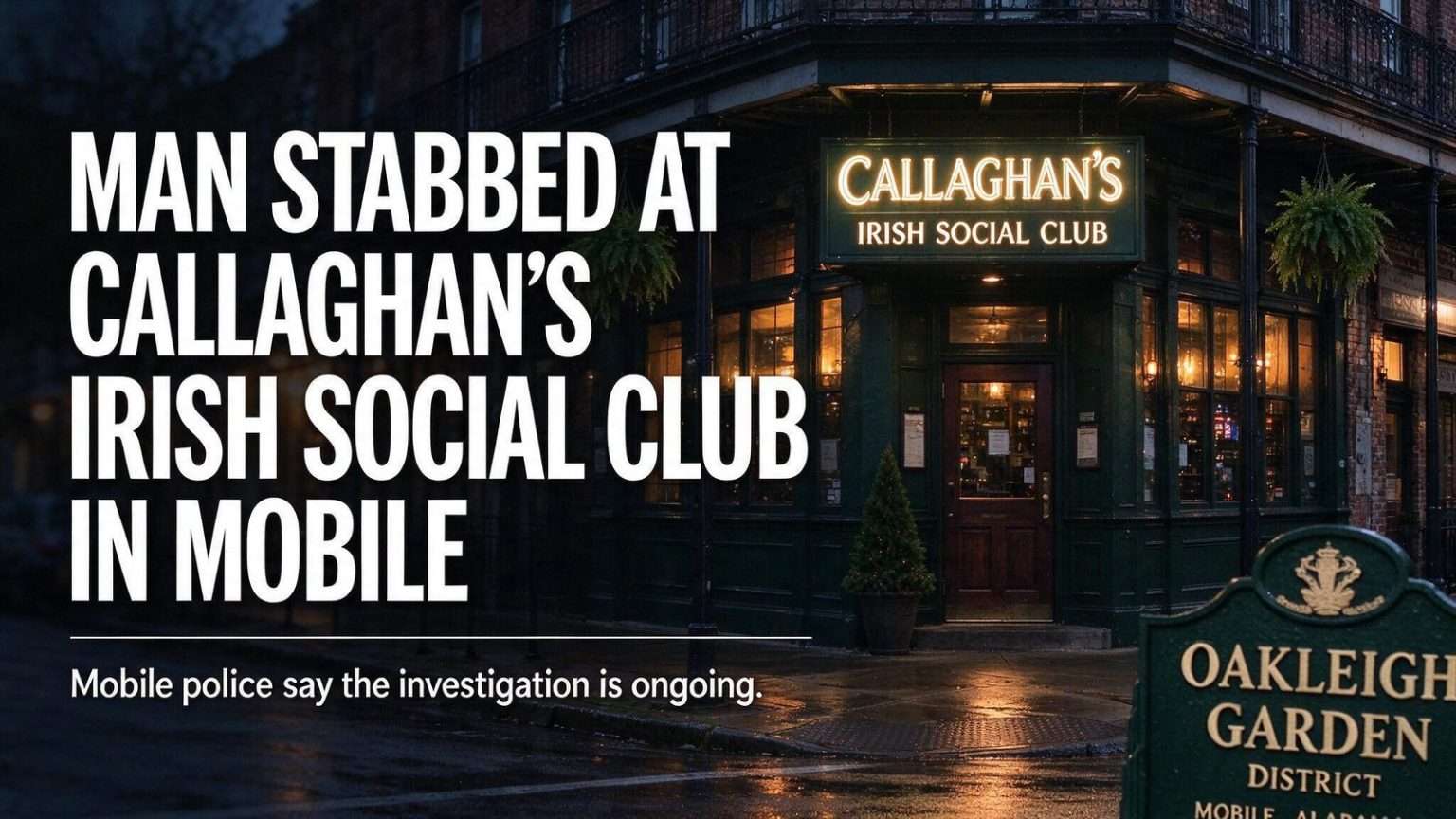
MOBILE, Ala. — Mobile police responded to a stabbing at Callaghan’s Irish Social Club on Wednesday evening, confirming that a man, approximately 65 years old, was stabbed at the popular neighborhood restaurant and bar. Officers said the severity of his injuries was not immediately known, and police remained on scene into the evening as they gathered details about what led to the attack.
No suspect information was immediately released. The investigation was ongoing, and authorities said additional information would be provided once it became available — the standard posture in the early hours of a violent incident, when detectives are still separating what witnesses saw from what they assume and working to establish the sequence of events that put a man in the hospital.
The location added a dimension that made the story travel quickly through Mobile’s social channels. Callaghan’s, a fixture of the Oakleigh Garden District, is among the city’s best-known neighborhood bars — a place known as much for its burgers and its close quarters as for its drinks, and a spot where locals, University of South Alabama fans, and city regulars have gathered for decades.
What Police Confirmed
The confirmed facts, as officers released them Wednesday evening, were sparse by design. Mobile police responded to the scene after reports of a stabbing. The victim was a man of about 65. He was stabbed inside or immediately around the establishment, and responding officers found him wounded and saw to it that he was transported for medical care. Beyond that — the number of attackers, the weapon used, the precise circumstances inside the bar, and the condition of the victim — officials declined to speculate while the investigation was in its first hours.
That restraint is standard. In stabbings especially, early public details are often revised as witnesses are interviewed and video is reviewed, and the Mobile Police Department has generally withheld specifics — names of suspects, motives, even the victim’s exact condition — until investigators can support each fact. Detectives canvassed the scene into the evening, collecting statements from patrons and staff and requesting any surveillance footage that covered the moments before and after the attack.
The Scene: Callaghan’s Irish Social Club
Callaghan’s sits in the Oakleigh Garden District, the historic neighborhood south of downtown Mobile known for its antebellum and Victorian homes, its oak-lined streets, and its concentration of the city’s favorite watering holes. The bar has operated for decades as a social club in spirit if not in structure — a small, often crowded room where neighborhood regulars mix with visitors drawn by the kitchen’s reputation, particularly its widely praised hamburgers, and by an atmosphere that feels more like a living room than a business.
The bar’s tight quarters are part of its charm and part of what made the evening’s news jarring. A stabbing in a space that size is a close-quarters event — there is no distance in Callaghan’s, no anonymous corner to slip away to, and any violence inside it happens in front of a room full of witnesses. That reality cuts both ways for investigators: plenty of people saw something, and every one of them was a potential interview.
How Mobile Investigates Stabbings
A stabbing response in Mobile typically follows a sequence familiar from countless cases. Patrol officers secure the scene and render aid; the victim is transported to a local trauma center, where his condition becomes the dividing line between an aggravated assault investigation and a homicide one. Detectives from the department’s violent crimes section take over the scene, photographing and processing for physical evidence, while uniformed officers hold the perimeter and begin the witness canvass.
The victim’s condition drives everything downstream. If the man survived his wounds, the case proceeds as an aggravated assault under Alabama law, which covers intentionally causing serious physical injury with a deadly weapon or dangerous instrument. If he had died, the investigation would become a homicide case, with the full apparatus of the department’s major crimes unit and the Mobile County District Attorney’s office engaged from the outset.
Investigators also weigh the possibility that the stabbing arose from an altercation rather than a stranger attack, and they examine whether anyone involved acted in self-defense — questions that Alabama’s self-defense statutes, including the state’s stand-your-ground provisions, would frame. In a crowded bar, the line between attacker and defender can be the central evidentiary question, and detectives build that picture from witness statements, physical evidence, and video.
Violence in Mobile’s Bar Districts
Stabbings and shootings in and around Mobile’s nightlife districts are, statistically, a familiar category of violent crime for the department, though violence inside a beloved neighborhood institution is rarer and lands differently in public perception. Police coverage of the city’s entertainment areas — from Dauphin Street downtown to the Oakleigh district’s cluster of bars — concentrates patrol resources on the late-evening hours when alcohol-fueled altercations peak.
Public safety officials have long noted that the most common serious injuries in bar settings grow out of fights that escalate, and that the difference between a punch and a stabbing is often the presence of a weapon and the seconds of anger it takes to use it. Establishments manage this risk with staffing, door policies, and relationships with the officers who patrol their blocks, and the city’s most popular bars tend to be the ones most practiced at defusing trouble before it reaches the point of violence.
The Oakleigh Garden District’s Stake
The Oakleigh district is one of Mobile’s most photographed neighborhoods — the Oakleigh House Museum anchors it, the streets around Washington Avenue and Government Street carry the city’s historic architecture, and the district’s restaurants and bars make it an evening destination in its own right. An incident of violence at one of its flagship establishments ripples outward: residents of the surrounding streets, many of whom walk to dinner and drinks, process the news personally, and the business community understands that perception of safety is fragile currency.
At the same time, Mobile’s neighborhood institutions have survived worse than one violent night. Callaghan’s has been part of the city’s social fabric for generations, and its regulars’ attachment runs deep enough that the immediate response from the community — in the hours after the news broke — was concern for the wounded man and for the staff who witnessed the event, rather than any rush to judgment about the place itself.
What Investigators Were Working to Establish
In the evening hours after the stabbing, the open questions were the ones that define any such case: who attacked the man, with what weapon, and why. Detectives were seeking to reconstruct the moments before the stabbing — whether an argument preceded it, whether the attacker was a patron or someone else, and whether any of the actions that led to the wounding were captured on the cameras that watch the bar and its surroundings.
The victim’s medical status would shape the charge the case eventually produced, and his own account — if and when he was able to give one — would anchor the narrative the witnesses’ statements built around. Until then, police held the details, promising updates once the investigation could support them.
How the Community Learned the News
News of the stabbing moved through Mobile the way breaking news now always does: first on the police scanners and social media accounts that track the city’s emergency traffic, then through the local stations’ confirmations with police, then through the comment threads and group chats where Mobile residents process the evening’s events. By nightfall, the basic outline — a man stabbed at Callaghan’s, police on scene, no suspect named — was widely known, with the significant details still filled by speculation that officials had not confirmed.
The impulse to share first and verify later is exactly what police ask the public to resist in cases like this. Unconfirmed descriptions of suspects or circumstances can contaminate witness recollection and complicate prosecutions, and the department’s withholding of suspect information while the canvass was underway reflected that discipline.
Anyone With Information
Police did not release suspect information Wednesday evening, which meant there was nothing for the public to act on except the standing invitation that accompanies every unsolved violent crime in Mobile: anyone with information about the case is urged to come forward. Tips can go directly to the Mobile Police Department or, for those who prefer anonymity, through CrimeStoppers of the Alabama Gulf Coast, which accepts anonymous tips by phone and online and pays rewards of up to a few thousand dollars for information that leads to an arrest in felony cases.
In a case with a room full of potential witnesses, the tips channel matters. Not everyone who saw something Wednesday evening will be comfortable giving a statement to a detective, and the anonymous route exists precisely for them. Investigators weighing conflicting accounts will sort the credible from the mistaken — but the first step is getting every account in.
The Days After a Stabbing
What follows a case like this one is predictable. The victim’s condition stabilizes or it doesn’t, and the charge — aggravated assault or something graver — follows. Detectives complete the canvass, collect and review video, and present the case to the District Attorney’s office, which decides what charges the evidence supports. If an arrest follows, the case proceeds through the Mobile County court system like any other, and the initial headlines give way to the slower machinery of prosecution.
For Callaghan’s, the aftermath will involve cooperation with the investigation, conversations with staff who witnessed the event, and the ordinary work of reopening a neighborhood institution after a violent night inside it. Bars recover from these incidents the way neighborhoods do — gradually, with the help of regulars who return — and Mobile’s attachment to its landmark watering holes has historically outlasted the news cycles that briefly defined them.
As of Wednesday evening, the facts were as police stated them: a man of about 65 stabbed at Callaghan’s Irish Social Club, the severity of his injuries not yet known, officers on scene into the night, no suspect information released, and the investigation continuing with more information promised once available. The next chapter belonged to the detectives and the witnesses — and to the victim, whose account, when he could give it, would shape everything that followed.


