
Man Wounded in Shooting on Costarides Street in Mobile
Mobile police investigated a Tuesday-evening shooting on Costarides Street that wounded a man whose injuries were not life-threatening.
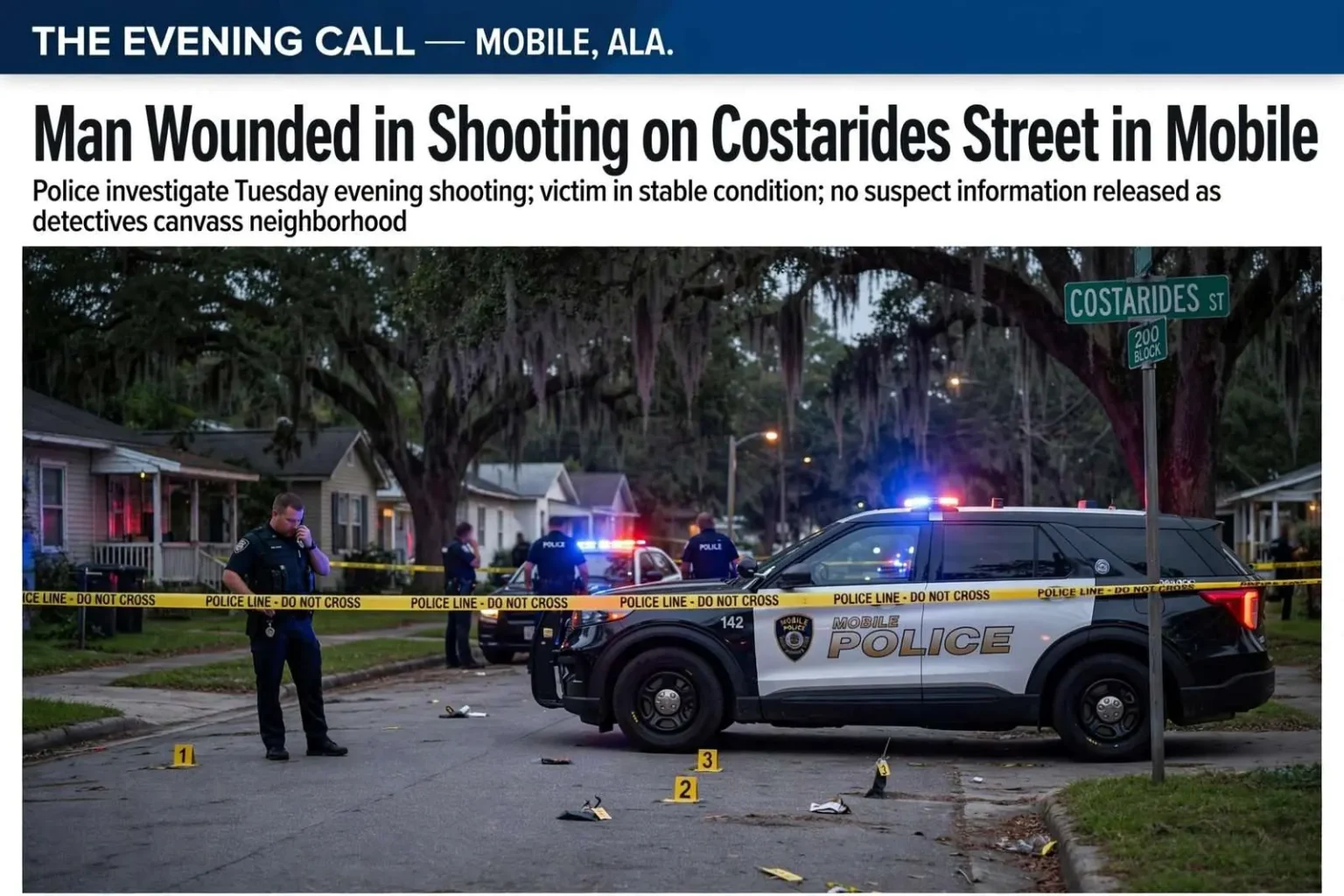
MOBILE, Ala. — Mobile police launched an investigation Tuesday evening after a shooting on Costarides Street left a man wounded, adding another case to the department’s docket of non-fatal gun violence that officers across the city work to solve week after week.
Police said the man was shot and suffered injuries that were not life-threatening — a description that, in the arithmetic of street violence, marks a case where the victim survived. His identity was not released, consistent with the department’s practice in shooting cases and with the privacy protections that surround people who are still receiving medical care.
No suspect information was immediately available as the investigation continued. Detectives began the work that non-fatal shooting cases demand: canvassing the neighborhood for witnesses, collecting physical evidence from the scene, reviewing any camera footage from nearby homes and businesses, and trying to establish the circumstances that put a bullet into a man on a Tuesday evening in a Mobile neighborhood.
The shooting underscored the reality that Mobile, like cities across Alabama and the nation, manages a persistent level of gun violence that claims a small number of lives and injures many more — cases that rarely generate sustained headlines but that occupy the police department’s investigators, prosecutors, and neighborhoods long after the tape comes down.
The Evening Call and the First Response
When shots are reported, the police response moves in a sequence designed for a scene where seconds matter and evidence is fragile. Patrol officers are dispatched first, and their initial tasks are urgent: locate the victim or victims, secure the area so anyone armed cannot approach or flee, provide immediate aid if the victim is still on scene, and hold the ground that paramedics and investigators will need.
The injured man’s condition — wounded but not in life-threatening condition — shaped the response. Victims with non-fatal wounds are stabilized at the scene or transported to a hospital emergency department, where trauma teams treat gunshot injuries of every degree of severity. Hospitals along the Gulf Coast treat hundreds of shooting victims a year, and the survival of most of them is the quiet success of trauma medicine that the public rarely counts.
At the scene itself, officers establish a perimeter, identify shell casings, note blood evidence, and begin the witness canvas that will determine whether the case can be solved. The first hour matters enormously in shooting investigations, because memories are freshest and witnesses are most willing to talk before the neighborhood’s quieter conventions take hold.
By nightfall on Costarides Street, the markers of a Mobile shooting investigation were in place: officers at the corners, detectives moving between houses, evidence markers dotting the pavement, and a neighborhood processing what had happened in its midst.
How Non-Fatal Shooting Investigations Work
A non-fatal shooting case presents investigators with a specific set of advantages and obstacles. The advantage is the victim. A living victim can describe what happened, identify the shooter if they knew them, and testify — the evidentiary spine that fatal cases lack. The obstacles are equally specific: victims of street shootings are often reluctant to cooperate, witnesses are reluctant to come forward, and the circle of people who know what happened typically knows more than they are willing to say to police.
Detectives therefore work multiple channels at once. They interview the victim, when his condition permits, about the circumstances of the shooting — where he was, whether he knew the shooter, whether there was an exchange of words or an ongoing dispute. They gather physical evidence, and shell casings in particular carry a scientific value beyond their location: their markings can be matched to specific firearms, and matches across cases can link shootings that no witness ever connected.
Camera footage has changed these investigations substantially. Residential doorbell cameras, business security systems, and the phones of bystanders have multiplied the eyes on Mobile’s streets, and detectives routinely knock on doors within camera range of a scene. Footage that captures the shooter, a vehicle, or even the direction of travel after the shots can convert a stalled case into a solvable one.
The department’s eventual release of suspect information — a description, a vehicle, a name — depends entirely on what those channels produce. In cases where no information is immediately available, as Tuesday’s shooting initially was, investigators hold the details close and keep working.
The Geography of Gun Violence in Mobile
Mobile’s experience with shootings follows patterns familiar to mid-sized American cities. The city of roughly 185,000 residents records dozens of shootings in a typical year, concentrated in particular neighborhoods and driven disproportionately by disputes — personal conflicts, retaliations, and arguments that escalate to gunfire. The Mobile Police Department responds with a combination of patrol presence, investigative work, and targeted enforcement in the areas where shootings cluster.
The department’s investigators carry caseloads that include fatal and non-fatal shootings alongside robberies and assaults, and their clearance rates — the measure of cases solved — depend heavily on community cooperation. Cities across the country have seen that cooperation wax and wane with community trust, and Mobile’s department, like others, has built programs intended to strengthen it: community policing initiatives, neighborhood association meetings, and tip channels that allow people to provide information without exposure.
Each shooting also lands on a neighborhood with force. Residents of the streets where they occur live afterward with the memory, with heightened anxiety, and often with the suspicion that another shooting may follow if the dispute that produced this one is not resolved. Community organizations and churches in Mobile’s neighborhoods have long played a role in violence interruption — mediating disputes, supporting victims’ families, and pressing for the street-level peace that policing alone cannot produce.
What Comes Next in the Case
In the days after a shooting like Tuesday’s, the investigation follows the evidence wherever it leads. If detectives identify a suspect, an arrest typically follows once the case is strong enough to present to prosecutors, who evaluate the evidence for charges ranging from assault depending on the circumstances and the victim’s injuries. If the trail cools, the case remains open — and unsolved non-fatal shootings remain a standing frustration for both the department and the neighborhoods where they occurred.
The victim’s recovery is its own track. Wounds classified as not life-threatening still can mean surgery, rehabilitation, and lasting effects, and victims face the practical questions — medical costs, time away from work, safety concerns — that follow anyone who survives being shot.
For the public, the confirmed facts of the case remained few and firmly stated: a shooting on Costarides Street on Tuesday evening, a man wounded, injuries not life-threatening, no identity released, and no suspect information immediately available. The rest belongs to the investigation — the canvass, the cameras, the casings, and the conversations that will determine whether the man who was shot on a Mobile street this Tuesday evening gets the answer the process exists to provide: who did this, and why.
The department’s handling of the case from here will follow the protocols that govern every shooting investigation in Mobile. The scene evidence will be logged and submitted for analysis. Detective work will continue beyond the neighborhood — into phone records if the victim’s cooperation provides a basis for them, into the records of any vehicle captured on camera, and into the histories that sometimes explain a shooting that strangers assume was random.
The distinction between random and targeted is among the first questions investigators try to answer, because it shapes everything else. A targeted shooting — one connected to a dispute or an ongoing conflict — suggests that the shooter knew the victim and can sometimes be identified through the victim’s circle. A random shooting is rarer and presents a harder problem, since the connection that would lead investigators to the shooter does not exist. In either case, the evidence at the scene and the accounts of witnesses are the raw material from which the answer must come.
The Witness Problem and How Departments Address It
The hardest reality of street shooting investigations is the witness gap. Neighbors hear gunfire, residents see the aftermath, and in many cases someone saw the shooter — yet investigations routinely stall because the people who know will not talk. The reasons are well documented: fear of retaliation, distrust of the process, and a code of silence that governs relationships in the neighborhoods where shootings occur.
Police departments have developed tools to work around the gap. Anonymous tip lines allow people to provide information without identifying themselves, and reward programs put money behind the tips that lead to arrests. Mobile uses these channels alongside the traditional canvass, and detectives often note that a single good tip — a name, a vehicle, a direction of travel — can move a case further than days of traditional work.
The Medical Side of a Non-Fatal Shooting
The phrase “injuries that were not life-threatening” carries a clinical precision that conceals a difficult reality. Non-fatal gunshot wounds frequently require emergency surgery, blood transfusion, and days of hospital care, and they can leave permanent damage — to organs, to limbs, to mobility — that reshapes a life without ending it. Trauma surgeons along the Gulf Coast treat these injuries with a routine born of repetition, but the routine exists because the injuries keep arriving.
The survival of shooting victims is one of the quiet stories of modern trauma medicine. Rapid transport, immediate blood availability, and surgical techniques refined in trauma centers have pushed survival rates upward, so that shootings which would have been fatal a generation ago now end with a wound, a hospital stay, and a recovery measured in months.
Recovery also has dimensions beyond the medical. Victims of shootings frequently experience the aftermath that follows violent injury — the anxiety, the hypervigilance, and the practical burdens of medical bills and lost income. Community and hospital-based programs in cities like Mobile increasingly address violence as a public health matter, connecting victims with services designed to interrupt the cycles that otherwise lead from injury to retaliation.
Tuesday Evening in Context
For the Costarides Street neighborhood, the shooting’s aftermath played out along a script its residents know: the response units, the tape, the detectives, and then the quiet. What differs from case to case is the ending — whether an arrest follows, whether the neighborhood’s information reaches the people who can use it, and whether the wounded man recovers to tell what happened.
What the public can confirm, from the department’s account, is unchanged since the first reports: a Tuesday evening shooting on Costarides Street, a man wounded, injuries not life-threatening, no identity released, and no suspect information immediately available. Those facts will grow as the investigation does. Detectives will follow the evidence, prosecutors will weigh whatever the evidence supports, and the case will move — at the pace investigations actually move — toward the resolution the process promises: an account of who fired the shots that wounded a man on a Mobile street, and a reckoning with the consequences.
Anyone with information about the shooting can provide it to the Mobile Police Department, where every piece of the record — a vehicle description, a voice heard before the shots, a figure seen running — becomes part of the effort to complete the picture that Tuesday evening’s gunfire interrupted.


