
Manson Follower Once Arrested in Mobile Recommended for Parole
A California panel recommended parole for Patricia Krenwinkel, the Manson follower captured by Mobile police after the 1969 Tate-LaBianca murders.
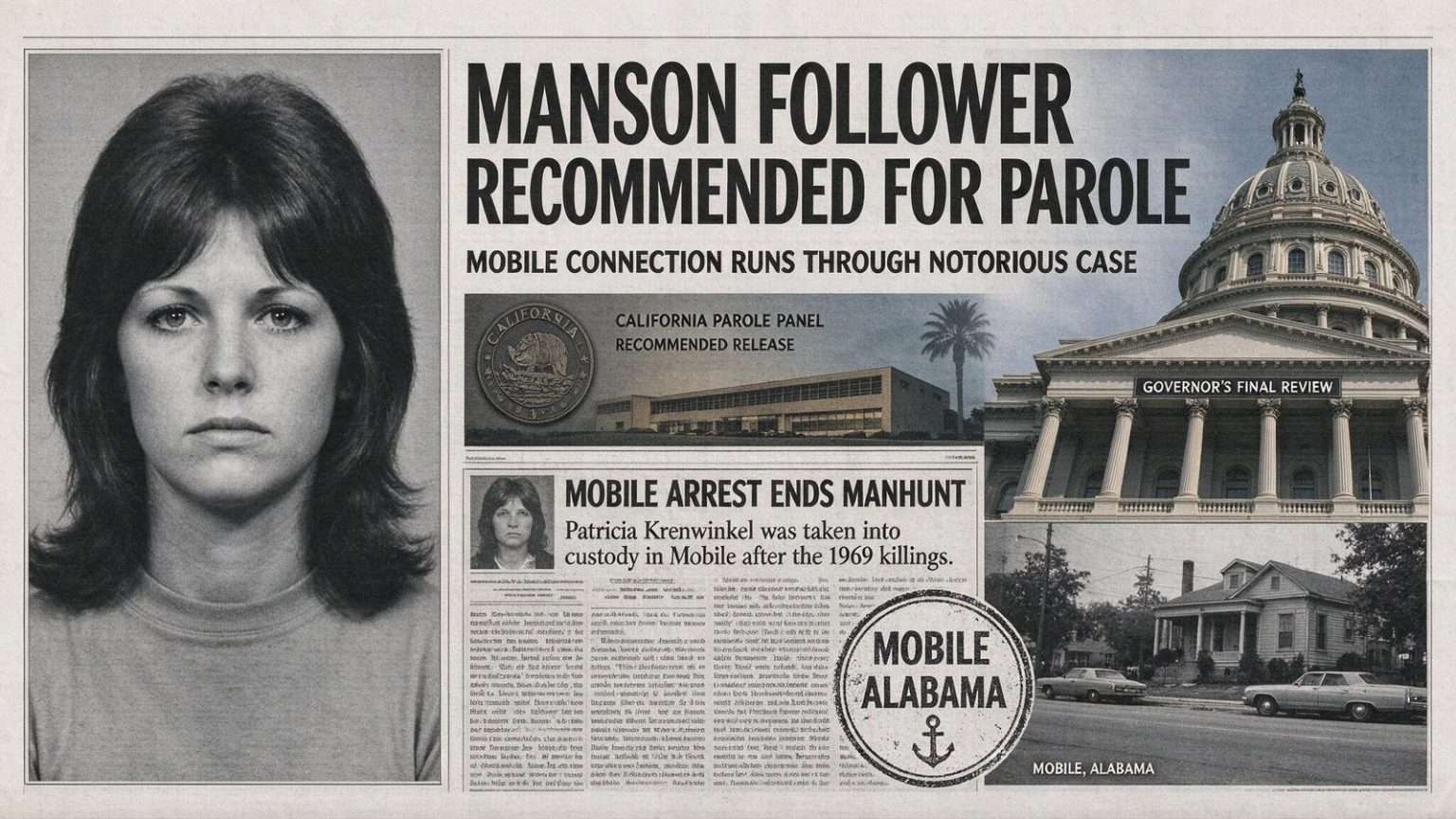
A Charles Manson follower whose capture more than five decades ago played out on the streets of Mobile has moved a step closer to freedom. A California parole panel recommended release for Patricia Krenwinkel, according to the Associated Press — the panel acted Thursday, more than 50 years after she and other Manson followers carried out two of the most infamous killings in American history. The recommendation does not free Krenwinkel; it moves her case to the desk of California’s governor, who has the final word.
Krenwinkel, now 74, has spent more than half a century in California prisons for her role in the 1969 Tate-LaBianca murders, a two-night killing spree that shocked the country and gave the era its darkest symbol. Her parole hearing drew national attention not only because of the crimes themselves but because of the unusual Alabama thread running through her story — a thread that runs directly through Mobile.
The Mobile connection
Krenwinkel’s path crossed with Mobile twice. She spent a semester at Spring Hill College, the Jesuit school that sits on a hilltop campus in the Spring Hill neighborhood of west Mobile, before meeting Manson at age 18 through her half sister. Her transfer to California, and her introduction to the drifter who would become her cult leader, set in motion the sequence that ended with her name on some of the most notorious criminal cases in the nation’s history.
The second Mobile connection came after the murders. When Los Angeles police were hunting for her after the 1969 killings, they contacted then-Mobile Police Chief James Robinson, who located and arrested her while she was staying with relatives in Mobile, according to the book “Helter Skelter.” The arrest in Alabama closed one of the largest manhunts of the era and returned Krenwinkel to California to face charges. For Mobile, the case became a footnote in national crime history — a reminder of how far the reach of the Manson investigation extended, all the way to a family home in the Port City.
Family members described the young Krenwinkel as a well-behaved, studious child who enjoyed school and church activities and had never been in trouble before falling under Manson’s influence. That description — of a girl whose family knew no trouble before California — became one of the enduring puzzles of the Manson case, cited by prosecutors, journalists and scholars trying to explain how ordinary young people from ordinary homes became killers in the summer of 1969.
The crimes and their aftermath
Krenwinkel helped kill pregnant actor Sharon Tate and four others in 1969, and grocer Leno LaBianca and his wife Rosemary the following night. The Tate killings took place at a hillside home in the Los Angeles hills, where five people were killed in the early hours of August 9, 1969; the LaBianca murders came the next night in the Los Feliz district. One victim’s blood was used to write “Helter Skelter” on a wall at the scene — a phrase drawn from a Beatles song that Manson had twisted into the apocalyptic race-war prophecy he taught his followers.
The murders paralyzed Los Angeles for weeks and became a defining crime story of the 1960s. Manson and several followers were tried together in a case that stretched across much of 1970, with Krenwinkel among those convicted and sentenced to death. When the California Supreme Court invalidated the state’s death penalty in 1972, the sentences of Manson’s followers were commuted to life imprisonment, which is why Krenwinkel’s case has come before parole boards repeatedly in the decades since.
What comes next
The parole recommendation for Krenwinkel is expected to reach California Gov. Gavin Newsom within five months for a final decision. The governor’s office reviews the record of the hearing, the recommendations of the board and any opposition from prosecutors or victims’ families before deciding whether to confirm, reverse or modify a parole grant. That review can take months, and decisions on Manson-family cases have consistently drawn intense public scrutiny.
Newsom has previously rejected parole for other Manson followers. As governor and, before that, as lieutenant governor sitting on the state parole board’s review panel, he has repeatedly declined to release figures from the Manson case, citing the gravity and horror of the crimes. Advocates for Krenwinkel have argued that more than 50 years of incarceration, her age and her record inside prison weigh in favor of release; prosecutors and victims’ relatives have countered each time that the crimes remain among the most brutal in the state’s history.
Manson himself died in prison in 2017 at age 83, still imprisoned more than four decades after the murders. His death left the remaining followers — Krenwinkel, Leslie Van Houten and others — as the surviving defendants whose futures are decided case by case in the parole process. Van Houten was released in 2023 after years of litigation over successive parole decisions, a development that has been cited in coverage of Krenwinkel’s case as a sign of how the disposition of the remaining Manson defendants has shifted over time.
A case that still echoes in Mobile
For Mobile, the parole recommendation revives a piece of local history that has faded with time. Spring Hill College students pass the campus where Krenwinkel spent a semester without necessarily knowing the story, and the arrest that Chief James Robinson carried out on a Mobile doorstep is preserved mainly in books and newspaper archives. But each time a Manson-case figure moves through the news — a death, a documentary, a parole decision — the Mobile thread resurfaces, linking the Port City to a chapter of American crime history that has never quite closed.
If Newsom allows the parole grant to stand, Krenwinkel would become the second Manson follower released in the modern era. If he rejects it, she would remain imprisoned and could seek another parole suitability hearing at a future date, as she has many times before. Either way, the decision will close another small chapter in a case whose aftermath — hearings, appeals and decisions — has now stretched longer than the half century between the murders and the Mobile arrest that once made local headlines around the world.
How California’s parole process works
Understanding where Krenwinkel’s case stands requires a look at how California parole operates for people sentenced to life with the possibility of parole. A panel of commissioners and deputy commissioners from the state’s Board of Parole Hearings conducts the suitability hearing, hears testimony from the inmate, reviews psychological risk assessments and considers statements from victims’ relatives and prosecutors. When the panel finds the inmate suitable, its recommendation is not self-executing: in murder cases, the decision is reviewed at higher levels of the corrections administration and ultimately by the governor, who has the constitutional authority to reverse or modify a grant.
The governor’s review is where Manson-family cases have repeatedly stalled. Successive governors — across both parties — have reversed parole grants for Manson followers, writing decisions that emphasized the exceptional notoriety and savagery of the 1969 murders. Litigation over those reversals has been a fixture of the process; in Van Houten’s case, courts ultimately sided with the parole board after multiple gubernatorial vetoes, clearing the way for her 2023 release. Whether a similar trajectory awaits Krenwinkel depends on the record developed at her hearing and the governor’s reading of it.
The five-month window for the recommendation to reach the governor is a procedural interval, not a deadline for the decision itself. During that period, prosecutors can lodge objections, victims’ family members can submit statements, and petitions and letters from both sides of the issue typically accumulate. Coverage of the hearing will keep the case in public view, as it has at every parole hearing for the Manson defendants since the 1970s.
Mobile’s place in the story
The Mobile connections remain among the most distinctive details in a case crowded with extraordinary details. Spring Hill College, founded in 1830 and one of the oldest institutions of higher learning in the South, appears in the Krenwinkel biography as the school where she spent a single semester — a short stay that preceded her move west at 18 and her introduction to Manson through her half sister. That detail has appeared in virtually every serious account of the Manson case, from courtroom coverage to books and documentaries, and it has given Mobile a recurring cameo in the story.
Chief James Robinson’s role is the second thread. In 1969, the Mobile Police Department was led by Robinson, whose cooperation with Los Angeles investigators put a local detective’s work at the center of the case’s endgame. Locating Krenwinkel at relatives’ home in Mobile, without incident, and holding her for return to California was the kind of cross-jurisdictional police work that the case required as warrants fanned out across the country. The account of the arrest preserved in “Helter Skelter” remains the standard record of how that chapter unfolded.
Now the case returns to the news with the state’s highest office holding the pen. Whether Newsom confirms or rejects the panel’s recommendation, the decision will mark another turn in a legal saga that began with murders committed before most of today’s Mobile residents were born, reached into the Spring Hill neighborhood for one semester and a family address, and now — more than fifty years later — still produces headlines on both coasts. For the families of the victims, the review period renews familiar grief; for Krenwinkel, it represents the closest she has come to release in five decades of incarceration.


