
Former Lockheed Martin CEO Marillyn Hewson to Speak at South Alabama on Sept. 17
Marillyn Hewson, former chairwoman, president and CEO of Lockheed Martin, will headline a free public conversation on leadership and aerospace at the University of South Alabama's MacQueen Alumni Center on Thursday, Sept. 17. Registration is required.
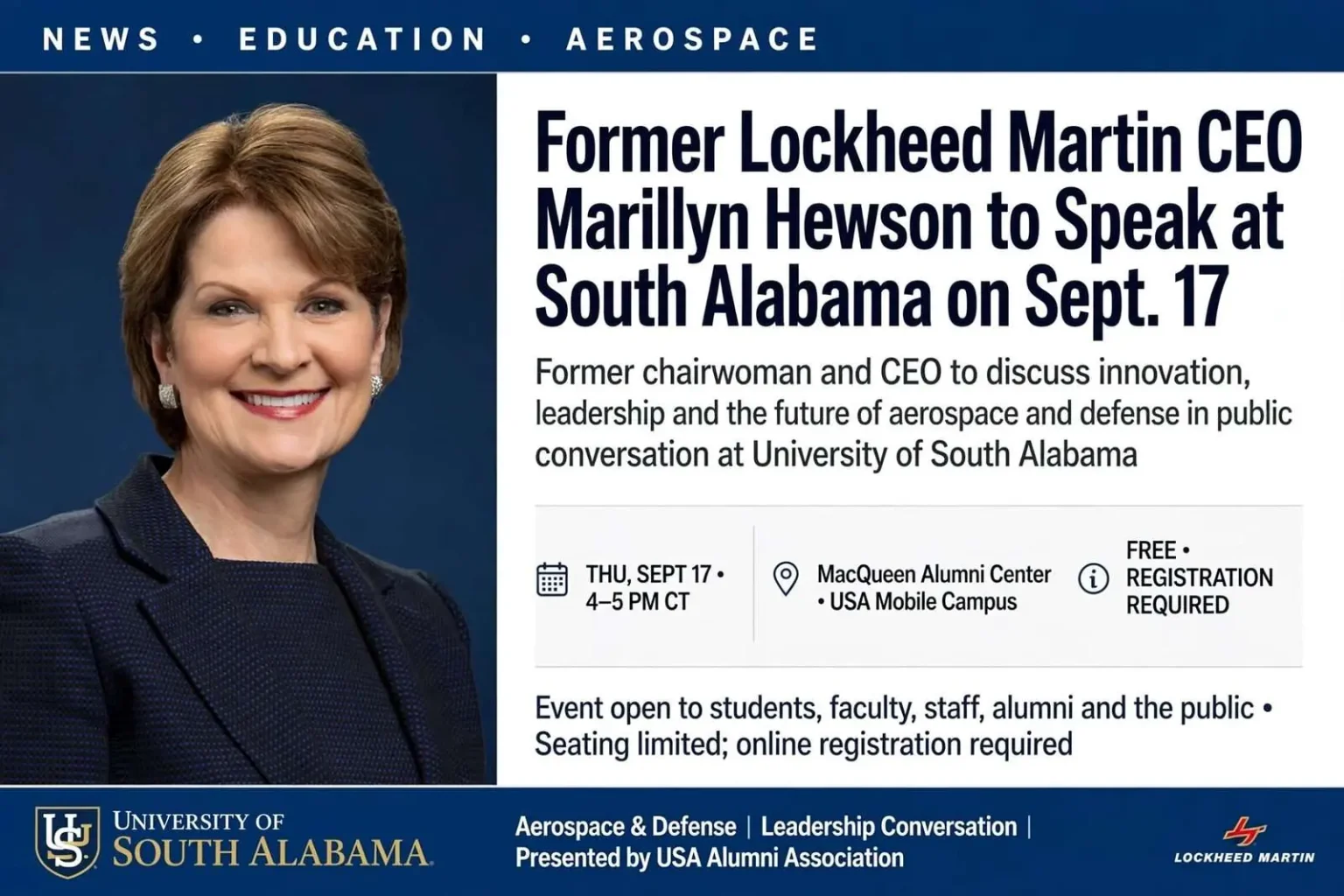
Marillyn Hewson, the former chairwoman, president and chief executive officer of Lockheed Martin Corp., will sit down for a public conversation at the University of South Alabama next week, bringing one of the aerospace and defense industry’s most prominent former executives to a city whose economy is increasingly tied to both fields.
The event is set for Thursday, Sept. 17, from 4 to 5 p.m. at the MacQueen Alumni Center on the university’s Mobile campus. It is free and open to the public, but seating is limited and online registration is required.
The university has invited students, faculty, staff, alumni and friends of the institution to attend what it describes as an engaging conversation on innovation, leadership and the future of aerospace and defense.
A Career Built Inside One Company
Hewson’s biography is unusual in an era when senior executives typically move between firms. She joined Lockheed Martin in 1983 as an industrial engineer and rose through the corporation to its top job, holding a range of leadership positions along the way.
Those roles spanned several of the company’s major business lines. She served as executive vice president of Lockheed Martin’s Electronic Systems business area, as president of Lockheed Martin Systems Integration, and as executive vice president of Global Sustainment for Lockheed Martin Aeronautics.
Each of those assignments sits in a different corner of a defense contractor’s work. Electronic systems covers the sensors, radars, fire control and mission systems that increasingly determine what a platform can actually do. Systems integration is the discipline of making separately developed hardware and software function as one coherent whole — a task that has become the central engineering challenge of modern military programs. Global sustainment is the long tail of the business: maintaining, repairing, upgrading and supplying aircraft for decades after delivery, which over a program’s life frequently costs more than building the aircraft in the first place.
An executive who has run all three has seen a defense program from design through fielding through middle age. That perspective is the substance behind the event’s billing.
Where She Serves Now
Hewson has remained active in the business, aerospace and technology communities since leaving the chief executive’s office.
She serves on the boards of directors of Johnson & Johnson and Chevron, two of the largest publicly traded companies in the United States, and as an executive advisor to World 50, a private peer network for senior executives at large global organizations. She also sits on the Board of Advisors of StellarXplorers, the Air & Space Forces Association’s national high school space education and competition program.
Her technical credentials include fellowships in two of the field’s principal professional bodies. She is a fellow of the American Institute of Aeronautics and Astronautics, the largest technical society devoted to aerospace engineering, and of the Royal Aeronautical Society, the British institution that has served as a professional home for aerospace practitioners since the nineteenth century. Fellowship in either organization is a distinction conferred for sustained contribution to the field rather than a membership category anyone can purchase.
Hewson is also a member of the Trilateral Commission, the Council on Foreign Relations, the National Academy of Engineering and the American Academy of Arts & Sciences. The National Academy of Engineering membership is worth pausing on: election to the academy is among the highest professional recognitions available to an American engineer, and it is awarded for contributions to engineering practice, research or education.
Earlier in her career she chaired the Board of Governors of the Aerospace Industries Association, the trade association representing U.S. aerospace and defense manufacturers, and she served on numerous U.S. government advisory bodies, corporate boards and charitable organizations.
Why the Topic Lands in Mobile
A conversation about aerospace and defense would be interesting in any college town. In Mobile it is close to a conversation about the local labor market.
Airbus operates a commercial aircraft final assembly line at the Mobile Aeroplex at Brookley, the sprawling former Air Force base on the west side of Mobile Bay. The facility, which began delivering aircraft in the mid-2010s, made Mobile the site of the European manufacturer’s first U.S. assembly operation, and Airbus has expanded its footprint there in the years since. The presence of a final assembly line has, in turn, drawn aerospace suppliers, logistics operations and maintenance firms to the region, and it has reshaped what the area’s technical schools and universities train people to do.
The defense side of the equation runs down the Mobile River. Austal USA builds vessels for the U.S. Navy and the U.S. Coast Guard at its Mobile shipyard and has expanded in recent years beyond aluminum construction into steel shipbuilding and into work supporting the Navy’s submarine industrial base. Together, the aviation and shipbuilding sectors employ thousands of people across the region and support a further layer of suppliers, fabricators and specialty contractors.
For an engineering student in Mobile, in other words, the industries Hewson spent four decades in are not abstractions on a career fair banner. They are within driving distance, and many of them are hiring.
The Company She Led
Lockheed Martin, described by the university as one of the world’s leading aerospace and defense manufacturers, sits at the center of American military aviation and space work. Its portfolio has long spanned combat aircraft, missiles and missile defense, rotary-wing aircraft, satellites and space systems, and the mission electronics that tie them together. Programs of that scale operate on timelines measured in decades and involve government customers, allied partners, thousands of suppliers and workforces spread across many states.
Running an organization of that shape is a different exercise from running a consumer company. The customer is largely a single government buyer operating under public appropriations, the products are subject to export controls and classification, program schedules are set years in advance, and the political environment can change faster than the engineering can. Executives who succeed in the sector tend to be fluent in engineering, contracting and public policy at the same time — one of the reasons a conversation about leadership in this industry rarely stays confined to business advice.
A Rare Path to the Top
Hewson’s ascent also carries significance beyond the balance sheet. Women remain underrepresented in senior engineering and executive roles across aerospace and defense, and the number who have led a major U.S. defense contractor is small. That she reached the chief executive’s office at a company she joined as an entry-level industrial engineer makes her career a specific kind of case study, and one that tends to draw questions from student audiences.
Her continued work with StellarXplorers, which runs a national space-focused competition for high school students, points in the same direction. Programs of that type exist largely to widen the pipeline into aerospace careers by reaching students before they have decided what they are capable of.
The University of South Alabama offers engineering, computing and business programs whose graduates feed directly into the region’s aviation, maritime and defense employers, and a session of this kind gives those students a rare hour with someone who has hired, managed and promoted people in exactly those fields.
What an Audience Can Reasonably Expect
Events of this format — a moderated hour with a former chief executive, held in an alumni center rather than a lecture hall — tend to cover ground that does not appear in a textbook. The value is generally less in strategic detail than in the texture of decisions: how a large organization sets priorities, how an engineer transitions into general management, how leaders handle programs that run long and over budget, and what a career looks like from the inside when it spans nearly forty years at one company.
The university has framed the session as an opportunity to gain insights into innovation, leadership and the future of aerospace and defense, which suggests a conversation aimed at a general audience rather than a technical one. Students weighing engineering, business or public policy paths are an obvious constituency, but the industries under discussion touch a much wider slice of the local workforce.
The MacQueen Alumni Center serves as the University of South Alabama’s alumni association headquarters and event venue on the main campus, and it is a comparatively intimate space. That is the practical reason for the registration requirement and the note about limited seating: rooms of that size fill.
Practical Details for Attendees
- Who: Marillyn Hewson, former chairwoman, president and chief executive officer of Lockheed Martin Corp.
- What: A public conversation on innovation, leadership and the future of aerospace and defense
- When: Thursday, Sept. 17, 4 to 5 p.m.
- Where: MacQueen Alumni Center, University of South Alabama, Mobile
- Cost: Free
- Registration: Required, online; seating is limited
- Open to: USA students, faculty, staff, alumni and friends, and the general public
Planning Your Visit
Because the event runs from 4 to 5 p.m. on a Thursday, attendees driving in from off campus should account for late-afternoon traffic and for campus parking, which is at its tightest during weekday class hours. Arriving early is the safer approach for any event with limited seating and a registration list.
Those who intend to go should complete the online registration in advance rather than planning to walk in, since the university has explicitly noted that capacity is constrained. Registration information and any updates to the schedule are distributed through the University of South Alabama’s event listings and alumni communications.