
Mario Van Peebles Bringing New Film ‘Armed’ to Mobile’s Saenger for Church Benefit Premiere
Mario Van Peebles brings his film 'Armed' to Mobile's Saenger Theatre Feb. 2, benefiting restoration of the historic Church of the Good Shepherd.
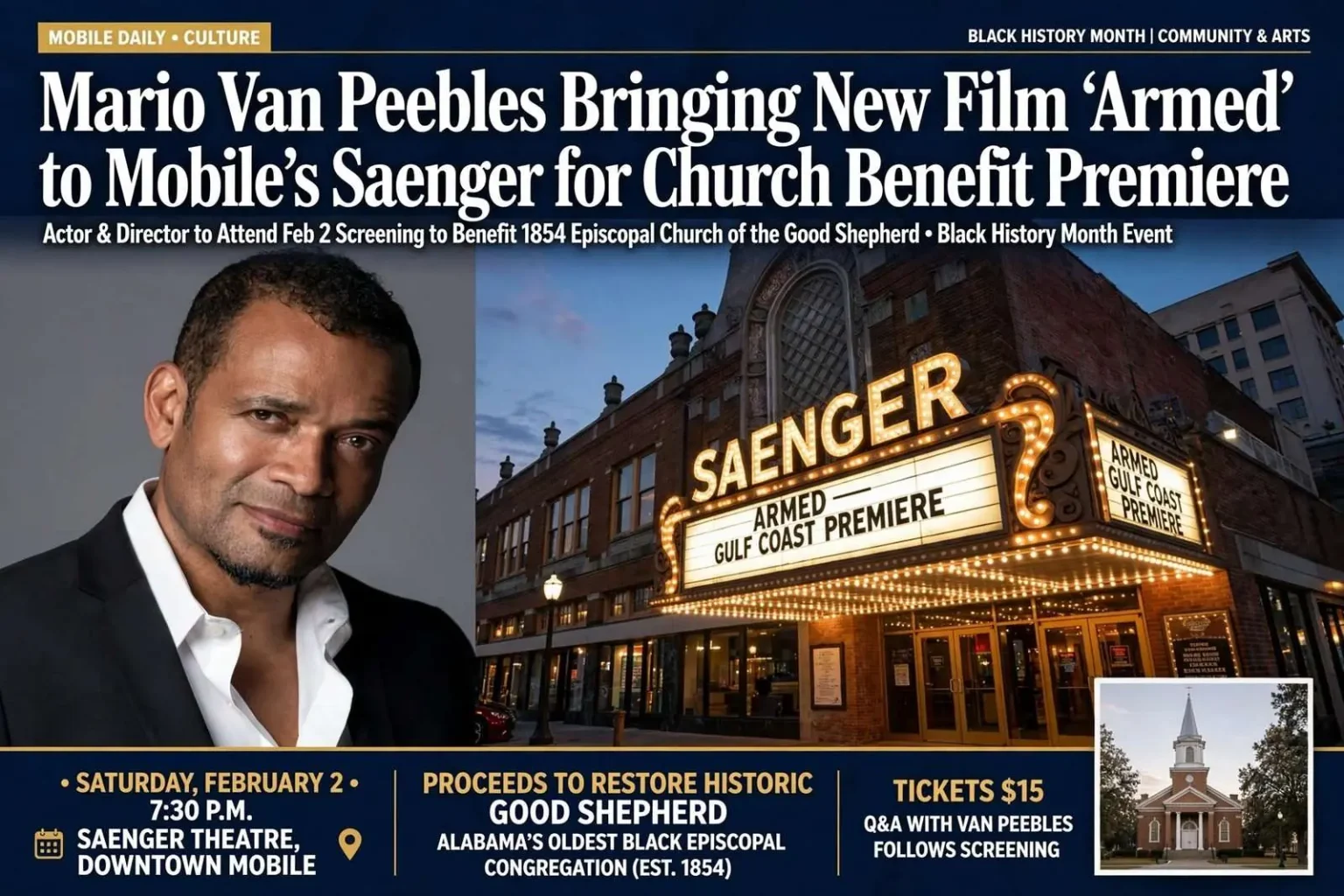
Actor and director Mario Van Peebles will be in downtown Mobile next month for the Gulf Coast premiere of his film Armed, with proceeds from the screening supporting the restoration of one of Alabama’s most historically significant Black congregations. The pairing of a Hollywood filmmaker with a 19th-century church restoration gives the event the feel of both a red-carpet night and a revival meeting, and organizers are counting on each to reinforce the other.
The premiere is set for Saturday, February 2 at 7:30 p.m. at the Saenger Theatre in downtown Mobile. Van Peebles will attend as guest of honor and take questions from the audience following the screening, giving ticket buyers a rare chance to quiz a working director about the film and the business behind it in the same room where the film plays. Broussard’s Piano Gallery is hosting the event.
The Saenger is a fitting stage for the occasion. Opened in the 1920s as a grand movie palace on Joachim Street and later restored as the city’s premier performing hall, the theater has spent recent decades at the center of downtown Mobile’s revival, hosting Broadway tours, concerts and film events. A Gulf Coast premiere staged there carries the glamour the organizers want while keeping the evening accessible at a $15 general admission ticket.
A Black History Month benefit
Organizers are staging the premiere as a Black History Month celebration, with proceeds directed to the restoration work and outreach ministry of the Episcopal Church of the Good Shepherd. The church, on Donald Street in the Toulminville community, was established in 1854 and is described as the oldest Black Episcopal congregation in Alabama—a title that places its founding a decade before emancipation and gives its surviving buildings and records documentary weight well beyond the neighborhood.
Toulminville, once a separate village absorbed by the growing city, has long been one of Mobile’s most historically significant Black communities, home to families whose stories run through the city’s Civil War, Reconstruction and civil rights eras. Good Shepherd’s buildings anchor that memory, and the restoration campaign aims to keep the congregation not just surviving but serving as a cultural institution—hence the deliberate pairing of the capital effort with music and the arts.
About the film
Armed stars William Fichtner, Ryan Guzman, Columbus Short and Jemma Dallender alongside Van Peebles, who also directs. The story follows Chief, played by Van Peebles, a former U.S. Marshal contending with personal setbacks and a health crisis that he comes to believe may point toward a larger conspiracy. The film gives its director a showy lead role as well as the back of the camera, a dual duty he has shouldered throughout a career that has consistently mixed acting, writing and directing.
Van Peebles carries one of American independent film’s most storied names. The son of pioneering director Melvin Van Peebles, he broke through as a director with New Jack City in 1991 and has worked steadily since across film and television, moving between studio projects and the independent arena where his family’s legacy was built. His Mobile audience will be watching a director equally comfortable discussing the craft of the frame and the business of getting a film made outside the studio machine.
Familiar ground for the director
Van Peebles has worked in Mobile before. He directed USS Indianapolis: Men of Courage, which was filmed in the city and starred Nicolas Cage, a production that brought naval-era drama and hundreds of crew and cast days to the local economy. The film dramatized the WWII cruiser whose sinking became one of the Navy’s worst disasters, and its Mobile shoot gave Van Peebles a working knowledge of the city’s film infrastructure—locations, crew depth and the local welcome that productions find when they come to the Gulf Coast.
His television credits include the remake of the miniseries Roots, featuring Forest Whitaker and Matthew Goode, along with episodes of Empire, The Last Ship, Sons of Anarchy, Lost, Damages and Boss. That resume spans network prestige drama, cable antiheroes and historical epics—a breadth that few working directors can match, and one reason his appearance in Mobile draws interest from film fans and students of the industry alike.
General admission tickets are $15 and go on sale at 10 a.m. Friday, January 18, at the Saenger box office. Organizers are betting the price point fills the house with a cross-section of the city—church members, film fans and downtown regulars—rather than a gala crowd, with the limited-ticket auxiliary events carrying the fundraising load.
Three nights of events
The Saenger premiere caps a three-night run of events built around Van Peebles’ visit. The weekend opens Thursday, January 31, with a black-tie gathering at Heron Lakes Country Club. On Friday night, a musical evening at the Episcopal Church of the Good Shepherd will debut a new high-end digital pipe organ the congregation acquired from Broussard Music in Mobile. The weekend also serves as the kickoff for the church’s rebranding and rebuilding effort, which organizers hope will make the historic congregation a focal point for arts and music in the community.
New details round out the lineup. Virtuoso organist Christopher Powell, a Juilliard-trained performer acclaimed as one of the finest young organists in the South, will headline Friday’s concert as featured performer on Broussard’s new Viscount Unico 300 Physis organ, with Van Peebles serving as master of ceremonies and a refreshments-and-meet-and-greet reception following the music. The instrument itself is a statement of intent: a state-of-the-art digital organ chosen to support both the congregation’s worship life and the concert programming that the rebuilding plan envisions.
At Thursday’s Heron Lakes Country Club dinner, attendees get a prime dinner followed by a presentation on the history of Black film in the United States, plus photo opportunities and interviews with Van Peebles. The program turns the black-tie evening into something closer to a seminar with a star—a history of an art form narrated by one of its working participants. Tickets for both events are limited, and organizers note Broussard’s Piano Gallery bills itself as the oldest music business on the Gulf Coast, a claim of longevity that fits the weekend’s theme of institutions worth preserving.
Taken together, the three nights sketch a strategy that goes beyond a single fundraiser. A church founded in 1854 cannot restore itself on Sunday collections alone, but it can reach new audiences by staging exactly the kind of weekend that gives people a reason to cross the city: a film premiere downtown, a concert in a historic sanctuary, and a dinner that educates as it raises money. If the model works, organizers say, the rebranded and rebuilt Good Shepherd could spend less time asking the community for help and more time giving the community a stage.
The Good Shepherd benefit also lands amid a broader conversation about historic Black churches and preservation in Alabama. Congregations established before the Civil War are vanishingly rare, and the buildings that house them often carry deferred maintenance measured in decades. Preservation advocates have increasingly argued that such churches deserve the same grant support and heritage attention that civilian landmarks receive, both for their architecture and for their role as the organizing spaces of Black community life—schools, meeting halls and safe harbors in eras when those functions were denied elsewhere. A documented founding date of 1854 puts Good Shepherd near the top of that list statewide.
The outreach ministry component of the campaign matters to Toulminville as well. Historic buildings, in the organizers’ framing, are means rather than ends: restored sanctuaries and halls are intended to host the programs—music education, arts events, community gatherings—that give a neighborhood institutions worth walking to. The Friday organ concert and the planned arts focus are previews of that intended use, designed to show donors and neighbors alike what the restored campus could be.
For the Saenger itself, the premiere continues its recent pattern of leveraging film events alongside its live bookings. Classic movie nights, premieres and director appearances have become part of the theater’s calendar, feeding the downtown nightlife economy that Mobile has worked to rebuild around Joachim Street and the surrounding blocks. A Saturday-night premiere with the director in person, followed by an audience question-and-answer session, is precisely the kind of programming that turns the theater from a rented hall into a destination.
Local film supporters will also read the weekend as another sign of Mobile’s growing relationship with the movie business. The USS Indianapolis production left behind crews and confidence, and visits like Van Peebles’ help maintain the relationships that decide where the next independent film shoots. A director who has already filmed in the city and returns voluntarily for a benefit is, in effect, a repeat customer giving the location a public endorsement.
As Black History Month programming goes, the weekend’s range—a Hollywood premiere, a Juilliard-trained organist, a history lecture over prime rib—covers more ground than most. What unites it is the destination institution: a congregation that has held together for more than a century and a half on Donald Street, now betting that its next chapter will be written with a restored building, a new organ, and a community that shows up when the lights go down.


