MAWSS: Online Service Requests Temporarily Down Amid System Upgrade
MAWSS says online service requests are temporarily unavailable during a system upgrade, and customers seeking additional water service should call Customer Service at (251) 694-3100.
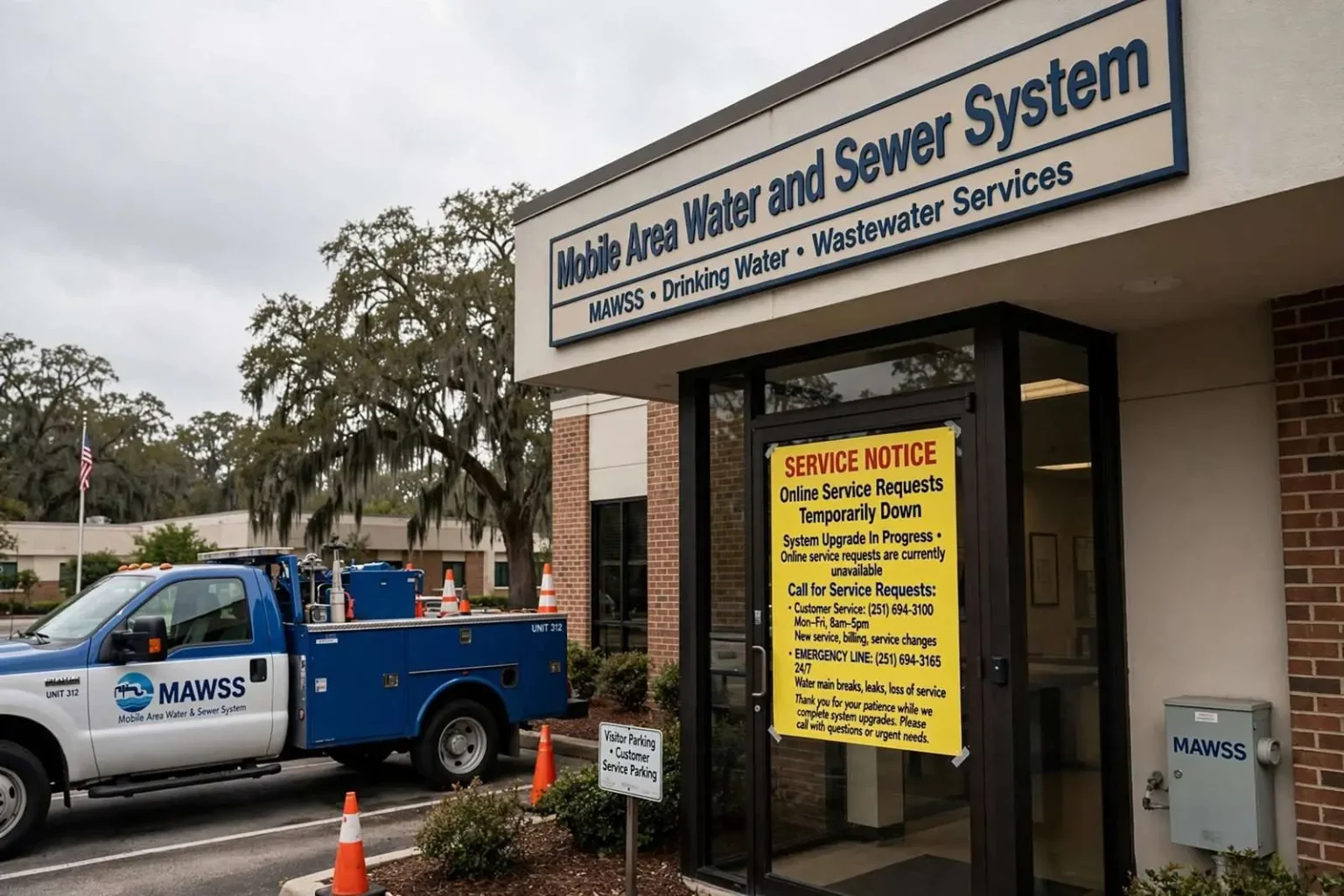
The Mobile Area Water and Sewer System (MAWSS) is asking customers to call rather than go online to request additional water service while the utility completes a system upgrade. Online service requests are currently unavailable, and MAWSS says the change is temporary while improvements are made to its request platform.
In the meantime, customers who need to establish additional service, such as turning on water at a second location, can call the MAWSS Customer Service team directly at (251) 694-3100. Customers with an urgent issue should call the utility’s emergency line at (251) 694-3165. MAWSS is thanking customers for their patience as the upgrade is completed.
The distinction between the two numbers matters for anyone who needs help quickly. The customer service line handles routine requests — new accounts, billing questions, service changes — and operates during business hours. The emergency line exists for active problems: main breaks, water pouring into a street, a sudden loss of service. Utilities like MAWSS ask customers to reserve emergency lines for true emergencies precisely so that a homeowner with a burst pipe at night is not stuck behind a queue of routine calls.
The Mobile Area Water and Sewer System serves customers across the city of Mobile and parts of Mobile County with drinking water, and operates the wastewater collection and treatment system for much of the same area. Its infrastructure includes wells, treatment facilities and hundreds of miles of mains and sewer lines, and its customer service operation handles the administrative traffic that keeps all of it matched to the people using it — accounts opened, deposits held, meters read and bills collected.
A system upgrade of the kind MAWSS is completing touches all of that at once. Request platforms sit on top of billing and account databases, and replacing or overhauling them means migrating customer records, testing the workflows that generate field orders, and making sure that a request submitted online produces the same work order, the same fee schedule and the same documentation trail as one taken over the phone. Rather than risk requests slipping through a half-migrated system, the utility has simply turned the online channel off and staffed the phones — an inconvenience for customers, but a controlled one.
What to Know About Requesting Additional Service
Requests to turn on water at an additional location can take 24 to 48 hours to process, according to MAWSS. The utility is cautioning that incomplete information on a request will delay processing, so customers are encouraged to have their account and property details ready before calling.
The 24-to-48-hour window surprises some customers, but it reflects the physical reality of the work. Turning on water at a property is not simply a keystroke: a service order must be generated, routed to a field technician, scheduled within a route, and completed at the meter — and the technician must confirm at the property that it is safe to open the valve. Customers planning a move, a rental turnover or a second account should build that processing time into their plans rather than expecting same-day service.
To establish an additional residential account, MAWSS may require a lease or deed for the property, and the customer must already have an active account in good standing. The utility says additional documentation, such as proof of service from another utility, may also be requested depending on the circumstances. Any new account must be under the same name as the customer’s existing account, and all bills must be mailed to the same address.
The documentation requirements serve the utility’s need to verify that the person requesting service actually holds an interest in the property. Water service, unlike electricity, can be tied to a property’s condition — a vacant house with water running can hide a leak for weeks and generate enormous bills and damage — so utilities are careful about who they connect and where. The lease or deed requirement establishes that interest; the same-name and same-address rules make the added account traceable to one responsible customer rather than scattering liability across households.
Customers whose current residential account is active and in good credit standing will not be required to pay a deposit for the additional service. However, a deposit of at least $100 will apply if the account has been delinquent in the past or is currently delinquent, if the customer requests a different mailing address, or if the customer already has more than three active accounts.
The deposit structure follows a logic utilities use across the country: past payment behavior predicts future payment behavior, so a customer in good standing gets the second account for free of collateral, while a history of delinquency, a split mailing address or an unusually large number of active accounts triggers a security deposit. The $100 floor protects the utility against the account being abandoned, and deposits are generally credited back to the customer’s bill after a record of on-time payments is established.
Customers with questions about how any of these rules apply to their situation should raise them on the same call that starts the request. Sorting out a deposit exemption, a documentation question or a mailing-address issue before a technician is dispatched saves everyone a second call, and during the upgrade period — when every request is being handled live by a service representative — the phone conversation is the one place the whole account picture can be reviewed at once.
Fees and Safety Requirements
MAWSS charges a $60 service fee for connections made the next business day or later. Because of insurance requirements meant to prevent flooding, someone must be present at the property to sign a service ticket confirming it is safe to turn on the water. If no one is available, MAWSS will install the meter but leave it in the “off” position, allowing the customer to turn the water on themselves at the meter afterward.
The presence requirement protects both parties. A technician who opens a valve at a house where no one is home cannot know whether the interior plumbing is intact — an open valve feeding a burst pipe or a disconnected fixture can flood a structure within minutes. Requiring a signature on the service ticket puts a responsible adult at the property to confirm fixtures are closed and the plumbing is ready, which is why the utility would rather leave the meter off and schedule a return than risk water damage it cannot see.
If MAWSS has to make an additional trip to connect or turn on service later, a separate $60 service charge will apply. The repeat-trip fee is the utility’s way of discouraging missed appointments while still leaving customers an escape hatch: the self-service option at the meter means a customer who cannot be present can still get water flowing the same day without paying twice.
Turning water on at the meter is a straightforward operation for most customers — the shutoff valve on the meter box in the right-of-way opens with a meter key or a suitable wrench — but MAWSS and other utilities caution against forcing a stuck valve or tampering with the meter itself, both of which can create damage and liability. When in doubt, scheduling the $60 service call is the cheaper option next to a broken meter or a flooded valve box, and field staff would rather make the trip than find out afterward that a DIY connection went wrong.
Business and commercial customers seeking additional service are directed to contact the MAWSS office directly rather than using the standard residential request process. Commercial accounts differ from residential ones in almost every dimension — meter sizing, demand charges, fire-line service, backflow prevention requirements — and the volumes involved justify a staffed review rather than a standardized request form. A restaurant adding a second location, for example, may need larger capacity, grease interceptor coordination and a different rate structure, none of which an automated residential workflow could handle. Business callers will generally be connected to a commercial service representative who can review the property’s needs before any technician is scheduled.
MAWSS serves residential and commercial customers throughout the Mobile area, providing both water and sewer service. Customers with questions about their account, an existing service request, or the ongoing system upgrade are encouraged to reach out to the Customer Service line during business hours.
For customers, the practical guidance during the upgrade window is straightforward: skip the website, call (251) 694-3100 for service requests, keep the emergency line at (251) 694-3165 for true emergencies, and have lease or deed information, account details and property information in hand before dialing. The utility says the online platform will return to service once the upgrade is complete, and the temporary shift to phone-based requests is part of building a system meant to make those same requests faster afterward.