MAWSS says wipes and grease are clogging Mobile sewers and costing customers millions
The Mobile Area Water and Sewer System is spending $1.5 million to clear disposable wipes and grease from its sewers, and customers end up paying for it.
The Mobile Area Water and Sewer System is spending big to clear items from its pipes that should never have been flushed in the first place. At a single MAWSS lift station, the utility is designing a roughly $1.5 million project to screen out the debris that customers are sending through the sewer, according to the utility. The work targets a problem that has grown steadily across the country as disposable products have become fixtures of everyday bathrooms and kitchens, and Mobile has found itself on the front lines of an issue the wastewater industry has come to call a plumbing pandemic.
The industry calls it a plumbing pandemic, and disposable wipes are at the forefront. Grease is the other major culprit, and the two work together to clog lines. On their own, each can slow a sewer line; combined, they form dense, mat-like masses that resist the normal flow of wastewater and strain every pump and pipe behind them. Wipes marketed as flushable do not break apart the way toilet paper does. They hold together as they travel through the system, and once they catch on any rough spot inside a pipe they stay there, collecting more material with every day that passes.
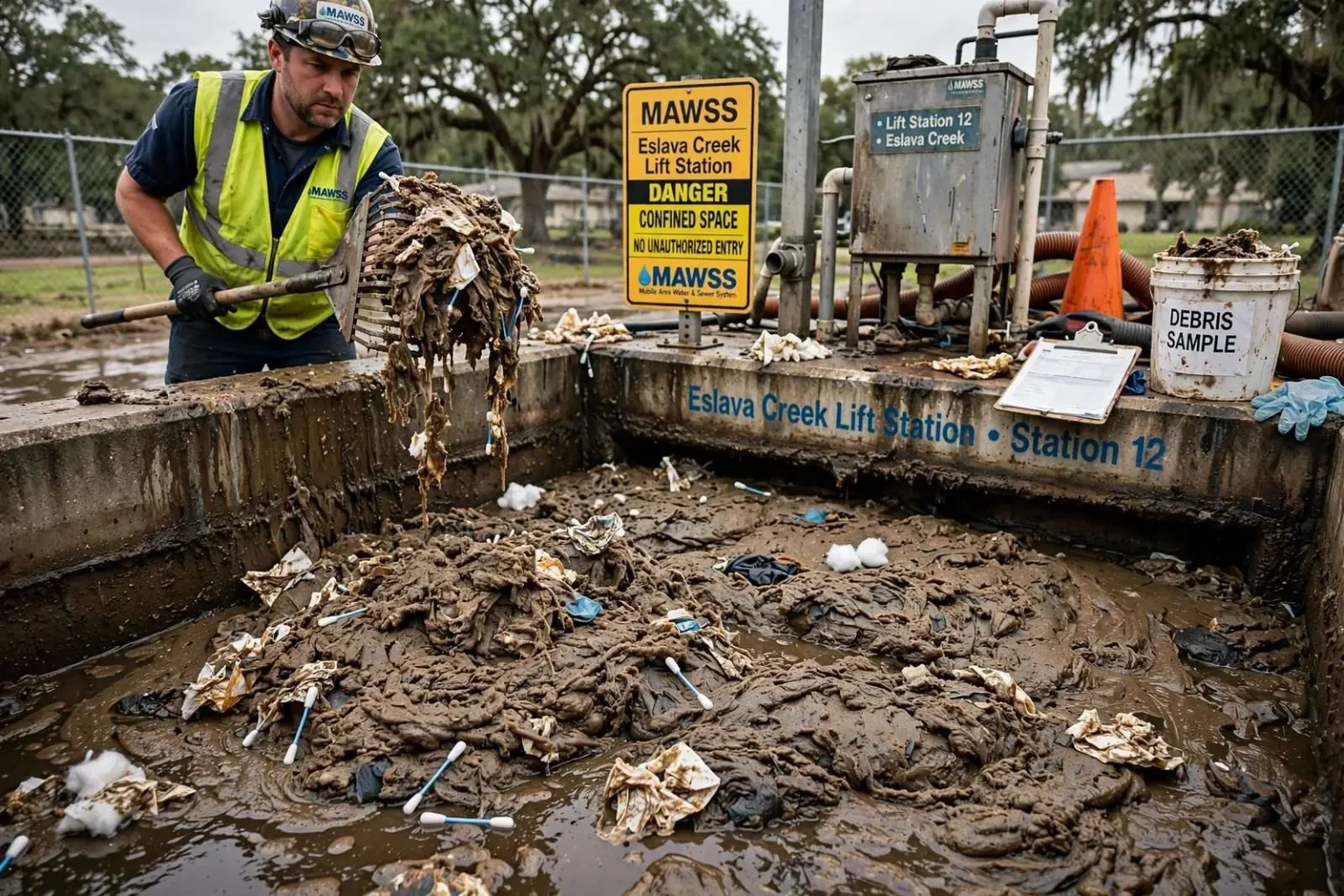
The clearest illustration of the problem sits at the Eslava Creek MAWSS lift station, one of the pumping facilities that move wastewater from low-lying parts of Mobile toward treatment. Lift stations are the unseen workhorses of any sewer network: gravity carries wastewater only so far, and pumps must lift it over high ground and on toward the treatment plant. That makes them especially vulnerable to anything customers send down the drain that the system was never designed to handle, because the debris arrives at the station and gathers there faster than it can pass through.
At Eslava Creek, what looks from above like a routine holding pool for roughly 6 million gallons of sanitary sewer water is actually capped by a hardened mat of grease and debris six to eight inches thick, sitting atop roughly 12 feet of wastewater. The surface layer is thick enough and uniform enough to disguise what lies beneath it, and it rebuilds continuously as material flows in from homes and businesses across the service area. It is the kind of buildup that no single household would ever notice from its own plumbing, but that becomes unmistakable when thousands of drains feed into the same line.
Terry Herman, lift station supervisor, said employees reeled out a sample showing the gunk chunking through the system. “It looks like dirt, but it’s grease and debris,” Herman said. “It’s created a mat and below that’s about 12 feet of actual waste water.”
The discovery puts a face on a problem that utilities usually describe only in dollar figures. Every wipe, cotton ball and spoonful of grease that goes down a drain in Mobile eventually has to go somewhere, and for the crews responsible for keeping the system moving, that somewhere is increasingly a lift station wet well that has to be dredged by hand.
What Crews Are Finding in the Pipes
A closer look at the sample revealed grease, cotton balls, Q-tips, condoms, toothbrushes, towels and disposable wipes. Herman said crews also find syringes, feminine products, hair, fishing line, coke bottles and washrags. None of those items belong in a sewer, and each one that arrives at a lift station adds to a buildup that crews must physically remove before it damages pumps or blocks the line entirely. Some of the items arrive intact after traveling through hundreds of feet of pipe, a sign of how durable the modern disposable products that flood the market really are.
The combination of wipes and grease is what turns an annoyance into a crisis. “When a disposable wipe is flushed and it catches on or snags on the inside of a pipe then fats and grease leach on to it and then you have a perpetuating snowball effect,” Herman said. A single snagged wipe becomes a framework. Grease poured down a kitchen drain is liquid while warm, but it cools and hardens as it moves through the line, coating whatever it touches. When it meets a wipe already lodged in the pipe, it soaks into the fabric and sets, and the mass grows from there.
The result is a structure that behaves less like wastewater residue and more like a solid obstruction. Crews in cities across the country have given these formations a nickname — fatbergs — and utilities have pulled masses the size of buses out of their systems. The mechanics are the same everywhere: a fabric base, a grease binder, and a steady supply of new material arriving from thousands of kitchens and bathrooms every day.
For MAWSS, the cleanup is not a one-time job. Crews already vacuum the mat of debris and grease by hand twice a year. The work is slow, unpleasant and expensive, and it has to be repeated as long as the material keeps arriving, which means as long as customers keep flushing wipes and pouring grease down the drain. Between cleanings, the buildup continues to grow, narrowing the space available for wastewater to flow and forcing pumps to work harder than they were designed to.
The price tag is substantial. A single station will cost $1.5 million to try to remove the rags and debris coming to it, MAWSS said. Multiply that across the lift stations serving Mobile’s neighborhoods, and the scale of the problem becomes clear. Every dollar spent on dredging rags out of a wet well is a dollar not spent on pipes, treatment capacity or system improvements, and the money has to come from somewhere.
“The end result is it’s the customer that has to pay for maintenance of what we do,” Herman said. Utility rates reflect the cost of operating and maintaining the system, and unnecessary maintenance driven by avoidable clogs pushes those costs upward for every household and business connected to the sewer, including the ones that flush nothing they should not.
MAWSS Response: Screens and a Push to Change Habits
MAWSS is in the design phase of screens for the lift station that would stop the mat before it forms — the roughly $1.5 million project for that one station. Screening systems intercept debris as wastewater enters a station, catching rags and wipes before they can reach the pumps and accumulate in the wet well. The screens have to be cleaned regularly themselves, but that is a far simpler and cheaper task than removing a thick mat of grease-soaked debris, and it protects the pumping equipment that keeps wastewater moving.
Engineering fixes, however, only catch the problem after it leaves the customer’s hands. The utility has also launched a program called “It’s Easy to be Ungreasy,” where customers can pick up a free grease container at select locations and return it when full. The idea is simple: collect used cooking grease in a sealed container instead of pouring it down the sink, then drop the filled container back off so the grease can be disposed of properly. It removes the single largest contributor to the grease half of the clog equation without asking anyone to change how they cook, only how they dispose of what is left behind.
The wipes half of the equation comes down to a message utilities have been repeating for years: the toilet is not a trash can. Only toilet paper and human waste should be flushed. Products labeled flushable, including many wipes, may clear the bowl, but they do not break down in the sewer system the way toilet paper does, and industry testing has repeatedly shown the difference once both materials are agitated in water. Cotton balls, Q-tips, dental floss, feminine products, paper towels and medications belong in the garbage as well.
For Mobile residents, the stakes are both financial and practical. A clogged utility line can push wastewater back toward homes, and a failed lift station can affect an entire drainage basin until crews can restore service. The mat at Eslava Creek is dramatic, but the same physics that built it operates at a smaller scale in every pipe between a bathroom and a lift station, and the first blockage a homeowner experiences is usually in the service line they are responsible for themselves.
The twice-yearly vacuuming strips out what has already accumulated, and the $1.5 million screening project in design is meant to keep the problem from rebuilding at the same pace. Neither measure works without cooperation from the tens of thousands of households whose habits created the buildup in the first place. Utilities elsewhere that have combined infrastructure fixes with public education campaigns have reported gradual improvement, but the cycle only breaks when the material stops arriving at the station.
Until then, crews will keep vacuuming the mat by hand, twice a year, and the cost of that labor will keep flowing back to the customers through their rates. The math is straightforward: a wipe in the trash costs a household nothing extra, while a wipe in the toilet costs the whole community a share of a multimillion-dollar cleanup. MAWSS officials hope that as more residents see what is actually accumulating beneath the surface of their sewer system, the message that it is easy to be ungreasy — and even easier not to flush the wipes — will finally take hold.