
Mayor teases electric scooters for Downtown Mobile in Christmas Day post
Mayor Sandy Stimpson teased shareable electric scooters for Downtown Mobile in a Christmas post. The city confirmed excitement but released no launch.
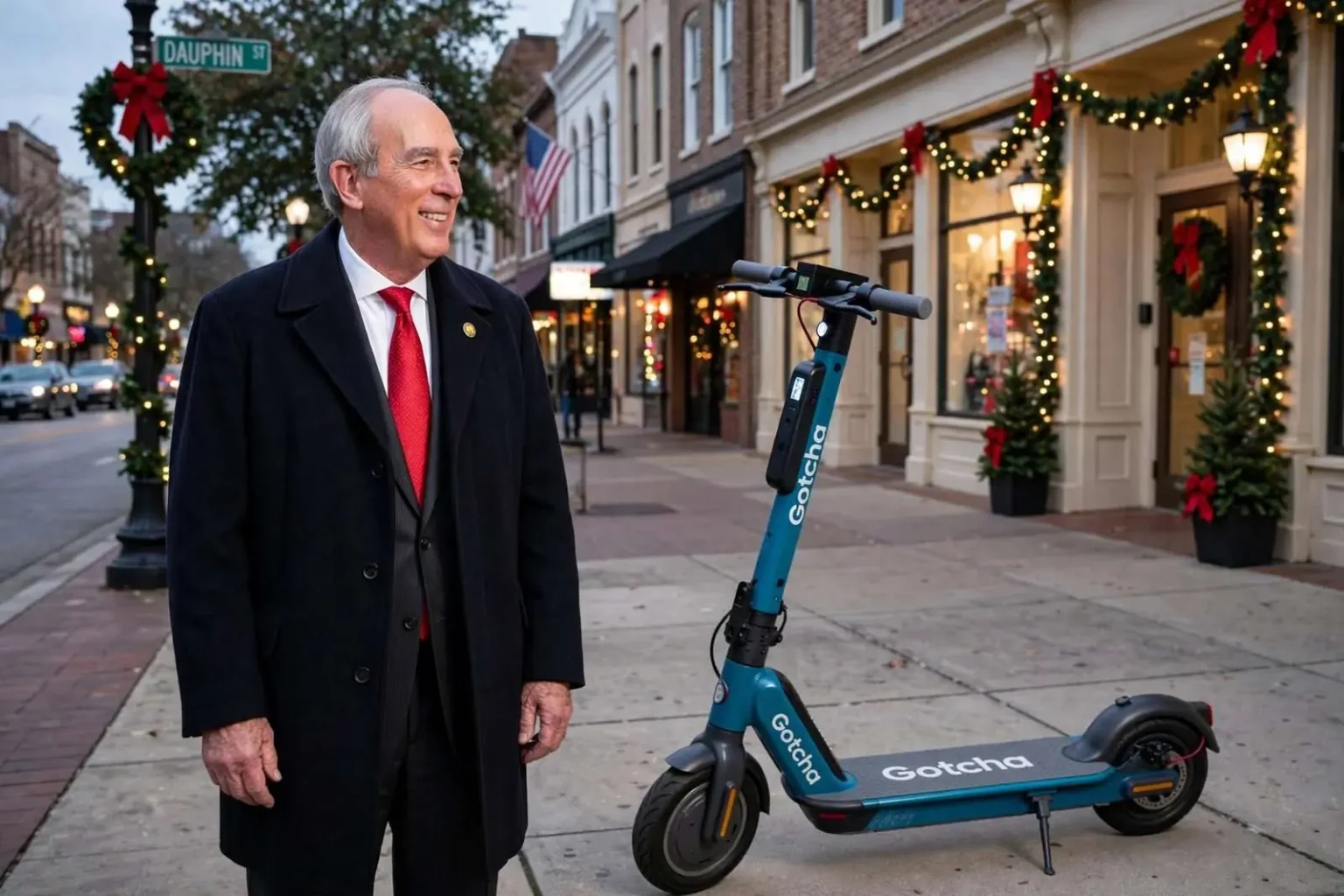
Downtown Mobile appears to be getting shareable electric scooters, based on a Christmas Day social media post from the mayor’s office. Mayor Sandy Stimpson posted a photo of an electric scooter to Facebook and Twitter on Christmas with the caption: “We must have been very good this year. Santa’s sending electric scooters to Downtown Mobile!”
The post was playful, but it confirmed a policy direction the city had been weighing for months: bringing dockless shared scooters to the streets and sidewalks of the central business district, where short trips between offices, restaurants and residences dominate the transportation picture.
City Confirms Enthusiasm, if Not Details
Asked about the apparent rollout, city spokesperson Jen Zoghby confirmed the city was on board with the addition. “We are excited, and we look forward to bringing another fun and environmentally friendly mode of transportation to Mobile,” Zoghby said.
What the city did not release was anything a rider would actually need to know. The announcement included no launch date, no fleet size and no pricing, leaving open the questions that determine how a shared-mobility system actually functions in practice — how many scooters will be on the street, what a ride will cost, and where users will be able to pick them up and leave them.
The scooter pictured in the mayor’s posts belongs to Gotcha, a shared-mobility operator that was already running in Alabama at the time, including on the Auburn University and University of Alabama campuses. Gotcha built its early business on college campuses, where dockless bikes and scooters serve students moving between dorms, classes and parking lots, and the company had been expanding into municipal systems in small and mid-sized cities.
Choosing an operator with existing Alabama experience lowers the execution risk for Mobile. The company already understood the state’s regulatory environment and had equipment positioned nearby, shortening the runway between an announcement and actual scooters on the sidewalk.
A Second Try at Shared Mobility
The scooters would arrive downtown after an earlier shared-mobility effort came and went. Lime’s dockless bike program ended its Mobile operation the previous January, leaving the city without a shared two-wheel option through most of the year. The departure was a familiar story nationally: dockless bike companies poured into cities with little notice, then pulled out just as quickly as their funding and business models wobbled.
The Lime exit taught Mobile and its peers a lesson about the industry’s volatility. A city that builds its transportation expectations around a private operator’s fleet is one corporate decision away from losing it, and the operators that survived the industry’s shakeout were the ones that diversified — which is how scooters, and companies like Gotcha, filled the space bikes left behind.
Cities across the Gulf Coast and the Southeast spent that period working out how to handle dockless scooters, which tend to arrive faster than the regulations governing them. A scooter can be dropped on a sidewalk the day a company launches; a permitting ordinance typically takes months of committee meetings. The gap between the two is where most of the friction happens, and nearly every city that has hosted dockless devices has a story about the season its sidewalks looked like an obstacle course.
The Questions Every City Has to Answer
The recurring questions for local governments have been where riders may operate — street, bike lane or sidewalk — where devices may be parked, and who is responsible for clearing scooters left blocking a sidewalk or storefront. Each answer shapes how the public experiences the system, and each has cost other cities a round of complaints before it was settled.
Where scooters may be ridden is primarily a safety question. Motorists and scooter riders share the street uneasily, pedestrians claim the sidewalk, and many cities split the difference by directing scooters into bike lanes where they exist. In districts without lane markings, the rules depend on enforcement that is hard to sustain, which is why operator education and app-based prompts have become the usual tools.
Where scooters may be parked determines whether the devices feel like a convenience or a nuisance. Dockless systems get their name from the lack of fixed racks, and the clutter that results — scooters tipped over on corners, lined up across doorways, floating into tree wells — is the most common complaint cities receive. Operators respond with designated parking zones, incentives for riders to end trips in approved spots, and crews that redistribute and right the devices daily.
Responsibility for clearing blocked scooters is usually written into the permit agreement. Well-crafted agreements give the city a way to have an obstructing device moved within hours and to fine operators who fail to comply, turning sidewalk clutter from a public grievance into a contractual matter.
For the operators, downtown density translates directly into utilization. A scooter earns money when it is ridden, and a device parked outside an office tower at lunchtime, a restaurant row at dinnertime and a parade route on Mardi Gras can log several paid trips a day. Sparse suburban deployments, by contrast, leave devices idle, which is why operators concentrate fleets in the urban core and why the mayor’s announcement pointed specifically at downtown rather than the city at large.
Learning From Other Cities’ Missteps
Mobile has the advantage of watching a decade of dockless rollouts elsewhere. In city after city, the pattern repeated itself: an operator arrived unannounced, deployment outpaced the rules, complaints piled up about sidewalk clutter and reckless riding, and the city responded with an ordinance drafted in reaction rather than in advance. The cities that avoided the turbulence — and there are several — were the ones that wrote their permitting terms first and let operators compete to meet them.
The usual elements of a modern agreement include caps on fleet size that grow with performance, geographic limits on where devices may be left, data-sharing requirements so the city can see where rides actually happen, and indemnification language covering liability when a rider collides with a pedestrian. Some cities add equity provisions, requiring operators to deploy a share of their fleet in neighborhoods outside the entertainment district.
None of Mobile’s specific terms are public, and the city has not said whether it will run a competitive process or negotiate with a single operator. But the sequence matters less than the substance: an agreement that anticipates the failure modes other cities lived through costs the same as one that does not, and it saves a year of complaints later.
Why Downtown Is the Right Test Market
Downtown Mobile’s compact street grid, with concentrated restaurants, offices and event venues within a short radius, is the kind of environment where operators typically see the strongest demand, particularly around Mardi Gras and other events that draw heavy foot traffic. Short trips are exactly what scooters are built for — distances too long to walk comfortably, too short to justify parking a car twice.
The downtown geography does much of the work on its own. Government Street, Dauphin Street and the surrounding grid put residences, workplaces, courts, restaurants and entertainment venues within a mile of one another, and parking downtown is limited enough that any alternative to driving a few blocks has value. Mardi Gras, with its parade routes and street closures, multiplies that effect — visitors parking once and moving around on foot or by scooter for the rest of the night.
What Riders and Businesses Can Expect
When the rollout happens, riders will use a smartphone app to locate a scooter, unlock it with a scan and pay by the minute, then leave it at their destination for the next user. Pricing in peer cities has generally followed a formula of a small unlock fee plus a per-minute rate, though Mobile’s actual rates will not be known until the city and its operator finalize their agreement.
For downtown businesses, the expected effect is more foot traffic that stays longer. Transportation options that make it easy to hop between venues spread customers beyond the block where they parked, and districts that have added shared scooters have generally reported the devices as a net positive for adjacent retail — provided the parking question is handled.
The environmental case is modest but real. Electric scooters replace short car trips, the kind that produce outsized emissions per mile because engines run cold, and they add no tailpipe emissions at all. Whether the environmental benefit materializes depends on what scooters replace — car trips versus walks — which is why operators and cities alike pitch them as part of a transportation mix rather than a solution on their own.
The city’s announcement stops short of promising any of this. What it does promise is a direction: Mobile intends to have shared electric scooters downtown, with an operator that knows the state, in a district whose layout suits them. The launch date, the fleet and the fine print will come later — but the mayor has already told the city what Santa is bringing.


