MCPSS Sees Sharp Rise in A and B School Report Card Grades
Mobile County Public School System posted broad gains on the state's latest school report cards, with more A and B schools and fewer D's and F's than a year earlier, including turnaround stories at Scarborough Middle School and perfect scores at two magnet schools.
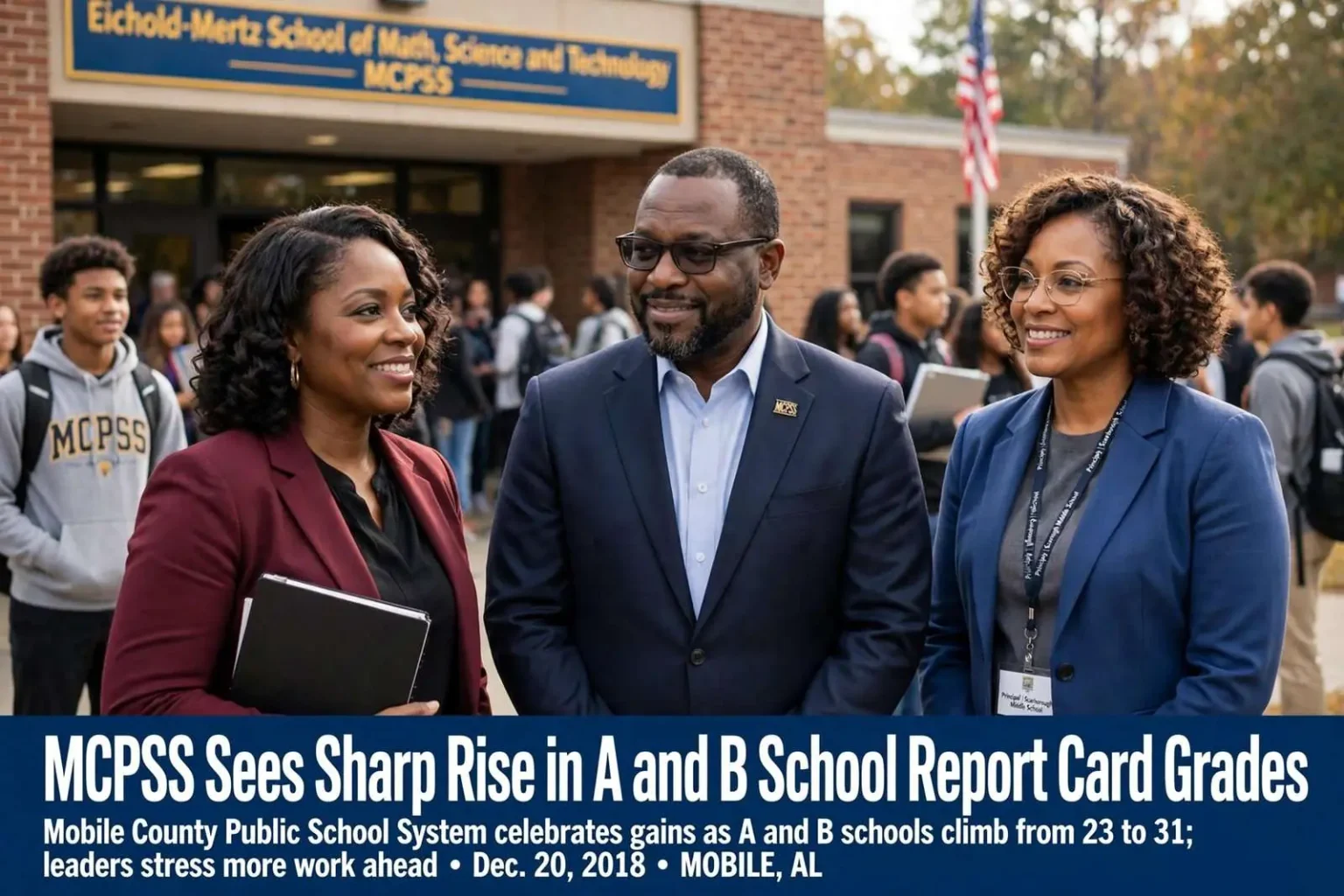
Mobile County Public School System leaders spent only a brief moment celebrating this year’s state report card results before turning their attention back to the classroom. Superintendent Chresal Threadgill said the gains posted across the district are encouraging, but not an excuse to ease up.
“These accomplishments are great, but it means it’s time for us to work harder,” Threadgill said.
The results come from the Alabama State Department of Education’s annual school report cards, which assign each public school a letter grade of A through F. This is only the second year the state has issued the grades, and the latest round shows broad improvement both statewide and within Mobile County.
Elementary school grades are built from state standardized test scores along with measures such as student growth from one semester to the next and attendance. High schools are evaluated using those same factors, plus graduation rates and the number of students who meet state benchmarks for college and career readiness.
Last year, 16 MCPSS schools received a D and seven received an F on their report cards. School officials at the time noted that those scores were based in part on the ACT Aspire exam, a test the state stopped using in 2017 after determining it was not properly aligned with Alabama’s curriculum standards.
This year’s grades instead relied on the Scantron assessment, given to certain elementary and middle school students, and the ACT college entrance exam, which all Alabama juniors have been required to take since 2014.
Under that new testing framework, MCPSS saw its number of A and B schools climb from 23 to 31, while the number of schools receiving a D or F fell from 16 to 10. Only one school in the district received an F this year, and four of the seven schools that failed last year improved by two full letter grades to earn an overall C.
Council Traditional School and the Eichold-Mertz School of Math, Science and Technology, both magnet programs, each scored a perfect 100 on their report cards. Only four schools statewide achieved a perfect score, and MCPSS was the only district in Alabama with more than one school reaching that mark.
Threadgill credited the improvement to leadership at the school level and the work of teachers in the classroom, while acknowledging that a system that has struggled with multiple low-performing schools in recent years still has ground to cover.
“We’re going to celebrate these results just one day, then it’s back to work,” Threadgill said on the day the scores were released. “Our kids deserve, as I often say, 110 percent each and every day. These improvements, to me, mean that our kids are capable. It signifies, to me, that our students and our faculty and staff can and will continue rising to higher expectations.”
Eichold-Mertz Holds Its Perfect Score
At Eichold-Mertz, the challenge this year was less about improving and more about maintaining an already high bar, since the school also earned a perfect 100 on last year’s report card.
The school serves about 600 students in grades K-5 and is one of seven magnet programs in the MCPSS system, which have historically ranked among its highest-performing schools. Magnet schools are open to all students in the district, though enrollment is decided by lottery and students must meet certain entrance requirements. The Denton Magnet School of Technology was the only MCPSS magnet program to score below an A this year; Denton was converted to a magnet school only two years ago after a long stretch of declining enrollment and low standardized test scores.
Eichold-Mertz Principal Michelle DuBose Adams attributed the school’s consistency to “hard work and high expectations” not just for teachers and staff, but for students and their families as well.
“One of the first people I go to each year is the parents, and if my parents say that the grandma is keeping that child, then I’m calling grandma,” Adams said. “Some of the teachers even started having parents sign contracts stating that they know there’s a certain project due.”
Adams said the school also works to bring parents into the instructional process, with teachers sometimes recording videos explaining specific classroom concepts or walking families through timelines for upcoming projects so they can better support their children at home.
The school leans heavily on collecting and analyzing student testing data, according to Adams. Like other MCPSS schools, Eichold-Mertz administers universal screening assessments in reading and math, and staff coordinate with feeder elementary schools to understand how incoming students are performing even before they arrive on campus.
Combined with teachers’ daily observations in the classroom, that data helps identify individual students’ strengths and weaknesses and allows administrators to use what Adams calls “creative scheduling” to pair struggling students with teachers who specialize in a particular subject. She compared the process to a visit to the doctor’s office.
“Before they do anything else, they’ve got to do a couple of tests. We do a lot of that,” Adams said. “When I find out what your strengths or weaknesses are, whether they’re in math or reading, I begin to write a prescription for you with certain teachers. I’m going to make sure you get paired up with them sometime during the day so that you can benefit from what they have to give.”
Adams said strong test scores over several years have earned Eichold-Mertz some flexibility to try new approaches, but she also credited Threadgill for recognizing that “every school has a different personality” and different needs.
Scarborough’s Turnaround From a ‘Failing School’
Threadgill was more blunt when discussing the academic history at Scarborough Middle School, calling it “a failing school for many, many years.” The school has appeared on the state’s list of schools designated as failing under the Alabama Accountability Act in multiple consecutive years.
In 2016, the Mobile County school board voted to reconstitute Scarborough, a process that brought in an entirely new staff, significantly increased the number of teachers and offered financial incentives to attract educators to hard-to-staff subject areas. When report cards were issued for the 2016-2017 school year, Scarborough received an F, though those scores reflected some measurements taken before the reconstitution took effect.
After two full years under the new model, results released in late December show significant gains. Scarborough’s overall score jumped from 50 percent to 71 percent, earning the school an overall C. That increase was second only to Booker T. Washington Middle School, which posted the largest gain of any MCPSS school with a 22-point increase from 2017 to 2018.
Andrea Dennis, who spent 18 years at Theodore High School before being named Scarborough’s principal in 2016, said some of the earliest and most visible changes after the transition included smaller class sizes and better access to technology.
Inside the classroom, teaching strategies changed as well. Scarborough teachers now work in teams organized by the grade level they teach rather than by subject, which Dennis said has encouraged more collaboration around how to reach specific students rather than specific content areas.
Dennis said the staffing overhaul was about more than adding people to the building. She credited student progress to the relationships students have built with teachers, administrators and counselors, made possible by greater staff stability and less turnover since 2016.
Building Trust With Students and Families
“It’s not just the content we have to focus on,” Dennis said. “I need people who are empathetic to what students are going through. It may be cliché to say, ‘they need to know you care,’ but they absolutely do. All students don’t come from the same households. They have challenges outside of school that filter into school, and we have to have people who are ready to address all of that.”
One of the staff’s earliest goals, Dennis said, was getting students and parents to buy into the transition and take ownership of the school’s performance. Over the past three years, she said, parental participation at Scarborough “has increased tremendously.”
“I spent my entire first year here at the school just building the relationships with parents and getting them to trust this process. They’d seen different principals and administrations come and go, and they’d also seen the results,” Dennis said. “We needed them to be involved, and not every parent is involved still, but every parent isn’t involved at any school.”
Like Eichold-Mertz, Scarborough leans heavily on student data, but the school has also made a point of being transparent with students about how they and the school overall are performing. Assistant Principal Keshia Barnett said that openness is meant to build “a collective ownership” among students rather than make any one student feel ahead of or behind classmates.
“We’ve established a culture here where it’s OK not to be at a certain level yet. You are where you are, and we’re going to keep pushing you,” Barnett said. “It’s almost like a cheerleading section. It’s a whole school moving forward together.”
Project Smart Extends Learning After School
Dennis pointed to an after-school and summer learning program called Project Smart as another major factor in Scarborough’s turnaround. The program has been funded for the past two years by a $450,000 competitive grant the school won in 2017.
Tivella Davis, an instructional specialist who coordinates Project Smart, said the grant allows Scarborough to offer two hours of academic support and enrichment activities after school at no cost to students, along with additional development opportunities during the summer.
Electives offered through the program include archery, coding and a music production course set up by Assistant Principal Luther Davis that requires software the school likely could not have afforded without the grant. Several students have since written and recorded an original song about Project Smart.
The program has also allowed Scarborough to offer targeted instruction for students who are struggling in specific areas while providing ACT preparation for students who are ahead academically. Some of the school’s higher-performing sixth, seventh and eighth graders are scheduled to take the ACT next month.
“Students have really been receptive to it. One thing we do here, teachers and students, is set goals,” Davis said. “We don’t have a mindset of ‘they can’t achieve’ or can’t do something. We know we have students on this campus performing at a high school level right now, and we’re making sure they’re exposed to curriculum and material at that level so they can continue to grow.”
Shifting the Narrative for Scarborough’s Students
Dennis said she is proud of the progress made by her leadership team and Scarborough’s teachers over the past two and a half years, but the celebration surrounding the school’s C grade did not last long. Like Threadgill, she said she has no intention of settling for average.
Classes resumed as usual when students returned to school on Jan. 7, and Dennis said the culture at Scarborough has shifted in a way that motivates students to help change the school’s narrative. Part of that motivation, she said, stems from the “failing” label the school still carries under the Alabama Accountability Act.
“When I first walked into this school, I met with a group of sixth graders and asked them what it meant to be at a failing school, and the responses I got included: ‘It means we’re bad,’ and ‘It means we’re dumb’ or ‘it means we’re stupid,’” Dennis said. “I don’t think the people who assign these labels really understand how children can internalize it and what it does to the psyche of the children and the community when they just accept: This is what we are.”
“It’s very important for us to try to get rid of that label for this school, for this community and for our children to be able to feel pride in their school and in themselves,” Dennis added.