A Mobilian Takes Over Griffith’s Office After the Staff Walks Out
Michael Galloway, a Mobile native who worked for Sonny Callahan and Jo Bonner, became chief of staff to Rep. Parker Griffith days after the congressman's entire staff resigned over his party switch.
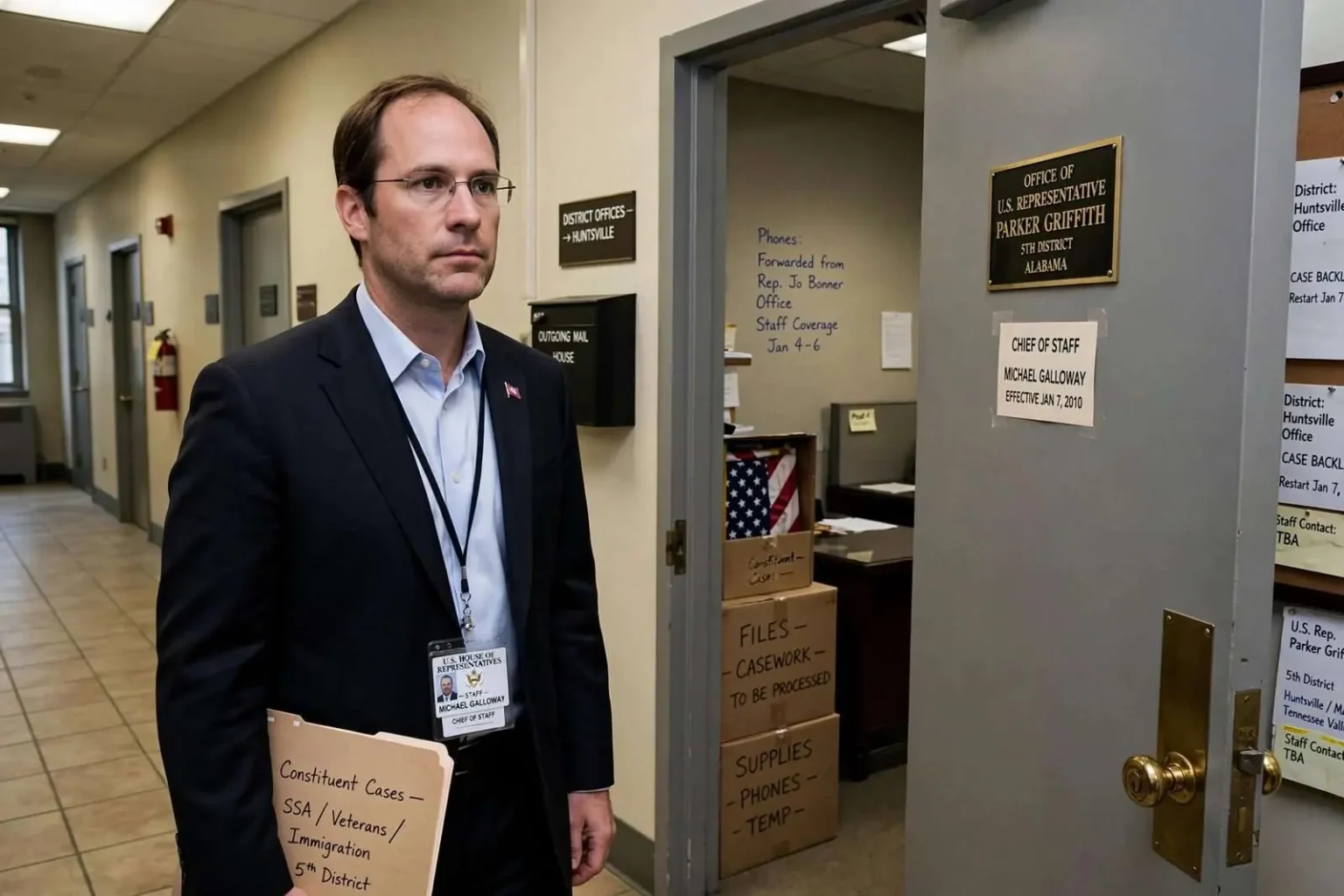
Michael Galloway, a Mobile native and veteran of two South Alabama congressional offices, went to work Thursday as chief of staff to U.S. Rep. Parker Griffith — taking over an operation that, a week earlier, had almost no one left in it. Griffith’s entire staff resigned en masse on Jan. 4, days after the Huntsville congressman announced he was leaving the Democratic Party to become a Republican. For a period, staffers in the Washington office of Rep. Jo Bonner of Mobile pitched in to answer the 5th District’s phones, keeping constituent calls and routine business moving while Griffith searched for a replacement team.
A congressional office is a small but demanding enterprise. The Washington operation handles legislation, votes and committee work, while district offices in Huntsville and the Tennessee Valley manage casework for thousands of constituents — Social Security disputes, veterans’ benefits, immigration questions and federal grant requests. The chief of staff supervises the Washington and district staffs, shapes the member’s schedule, and serves as the office’s principal contact with other offices and agencies.
Staff turnover always follows a party switch, but the scale of the Jan. 4 resignation was the striking part. Congressional staffs are, as a rule, intensely loyal to the member they serve,. a sitting member of Congress with a district of roughly 650,000 people and no staff of his own.
Who Galloway is
Galloway previously served on the staffs of former U.S. Rep. H.L. “Sonny” Callahan and of Bonner, Callahan’s successor in Alabama’s 1st Congressional District. The 1st District, anchored in Mobile, has for decades been a training ground for much of Alabama’s congressional staff talent, and Galloway came up through exactly that pipeline. He learned the mechanics of a Republican House office at a time when the Alabama delegation’s Republican side was building its institutional depth, first under Callahan and then under Bonner.
Most recently, he resigned from MITA, a Washington-area political consulting firm, to take the new assignment. Galloway took the job knowing the office he was joining had just been rebuilt from nothing and that its member would face a difficult primary in a matter of months.
He is the son of Mobile attorney Bob Galloway and his wife, Annie. In a state where political hiring runs on relationships, the hire was read as the Mobile establishment vouching for one of its own in an office that needed stability fast.
Why Mobile ended up staffing Huntsville
The mass resignation was an unusually complete repudiation. It reflected how personally Griffith’s Democratic staff took the change, and it left the congressman with a district of roughly 650,000 people and no one to run his operation. The vacuum had to be filled quickly, and it was filled from the only place available: the Republican network that Griffith had just joined. In Alabama, that network’s most experienced congressional hands were concentrated in the delegation’s Republican offices, and the deepest bench of them belonged to the 1st District, where Callahan had served for two decades before Bonner succeeded him in 2003.
So a Mobilian went to Huntsville, in a manner of speaking — running a north Alabama congressman’s office from Washington, hired because he knew how a Republican House office works and because the people who vouched for him were Bonner’s people. The arrangement made practical sense. Griffith needed someone who could restore casework, appropriations requests and constituent service within days, not weeks, and the fastest route to that was hiring from the delegation’s established Republican staff corps rather than searching the 5th District’s local talent pool for someone new to Washington.
The hire told Alabama Republicans something about Griffith. A party switcher’s first personnel decisions are read closely, and choosing a chief of staff from within the establishment of the state’s most reliably Republican congressional delegation was a signal of intent — that he meant to be a functioning Republican rather than an independent operator wearing a new label. In the weeks after the switch, Griffith’s every move was evaluated by a Republican electorate that had watched him run as a Democrat in 2008, and staffing was the most tangible test available.
It did not persuade everyone. Griffith faced a serious Republican primary challenge from Mo Brooks, a Madison County commissioner and former state legislator, and the criticism from Republicans in the weeks after the switch had been notably cool. Party officials and activists in the Tennessee Valley questioned how a member could change parties without facing the voters, and several prominent Republicans declined to clear the field for the new arrival. One veteran Alabama Republican, asked about the congressman’s sincerity, said that checking out his staff was really all anyone needed to know.
Griffith lost the June 1 primary to Brooks, ending the experiment almost before it had begun. Brooks went on to win the seat outright that fall, beginning a long tenure that would make the 5th District one of the most reliably Republican in the state.
Galloway’s tenure in the office was, in consequence, brief — a footnote to one of the shortest and strangest congressional careers in modern Alabama history, a single term spanning parts of two parties.
The political meaning of the switch
Griffith’s decision to change parties came at a moment when Alabama’s congressional delegation was completing its transformation into an all-Republican body. Every other member of the delegation from the state’s six other districts had already consolidated under the Republican banner, and Griffith — a Democrat who had publicly considered his options for months — concluded that his path to survival ran through the GOP. The calculation turned out to be wrong in the most direct way possible: voters in the 5th District rejected the switch when it was tested in a primary.
The walkout of his staff illustrated the same problem from the inside. The people who know a member’s operation best — the caseworkers, legislative aides and district directors who serve constituents day to day — are also the people least able to be indifferent to a member’s fundamental political identity. When Griffith changed parties, they did not stay to operate a Republican office under a Democrat-turned-Republican they had signed on to serve; they left, and the office had to be rebuilt around them.
The Mobile connection
For South Alabama, the episode was a reminder of how much of the state’s Washington infrastructure ran through the 1st District. Callahan’s office had trained a generation of Alabama Republican staff, and those alumni turned up throughout the delegation, in lobbying firms, in consulting shops and, occasionally, in the offices of congressmen who had just changed parties and needed someone to answer the phone.
Callahan, a Mobile banker first elected to Congress in 1988, spent two decades building seniority on the Appropriations Committee, and the staff he cultivated learned the constituent-service work that keeps a district office running. When he retired, Bonner succeeded him in 2003 and kept the operation’s institutional habits intact. The alumni network spread outward from there, so that when any Alabama Republican needed a tested hand, the first calls went to Mobile.
Galloway’s one-week turnaround from consultant to chief of staff for a congressman he had never worked for showed the network operating exactly as designed. A member in crisis needed competence and discretion on short notice, and the delegation’s informal personnel exchange supplied both. That Huntsville’s problem could be solved from Mobile said as much about the reach of the 1st District’s political machinery as it did about the desperate state of Griffith’s operation — and for a few weeks in an unusually turbulent year, the 5th District’s phones were answered, in effect, by South Alabama.
The borrowed-staff arrangement that bridged the gap also said something about how the Alabama delegation operated across party lines. Although Bonner and Griffith were now nominal partisan allies, there was no formal mechanism for one office to take over another’s phones; it happened because career staff in nearby offices considered answering a neighboring district’s calls part of the job. Constituent service in a congressional office cannot simply stop — benefit checks, passport applications and military records do not pause for a political crisis — so the work continued even as the office’s own payroll sat empty.
For the 5th District’s constituents, the transition was mostly invisible. The district offices in Huntsville and the surrounding Tennessee Valley communities kept their functions, and the casework backlog that often follows a staff upheaval was contained by the quick replacement. Residents writing about Social Security claims or veterans’ benefits in early 2010 may never have known that the people answering their letters had resigned days earlier and been replaced by a stranger from Mobile.
History has since treated the affair as a curiosity of an unusual political season. Party switches by sitting members are rare, and complete staff walkouts rarer still; the combination, followed by a primary defeat, made Griffith’s two years in the House a recurring reference point in discussions of how — and how not — to change parties. For Galloway, the episode was a brief assignment in a career otherwise spent in more stable surroundings, and a demonstration of the 1st District’s habit of supplying its neighbors with seasoned help whenever it was asked.