Huckabee to Headline an Ecumenical Arts Night at Cottage Hill Baptist
Former Arkansas governor Mike Huckabee will keynote vivace, an arts event drawing students and performers from schools and churches across Mobile to Cottage Hill Baptist Church in January.
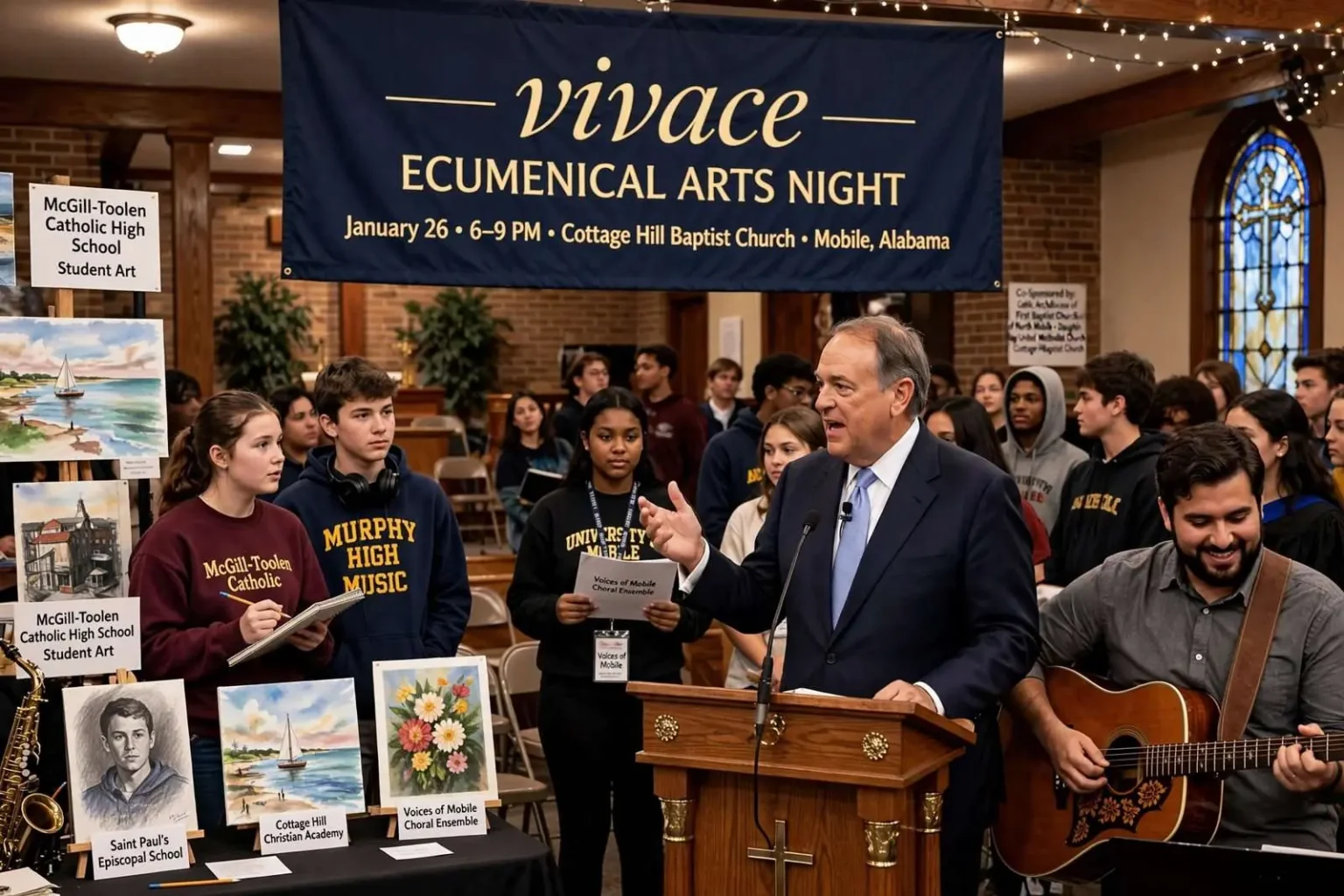
Former Arkansas Gov. Mike Huckabee, a leading prospect for the 2012 Republican presidential nomination, will keynote an ecumenical arts event in Mobile next month, bringing a national political figure into an evening built around student musicians, painters and singers. The event, called vivace — pronounced vee-VAH-chay, from the Italian musical direction meaning lively — is scheduled for Tuesday, Jan. 26 from 6 to 9 p.m. at Cottage Hill Baptist Church.
The pairing of a presidential prospect with a student art show and a church-based concert program is an unusual construction, and it is deliberately so. Vivace has been arranged less as a political rally than as a cultural evening — one that gives local schools and ensembles a large stage while lending the program the drawing power of a national name.
How the evening is arranged
The program comes in two parts. From 6 to 7:30 p.m., an open house of music and art will feature work by students and professional artists. At 7:30 p.m., a mainstage show begins, with Huckabee’s address as its centerpiece.
The performance lineup is drawn largely from Mobile: the jazz-flamenco fusion guitar duo Roman Street; Voices of Mobile, the nationally recognized ensemble from the University of Mobile; the a cappella group Elements of Difference; and the pop-Broadway performance group Sounds of Mobile.
Artists, performers and musicians participating in the open house come from the University of Mobile, McGill-Toolen Catholic High School, Murphy High School, Saint Paul’s Episcopal School, Cottage Hill Christian Academy and other institutions.
The lineup blends some of the most recognizable musical names in the city. Roman Street has built a substantial following along the Gulf Coast with its instrumental blend of jazz and flamenco guitar, the kind of act that moves easily between coffeehouse dates, festival stages and corporate events. Voices of Mobile tours nationally as the flagship ensemble of the University of Mobile’s music program, which has long been one of the strongest church-music training grounds in the region. An a cappella group and a Broadway-style revue round out a program that spans genres about as widely as a single stage can.
For the high school choirs and art programs, the evening offers something rarer than a venue: an audience that includes families from other schools and other traditions. Students from McGill-Toolen and Murphy — schools on opposite sides of the city, one Catholic, one the city’s largest public high school — would otherwise rarely share a program. Vivace puts their work in the same room by design.
An unusually broad coalition
The list of supporting institutions is the most striking feature of the event. Backing comes from the Catholic Archdiocese of Mobile, First Baptist Church of North Mobile, Cottage Hill Baptist Church and Dauphin Way United Methodist Church — Catholic and Protestant, evangelical and mainline, cooperating on a single program.
In a city whose religious history runs from the French colonial Catholic parishes of the eighteenth century through the Baptist and Methodist congregations that grew up around them, that kind of cooperation is not unheard of, but neither is it routine. Mobile’s Catholic heritage is the oldest in the region — the Archdiocese traces its roots to the earliest European settlements on the Gulf Coast — while the city’s Protestant congregations have grown into some of the largest institutions of any kind in west Mobile. The two worlds overlap at school events and charity drives, but a shared stage and a shared program is a more deliberate statement.
Vivace was explicitly designed to cross those lines. The event is produced by the United for Life Foundation, a 501(c)(3) nonprofit founded by Lee John Bruno to promote what the organization calls culture-building work.
The term “culture-building” is doing real work in the foundation’s framing. The organization’s premise is that a community’s shared culture — its music, its art, the events its families attend together — is built deliberately rather than inherited, and that the way to build it is to give young artists a platform and give churches and schools a reason to cooperate. An ecumenical arts night, in that framing, is not just a concert; it is an argument about what the city’s institutions can accomplish jointly that none could accomplish alone.
The politics in the room
Huckabee’s presence gave the evening a second dimension. A former Baptist pastor as well as a former governor, he had run a strong campaign for the Republican presidential nomination in 2008, winning the Iowa caucuses and carrying much of the South, and he was by late 2009 hosting a weekend program on national cable news and appearing regularly on lists of likely 2012 candidates.
Alabama’s own presidential primary would not arrive until 2012, but the state’s evangelical voters were a constituency any Republican contender needed, and Mobile — the largest city in the most conservative corner of a conservative state — was a reasonable place to be seen. Huckabee was not the only national Republican making his way through Alabama that winter; the state’s crowded gubernatorial primary had drawn its own share of visiting endorsers.
For Huckabee, the event’s format is friendlier terrain than a county GOP fish fry. His biography — small-town Arkansas pastor, lieutenant governor, more than a decade as governor, bass player in his own band — has always bridged the space between pulpit and stage, and an arts evening built around church and school musicians plays directly to the cultural-conservative identity that carried him through Iowa. A keynote here reads as cultural engagement first and campaign positioning second, whatever the 2012 watchers in the audience make of it.
Local organizers, for their part, gain the practical benefit of his name: an event built around high school choirs draws families and friends; an event with a national television personality draws a house.
Tickets and logistics
General admission was $15 in advance, $20 at the door. Priority seating was $35 in advance, $50 at the door. Tickets and locations were available at joinrock.com, or by calling (251) 545-4501.
The pricing keeps the event accessible — a family of four can attend at general admission for the price of a modest dinner out — while the priority tier offers front-of-house seating for supporters who want the closest view of both the student performances and the keynote. Advance purchase carries a consistent $5 discount across both tiers, an incentive aimed squarely at churches and schools that might organize group orders.
Cottage Hill Baptist Church, perched on the hill that gives the surrounding neighborhood its name, is among the largest church campuses in west Mobile, with sanctuary capacity and parking that few secular venues in the city can match. Hosting the event there solves the practical problems a downtown hall would pose for a program of this size, and it places the stage in the geographic center of the coalition’s member congregations.
For the students involved — the McGill-Toolen and Murphy High choirs, the University of Mobile ensembles, the young artists whose work would hang in a church fellowship hall for one night — the draw was less the keynote speaker than the stage. One evening, one large room, and an audience assembled from across the city’s Protestant and Catholic schools: that is the arrangement vivace was built to deliver, with a former governor and presidential candidate keeping the door open and the seats filled.
Mobile’s music infrastructure on display
The evening doubles as a catalog of Mobile’s musical training pipeline. The University of Mobile has spent decades turning out performers who staff churches, schools and touring ensembles across the region, and its Center for Performing Arts has made the university a regular stop for nationally known Christian artists. Voices of Mobile, the university’s flagship touring group, has performed for audiences far beyond Alabama, and its members’ polish shows the investment the school makes in performance training.
Roman Street’s presence brings a different kind of credential. The duo’s instrumental guitar work — a blend the group describes as jazz and flamenco fusion — has made it a staple of Gulf Coast festivals, wedding receptions and listening rooms, and a rare example of an original Alabama act that lives comfortably on stages built for any audience at all. For students who have only heard the group on local radio or festival billings, seeing it on a church mainstage is a reminder that a music career can be built from Mobile rather than made in Nashville.
The a cappella and Broadway-style acts fill out the program’s range. A cappella singing has enjoyed a long run of mainstream popularity, and church-based vocal groups have fed much of that wave; the Sounds of Mobile’s pop-Broadway format, meanwhile, gives the evening its theatrical element, the closest the program comes to staging a production number rather than a concert set.
Why churches host the city’s cultural life
It is worth noting how much of Mobile’s community cultural calendar runs through churches. Sanctuaries and fellowship halls host choirs, art shows, recitals, lectures and charity concerts year-round, because few civic buildings offer both the seating and the volunteer workforce that congregations can provide. An event that unites the Archdiocese with three Protestant congregations is unusual in its breadth, but the underlying mechanism — a church campus as the city’s gathering place — is one of the oldest patterns in Mobile’s public life.
What vivace adds to the pattern is the pairing of that infrastructure with the schools. Catholic high schools, public schools, Episcopal and Baptist academies all maintain music and art programs that compete for funding, audience and recognition; a joint evening gives each program’s families a reason to see the others’ work, and gives administrators a shared success to point to. Cooperation across those school lines is the quiet achievement of the event, and the part most likely to outlast the keynote speaker’s visit.
Whether the evening becomes an annual fixture will depend on turnout on Jan. 26 — but the ingredients are assembled: a large host campus, four sponsoring institutions spanning the city’s Catholic and Protestant communities, a performance lineup drawn from its best-known ensembles, and a nationally recognized speaker whose own history bridges pulpit and stage. Mobile has seen plenty of concerts and plenty of political visits; it has seen considerably fewer evenings that set out to build culture on purpose, and meant it.