Missing Mobile woman Danniella Vian’s car pulled from Bayou Sara; remains found
Mobile police confirmed a car pulled from Bayou Sara belonged to missing mother Danniella Vian, and that human remains were found inside the vehicle.
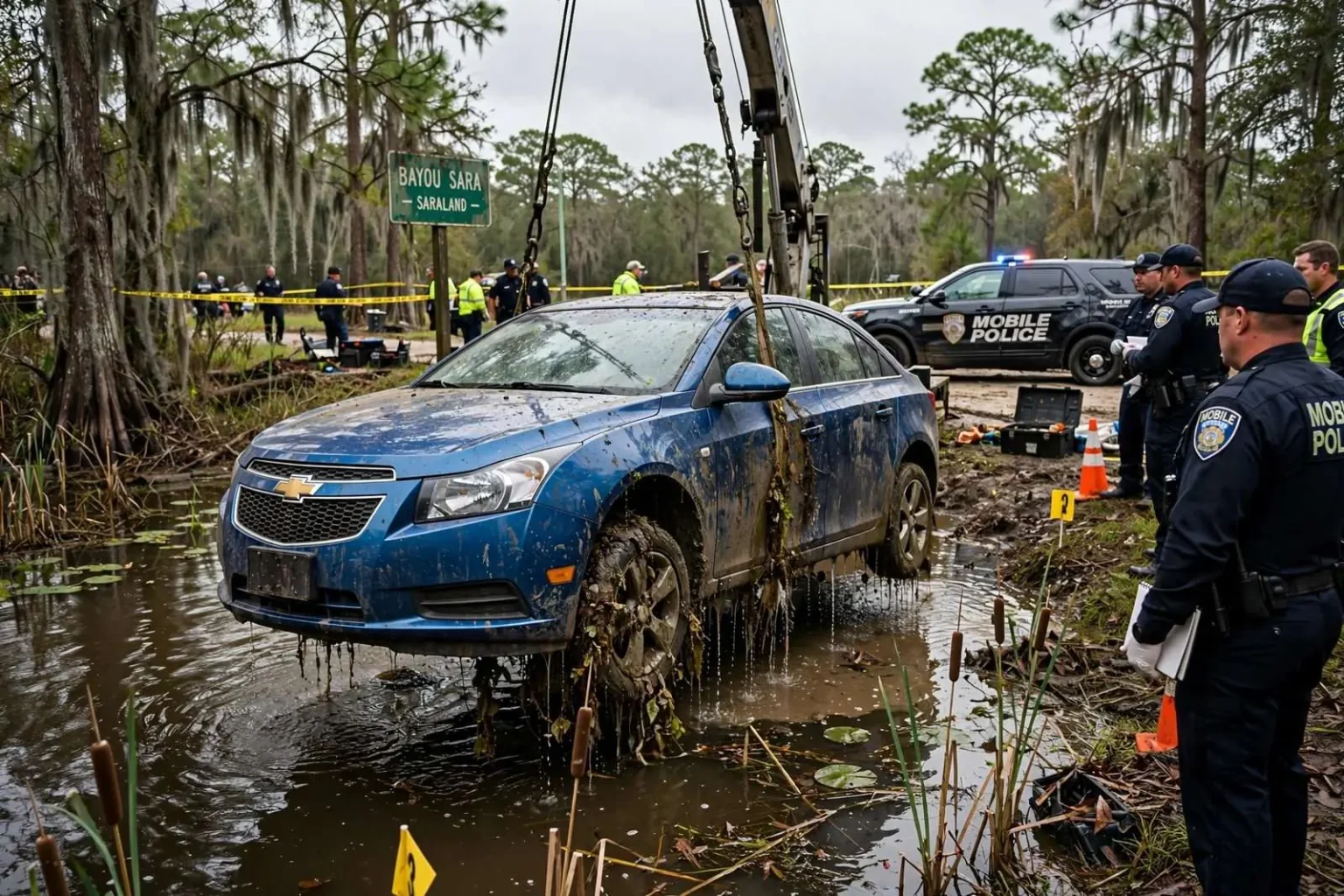
Mobile police confirmed Friday that a car pulled from Bayou Sara belonged to missing mother Danniella Vian, and that human remains were found inside. Chief Lawrence Battiste said the vehicle had been lifted from the water and investigators would let it drain and search it for evidence. He confirmed the remains were those of an adult female, and said the body would undergo forensic testing to determine whether it was Vian.
Vian, 25, was last seen alive on July 17, 2018, at the Shell station at Government Boulevard and Interstate 65. She had purchased a blue 2014 Chevrolet Cruze that day. She had been missing since that July, and the discovery nine months later brought the first tangible answer to a case that had produced few leads since her family reported her gone.
The car was discovered in Saraland’s Bayou Sara on Thursday evening, matching the make and model of Vian’s vehicle. Mobile police found it during a diving training exercise, and crews planned to remove it Friday. Divers train regularly in area waterways, and it was during one of those sessions in the Saraland bayou that the submerged sedan was spotted, a coincidence that ultimately advanced a stalled investigation.
After her disappearance, a missing persons report was filed by her 5-year-old daughter’s grandmother, and the case was moved to Mobile Police’s homicide unit. Authorities offered a $2,000 reward for information, later increased to $5,000, and launched a blog to gather tips. The daughter was among the family members left waiting for answers through the months of searching.
Vian’s Final Hours
New details have since emerged about Vian’s final hours. On July 17, 2018, she spent the afternoon buying her first car, a purchase she had been planning for herself and her young daughter, then stopped at Bel Air Mall before meeting friends at a pair of west Mobile bars. Surveillance accounts from that night place her leaving Dublin Irish Pub and Eatery around 10:45 p.m. with an acquaintance; her vehicle’s dealership-installed GPS tracker went dark at 11:07 p.m. near the Shell station at Government Boulevard and Interstate 65.
The tracker’s final signal became one of the case’s defining details, fixing the vehicle’s last known location at one of west Mobile’s busiest interchanges before it vanished from the record. Investigators and family members alike have worked backward from that point, trying to account for the twenty-two minutes and every mile between the last GPS ping and the discovery in Saraland.
Battiste’s confirmation gave the family the answer they had feared but also the specificity they had been seeking: the search was no longer abstract. From that Friday forward, the case shifted from a missing persons investigation into a death investigation built around a recovered vehicle, a submerged bayou and a set of questions that remain unanswered to this day.
When the Chevrolet Cruze was pulled from Bayou Sara in May 2019, medical examiners listed her cause of death as “undetermined” because of the condition of the remains. Investigators said they believed the death was accidental and that no foul play was involved, a conclusion Vian’s family and friends have never accepted.
Adding to the family’s questions, the submerged car later surfaced on a Ukrainian online auction site, listed with “major water/flood” damage and sold for $25, with taxes and fees bringing the total to about $4,150. The episode left the family pressing for answers about the vehicle’s chain of custody after it left the evidence process, and it became one more thread in a case defined by loose ends.
Family advocate Shanna Haden has said the biggest unanswered question is how Vian’s car traveled from the busy Government Boulevard interchange to a Saraland bayou reachable only by winding residential streets, an area where Vian had no known connections. The route between those two points crosses several miles and multiple municipal boundaries, and nothing in Vian’s background explains why her first-day car would have ended up in that stretch of water north of the city.
Haden said police are not actively investigating but believes the case remains open, and she continues urging anyone with information to come forward. For the family, public appeals have been the main avenue for generating tips since the initial investigation wound down, and advocates have kept Vian’s name circulating through social media posts, anniversary appeals and local coverage.
Bayou Sara and the Geography of the Case
Bayou Sara winds through Saraland north of Mobile, draining toward Mobile Bay through a low-lying corridor bordered by residential neighborhoods and wooded stretches. Waterways like it are common across Mobile County, and area police departments routinely use them for diving certification and training exercises precisely because they offer realistic conditions close to home.
The bayou’s distance from the Government Boulevard interchange, roughly ten miles north across two city limits, is what makes the vehicle’s presence there so hard to explain. Without a working GPS trail past 11:07 p.m., investigators and family have had to reconstruct that route from witness accounts, camera footage and guesswork, none of which has produced a public answer.
The May 2019 recovery also settled the question of what happened to the car itself, if not the question of how it got there. Investigators photographed and processed the vehicle as it drained, cataloging whatever the water had left behind, and the forensic work that followed proceeded alongside the medical examiner’s examination of the remains. Every conclusion drawn from that evidence, from the tracker timeline to the condition of the car, now forms the factual backbone of a case the family refuses to let close.
The auction-site discovery added an unsettling coda. How the car reached an overseas listing, who sold it and under what authority were questions the family raised publicly, and the episode underscored how even the physical evidence in a case can slip beyond a family’s reach once official attention moves on. Advocates pointed to it as a reason the case deserved more sustained institutional attention than it received.
How Missing Persons Cases Move in Alabama
The structure of the Vian case reflects how such investigations typically unfold in Alabama. A missing persons report from a family member triggers an initial welfare check and canvass, and cases that show signs of unexplained disappearance are referred to specialized units, in Mobile’s case the homicide division, which handles suspicious deaths and long-term missing persons investigations. Rewards, tip lines and public outreach usually follow when early leads run dry.
Forensic identification plays a central role in cases where remains are found long after a disappearance. Medical examiners work from dental records, DNA comparison and other evidence to confirm identity, and the condition of remains recovered from water can limit what an autopsy can determine about cause and manner of death, which is how findings like “undetermined” arise.
For families, the indefinite answers are often the hardest part. A recovered vehicle and confirmed remains close one chapter, but an undetermined cause of death and an unexplained route leave the central question of what happened unanswered, and families in that position frequently become their own advocates, keeping pressure on authorities and appealing for witnesses years after the initial news cycle moves on.
Vian’s case drew attention across the Gulf Coast precisely because of those gaps: a young mother, a new car, a final GPS ping at a busy interchange and a discovery miles away in another jurisdiction. Each detail is documented, but together they still do not tell the story her family has been asking for since July 2018.
Anyone with information about the case is urged to contact Mobile police or the tip channels established during the investigation. For the family and advocates who have carried the case forward, even a small detail from the night of July 17, 2018, or the days after, could be the piece that finally explains how Danniella Vian’s car ended up in Bayou Sara, and what happened in between.
The $5,000 reward and the case blog established during the search were early examples of the tools families now lean on. Social media appeals have changed the dynamics of missing persons cases across the country, allowing relatives to reach thousands of people directly, and Vian’s family and advocates used those channels consistently from the first weeks after her disappearance.
Saraland police and Mobile police jurisdictions meet along the corridor between the two cities, and cases that cross municipal lines like this one require coordination between departments. The vehicle’s recovery in Saraland during a Mobile police training exercise illustrates the occasional accidents of investigation: no agency had reason to search that bayou for Vian’s car until divers happened to find it, nine months after the tracker went dark.
The details of those final hours, from the dealership paperwork to the last GPS signal, remain the framework around which any future answer will have to be built.