Inside the 2005 Mobile Mayor’s Race: A Campaign as Its Operatives Saw It
A trove of correspondence from operatives in Mobile's 2005 mayoral campaign shows how insiders read the polls, the TV buys and the racial arithmetic of the race that elected Sam Jones.
Political campaigns are argued in public and understood in private. Over the summer of 2005, as Mobile chose the mayor who would lead it for the next decade, a steady traffic of correspondence moved among the people running, advising and watching the campaigns — and it captured a race that looked considerably different from the inside than it did on television.
The correspondents’ identities are withheld. What follows is drawn from that traffic, and it is a portrait of how professionals actually think: how they read an opponent’s advertising, how they set expectations, and how they priced the moods of a city that believed its biggest days were just ahead.
The field
Four principal candidates competed to succeed longtime Mayor Mike Dow. County Commission President Sam Jones brought the largest institutional base, years of running a two-billion-dollar-plus county government’s top elective board and a name built across the county’s Black and white political networks. Businessman John Peavy offered a self-financed, commerce-oriented campaign aimed at the city’s growth-minded middle.
Ann Bedsole entered as the most decorated résumé in the field — the first Republican woman elected to both the Alabama House and Senate, and a founder of the Alabama School of Mathematics and Science, the residential public school that stands as her signature civic legacy. City Councilwoman Bess Rich rounded out the field with the loyalty of a fiscal watchdog constituency built over years of casting lonely votes against spending she considered wasteful.
Each carried a distinct theory of the race. Jones needed consolidation, Peavy needed momentum, Bedsole needed time, and Rich needed the anger of taxpayers to outperform the optimism of boom times. The private traffic of that summer was, in effect, a running argument about which of those needs would be met first.
Reading the television
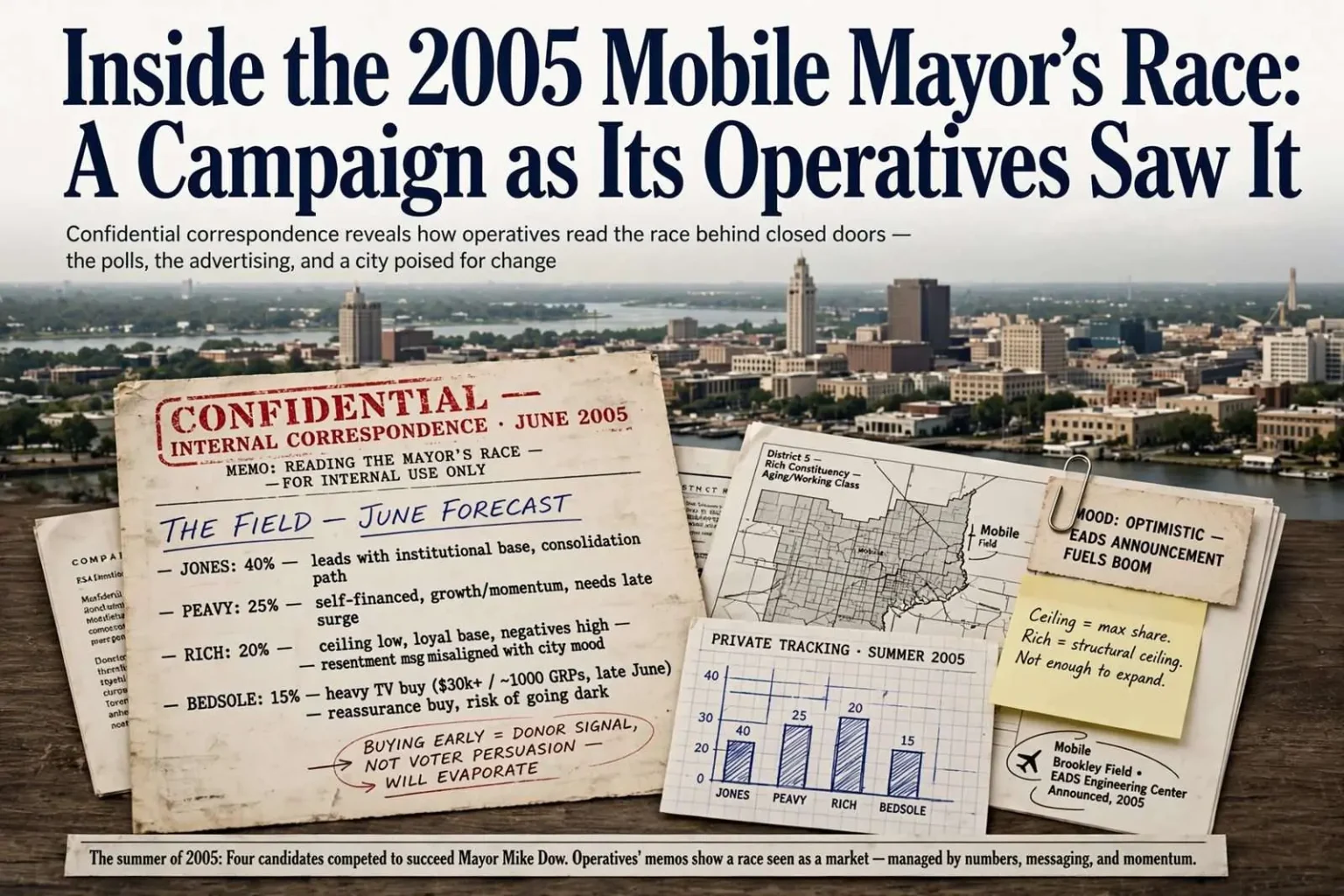
The earliest arguments were about advertising. In late June, one correspondent flagged that Bedsole had spent more than $30,000 on roughly 1,000 gross rating points of television — extraordinarily early for a candidate whose name recognition already stood near 80 percent. In a summer race, buying television that early was read in the trade as a signal rather than a strategy.
The analysis that came back was withering, and it was a lesson in the trade. Advertising buys name identification; Bedsole did not need name identification. “Any consultant will tell you that you can’t go up and then go dark,” one wrote. Going on air early and then off again produces a bump that evaporates — and an evaporating bump is worse than never going up at all, because the fall is what people remember.
The purpose, the correspondent concluded, was not to persuade voters but to reassure supporters — to alter the perception of a losing effort. Early airtime tells donors and endorsers that a campaign is viable, and viability is the currency that keeps checks arriving. The cost of that reassurance was a depleted account and a schedule the campaign would later struggle to sustain.
The same writer offered an early forecast that framed the rest of the summer: Jones around 40 percent, Peavy about 25, Rich about 20, Bedsole about 15. Numbers like those, circulated privately weeks before any public poll, function as benchmarks — campaigns measure their own tracking against them, and operatives stake their reputations on calling them early and calling them right.
Reading Bess Rich
The forecast came with an unsparing footnote about Rich. He noted that Rich had a ceiling, describing her negatives as among the highest he had seen. A candidate’s ceiling — the maximum share of the electorate that will consider her under any circumstances — is the number professionals watch first, because it determines whether money and message can move the result at all.
He characterized her message as one of resentment aimed at people perceived as powerful — the incumbent administration, the business establishment, the chambers and committees that Mobile’s moneyed class had built around the mayor’s office. That message had won Rich a devoted council constituency. But as a theory of a citywide mayoral race in 2005, the operative judged it a difficult sell in a city that had grown optimistic on the strength of announcements like the EADS engineering center.
The timing mattered. Mobile in 2005 was riding a wave of good news. The aerospace giant’s decision to build an engineering operation at Brookley Field had convinced many residents that the Airbus era was about to arrive in earnest, and the civic mood — after two decades of Dow’s redevelopment cheerleading — leaned toward continuity and big plans rather than audits and grievance. A campaign built on resentment of the powerful runs into headwinds when the powerful appear to be delivering.
The Rich ceiling, in the operative’s view, was thus not merely personal but structural: her coalition was real, loyal and arithmetically insufficient. Every point she added to her base came from voters the optimistic tide was pulling the other way.
What professionals know that campaigns show
The private traffic treated the election less as a debate than as a market. Every move — an ad buy, a mailing, a debate appearance, a trembling number in a tracker — was priced against the expectations game. The purpose of a public campaign, in this view, is to manage the narrative toward the result the numbers already imply: to make a win look inevitable, a loss look like an upset, and a strong second look like momentum.
The June television assessment is the clearest specimen of that thinking. A casual observer saw a well-known candidate advertising energetically. A professional saw a campaign spending scarce cash on a product it did not need to sell, in order to reassure the suppliers of its next round of cash — a move that solved today’s anxiety while creating next month’s problem.
The same discipline applied to the forecast. Numbers like Jones 40, Peavy 25, Rich 20 and Bedsole 15 were never just predictions; they were instructions. They told Jones’s operation it could run a consolidation race, told Peavy’s that a second-place finish meant a runoff lifeline, and told Bedsole’s and Rich’s camps that unless their ceilings cracked, the race was about positioning for the future rather than for the office.
The city the race was fought over
Understanding the summer’s private arithmetic requires understanding Mobile as it stood in 2005. The city of roughly 200,000 had spent sixteen years under Mike Dow, an era defined by redevelopment bets — the convention center and museum downtown, the restoration of Dauphin Street, the early skirmishes over the old Brookley Air Force Base — that transformed the central city while leaving older neighborhoods in the council districts Rich represented still asking when their turn would come.
The EADS announcement had supercharged the narrative. An aerospace engineering center at Brookley promised the kind of high-wage industrial jobs the region had chased since the shipyards wound down, and it validated the long civic argument that Mobile’s future lay in aviation and the port. Into that optimism walked four candidates selling four versions of what a post-Dow city should be.
Bedsole’s entry was itself a marker of the city’s political evolution. A Republican of statewide standing running for mayor of a city whose municipal politics had long been nonpartisan in name and Democratic in habit signaled how far the GOP’s coastal growth had penetrated local offices. Her profile — education legacy, legislative experience, establishment respect — was built for exactly the optimistic, growth-minded electorate the operatives described.
How it ended, and what the traffic got right
When the votes were counted in the summer of 2005, the forecast’s ordering proved durable: Sam Jones finished on top and, after a runoff, won the mayor’s office, becoming the first African-American mayor in Mobile’s history. The professional consensus that had formed in the June correspondence — Jones’s coalition too broad, Rich’s ceiling too low, Bedsole’s money spent too early, Peavy’s lane too narrow — matched the outcome with a precision that explains why such traffic is traded at all.
The losing candidates’ fates tracked the private analysis almost line for line. Bedsole’s early advertising, read in July as donor reassurance, was remembered as the summer’s cautionary tale in pacing. Rich’s resentments, banked over years of council dissent, translated into exactly the loyal minority the operatives predicted a low ceiling would allow. Peavy ran the growth-lane campaign his numbers implied.
For the city, the transition marked a generational turn. Jones inherited the Brookley momentum, the redevelopment agenda and, within weeks of taking office, a hurricane that would test every assumption about Mobile’s future. The optimism of the summer of 2005 — the EADS promise, the booming downtown, the sense that the city’s decade had arrived — was about to collide with the most expensive natural disaster in the region’s history.
But the correspondence itself remains the artifact worth studying. Read cold, it strips the romance from a mayoral race and shows the machine underneath: a campaign is a pricing problem, a name is an asset that either appreciates or does not, an ad buy is a message to donors, and a ceiling is a sentence handed down before the first vote is cast. Mobile chose a mayor that summer. Its professionals, privately, had already chosen the story they would tell about how it happened.