Mobile Adds $172,114 in Forklifts and Floor Scrubbers to the Regions Arena Shopping List
Mobile is preparing to spend another $172,114.54 on forklifts and industrial cleaning equipment for Regions Mobile Arena, with both purchases going before the City Council on Tuesday.
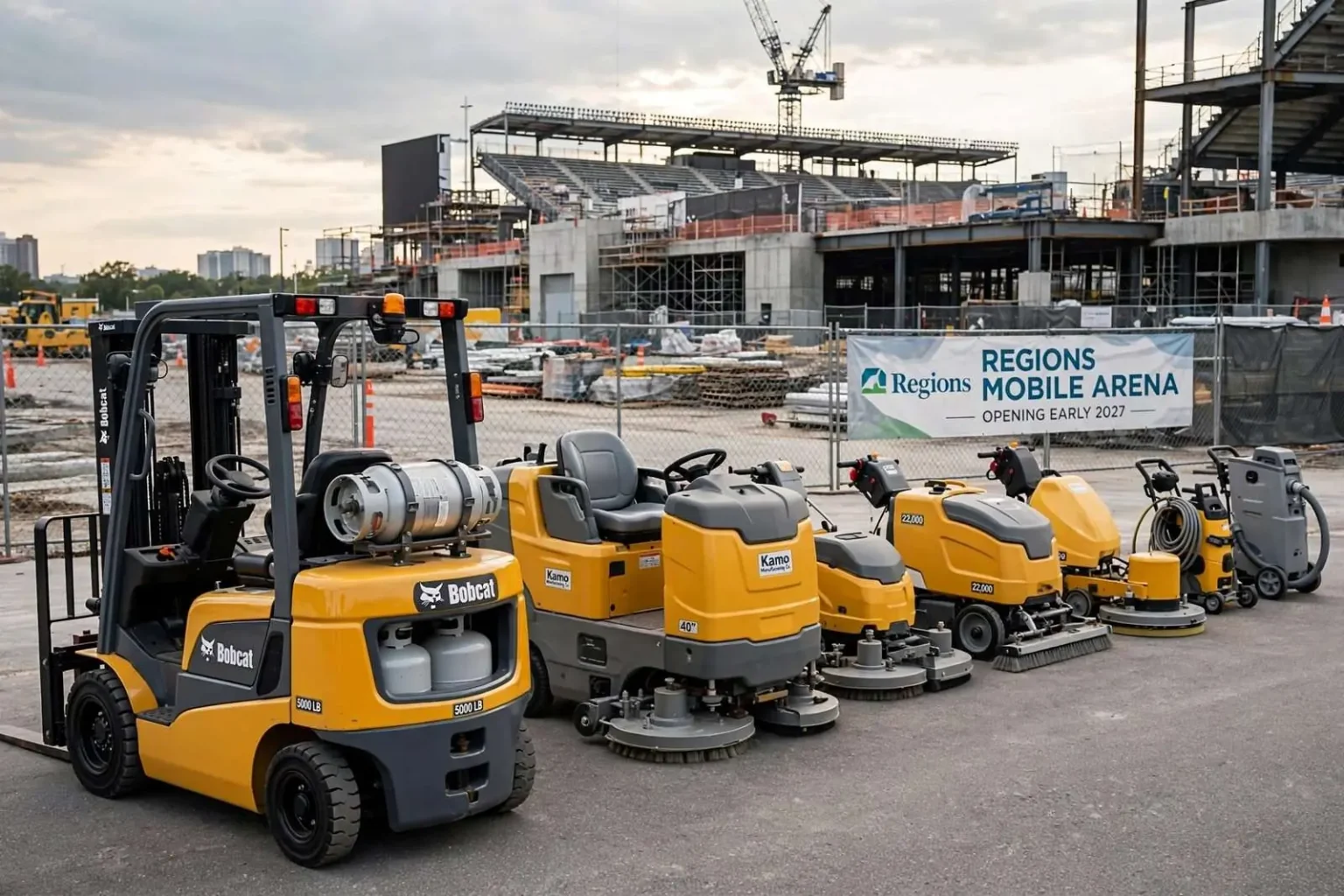
The most visible part of building an arena is the part everybody can see from the interstate: the steel, the glass, the seating bowl taking shape block by block in downtown Mobile. The far less glamorous part is everything that has to be rolled through the loading dock before a single ticket is scanned — the machines that move freight, scrub concourse floors, sweep parking decks and clean restrooms between events. Mobile is now preparing to spend another $172,114.54 on exactly that category of equipment for Regions Mobile Arena.
Two purchases are scheduled to go before the Mobile City Council on Tuesday. Together they cover the heavy lifting and the heavy cleaning that an arena of this size requires from the day it opens.
What the City Is Buying
The larger of the two items is a $99,595 industrial cleaning package. It is not a single machine but a fleet, assembled to cover every surface type inside a multi-level public venue:
- A 40-inch rider floor scrubber, the workhorse for wide concourse runs
- Two walk-behind scrubbers for tighter spaces where a rider unit cannot maneuver
- A rider sweeper carrying a $22,000 price tag on its own
- Vacuums for carpeted areas such as suites, clubs and office space
- Carpet extractors for deep cleaning between events
- A restroom-cleaning machine
- A floor burnisher for polishing hard surfaces
- A pressure washer for exterior and back-of-house surfaces
The second purchase covers two propane-powered Bobcat forklifts, each rated to lift 5,000 pounds. The pair would cost $72,519.54, or $36,259.77 each.
If the council signs off Tuesday, Burwell Material Handling would supply the forklifts and Kamo Manufacturing Co. would supply the cleaning equipment.
Where the Money Comes From
Both purchases would be drawn from the city’s Regions Mobile Arena furniture, fixtures and equipment capital account — the FF&E account, in the shorthand of public construction. The city previously established that account at approximately $11.8 million, a pool set aside specifically for the contents of the building rather than the building itself.
That distinction matters more than it might first appear. A construction contract delivers a structure: foundations, framing, roof, mechanical systems, seating, finishes. It does not deliver an operating business. Everything required to actually run events — the equipment, the tools, the furnishings, the specialized machinery particular to arena programming — is budgeted and purchased separately, usually in a long series of individual approvals rather than a single line item.
Mobile is now working its way through that series. Arena purchases already approved include an ice-resurfacing machine, rolling staging and a basketball floor package. The latest request adds material handling and janitorial capacity to that list.
Why an Arena Needs Its Own Forklifts
To anyone who has never worked an arena load-in, buying two forklifts may look like an odd use of six figures. To anyone who has, it is close to the first thing on the list.
A touring concert, a hockey game and a trade show all arrive the same way: on trucks, in cases, on pallets. Sound and lighting rigs, staging decks, dasher boards, merchandise, catering supplies, athletic flooring and the endless miscellany of a live event all have to move from the dock into the building on a schedule that is measured in hours, not days. Venues that cannot move freight quickly either rent equipment for every event — at recurring cost and on someone else’s availability — or lose bookings to venues that can.
The propane detail is also functional rather than incidental. Propane-powered lifts are common in indoor venue operations because they can run continuously through long load-in and load-out cycles without the recharge downtime that battery equipment requires, while still being usable indoors with appropriate ventilation. The 5,000-pound rating puts them in the standard range for palletized freight and staging components rather than heavy industrial loads.
The Cleaning Fleet Is a Turnaround Tool
The janitorial package answers a related operational problem: turnaround time. An arena that hosts a hockey game one night and a concert the next has a narrow window to reset tens of thousands of square feet of concourse, seating bowl, restrooms and back-of-house space. That window is what determines how many events a building can realistically hold in a month, which in turn determines how much revenue it generates.
The mix of machines in the package reflects the mix of surfaces. Rider scrubbers cover open concourse quickly. Walk-behind units handle the corners, vestibules and narrow service corridors a rider unit cannot reach. Sweepers handle debris before wet cleaning begins. Extractors and vacuums serve carpeted premium areas. Burnishers maintain the appearance of hard flooring over years of heavy foot traffic. A dedicated restroom machine addresses the single most labor-intensive cleaning task in any public assembly building.
Bought together, the fleet is sized to let a crew reset the building overnight. Bought piecemeal or rented per event, the same work takes longer and costs more over the life of the venue.
A Building Still Months From Opening
Regions Mobile Arena is expected to open in early 2027. The venue is the centerpiece of a roughly $300 million downtown project that will replace the aging Mobile Civic Center, a facility that served the city for decades but had fallen well behind modern standards for touring productions, premium seating and back-of-house operations.
The building already has an anchor tenant lined up. The Mobile Mysticks were revealed earlier this month as the newest franchise in the Southern Professional Hockey League and will call the new arena home — which explains why an ice-resurfacing machine was among the equipment purchases the council approved earlier in this process.
A hockey tenant also raises the operational stakes for the equipment now under consideration. Hockey schedules are dense, and a building that hosts hockey plus concerts, family shows, graduations and conventions has to convert between configurations repeatedly across a season. Every conversion involves moving heavy components and cleaning the space afterward.
The Unglamorous Half of a Capital Project
Approvals like Tuesday’s rarely draw a crowd to council chambers. They are, however, a reasonable barometer of how close a project is to the finish line. Cities do not buy floor burnishers and restroom machines for buildings that are still years out. Purchases at this stage indicate a project moving from construction into commissioning — the phase where a structure is progressively handed over to the people who will operate it.
It is also the phase where the FF&E account gets spent down in visible increments. At roughly $11.8 million, the account has to cover a long inventory: seating and furnishings for premium spaces, kitchen and concession equipment, box office and point-of-sale systems, office furniture, audiovisual and scoreboard components, athletic and event flooring, staging, and the operational equipment now on the agenda. Each piece arrives through its own approval, and the running total is one of the few public windows into how a venue is actually being outfitted.
What Happens Tuesday
The council will consider both items at its regular Tuesday meeting. Approval would authorize the purchases from the arena FF&E capital account and clear Burwell Material Handling and Kamo Manufacturing Co. to supply the equipment.
For residents watching the arena rise downtown, the practical takeaway is straightforward: the shopping list is getting longer because the opening is getting closer. The equipment approved this month is what will be waiting in the service corridors when the first crowd arrives in early 2027 — and what will quietly reset the building for the next one after everybody goes home.