
Mobile Area Group Buses to Washington for Jan. 6 Trump Rally
About 28 Mobile area residents with the Common Sense Campaign rode a bus 15 hours to Washington for the Jan.
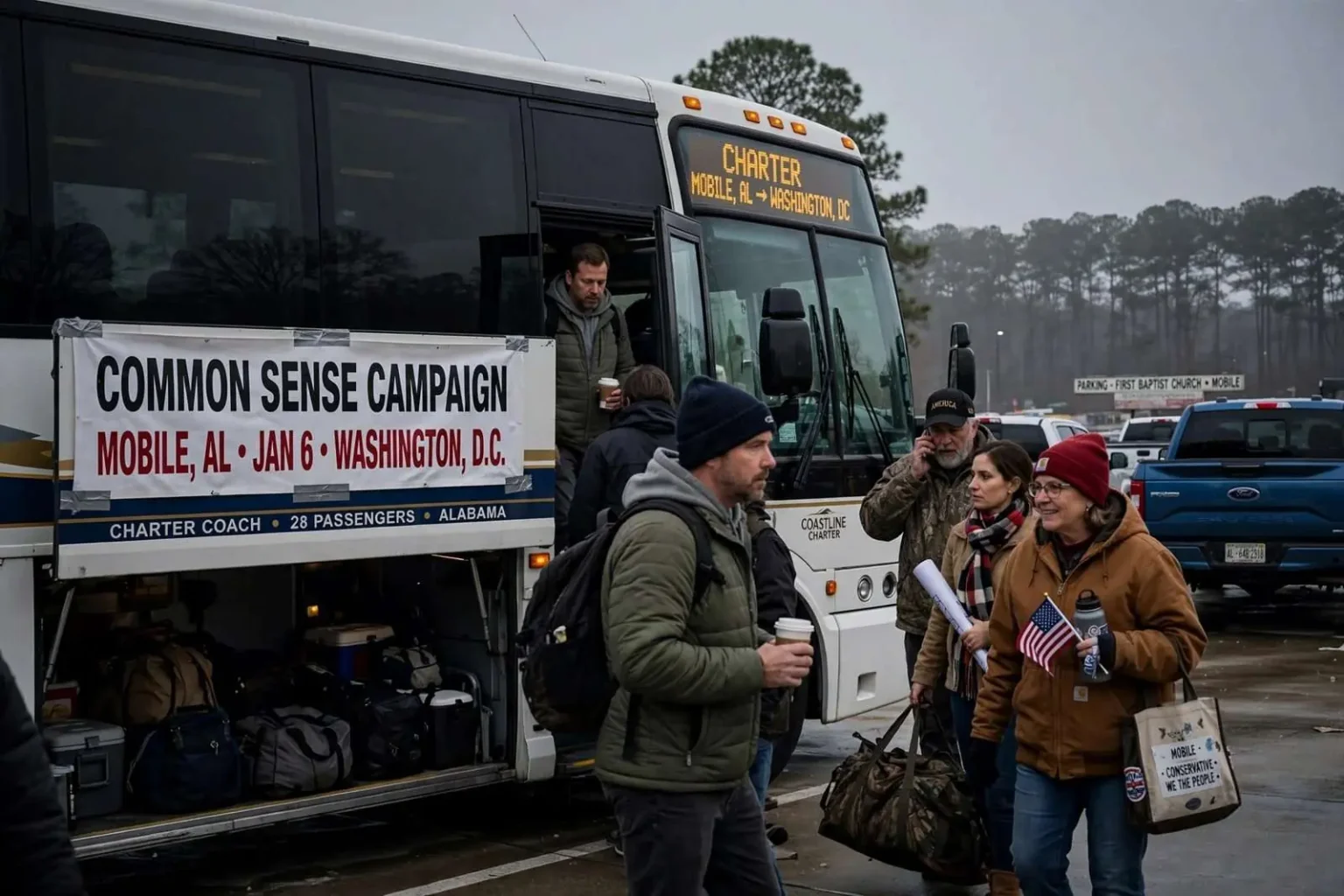
A group of Mobile area residents boarded a bus for Washington, D.C., to take part in a rally supporting President Donald Trump as Congress prepared to certify Joe Biden’s Electoral College win. The trip came together on short notice, assembled by members of a local grassroots organization in under two days.
Pete Riehm, who was on the bus, said members of the Common Sense Campaign decided on a Saturday to make the journey and assembled the whole thing in under 48 hours. The Common Sense Campaign has been a fixture of Mobile-area conservative politics for years, organizing around fiscal and constitutional issues and turning out volunteers for local and national causes.
Even with the late notice, interest kept coming in after departure. “We were two hours down the road and I had somebody call me and go, ‘Could I still get on the bus?’” Riehm said.
Who Made the Trip
Riehm said roughly 28 people were aboard, most of whom had never met before the trip. The passengers ranged across ages and backgrounds, bound together by a shared decision to make the roughly 1,000-mile journey from the Gulf Coast to the capital.
“I think what you’re seeing though is the American people are frustrated enough that you’ve got basically 28 average Americans, random citizens who have come together,” he said, adding that only a few of the passengers knew each other beforehand but “felt it was important enough to ride a bus for 15 hours to get to D.C. and make our voices heard while we still can.”
He said most participants had concluded weeks earlier that they wanted to go. “I would say all the folks that are with us have kind of known for a few weeks that they needed to go and they wanted to go,” Riehm said. The gap between deciding to go and actually arranging travel closed quickly once the group committed to chartering a bus, a mode of political travel that has long roots in American protest movements, from civil rights marches to recent large-scale demonstrations.
Charter bus trips to Washington are a well-established tradition for groups of all political persuasions. The drive from Mobile to the capital runs about 15 hours through Alabama, Georgia, the Carolinas, and Virginia, far too long for most individuals to drive alone, which is why organized bus trips have become the standard way for regional groups to bring members to national demonstrations.
The Political Backdrop
The rally was scheduled for Jan. 6 at the Ellipse in Washington, with Trump saying in a post the evening before that he planned to speak there at 11 a.m. Eastern. The Ellipse, the park just south of the White House grounds, sits roughly a mile from the Capitol, where the joint session of Congress to count the electoral votes was set to convene the same day.
Trump continued to assert that the election had been taken from him, a claim that state election officials and courts had rejected. Recounts, audits, and dozens of lawsuits across the contested states had failed to change the outcome, and officials from both parties, along with the Department of Justice, had said they found no evidence of fraud on a scale that could alter the result.
He was also pressing Vice President Mike Pence to intervene in the certification, an action Pence did not have the constitutional authority to take. The vice president’s role in the joint session is formally ministerial under federal law, presiding over the count of electoral votes already certified by the states, and Pence had told the president in the days before the rally that he did not believe he had the power to reject the count.
The certification process itself is defined by federal statute. After the states certify their results and electors meet in December, Congress meets in joint session on Jan. 6 to count the electoral votes, with objections requiring the votes of both chambers to alter the count. In the days before the rally, a group of Republican members of Congress had announced plans to object to results in several states, ensuring the joint session would stretch into a long day of debate regardless of the outcome.
The group traveling from the Mobile area said it planned to join demonstrators already in the capital who were urging members of Congress to reject the Electoral College count affirming Biden’s win. Organizers of the Washington rally had promoted the event for weeks, and travel companies and political groups across the country had chartered buses into the city for the day.
The Itinerary
The bus stopped overnight in North Carolina and was set to leave for Washington around 5:30 a.m. Riehm said the plan was to head straight to the Ellipse for the rally and the president’s remarks, attend an afternoon protest, then depart the city at 3 p.m.
The tight departure time reflected the realities of the return trip. A 15-hour drive back to Mobile meant the group would arrive home early the next morning, and the organizers wanted passengers back for work and family obligations. Overnight stops in North Carolina broke the northbound drive into manageable segments, with the final leg leaving the group several hours in the capital.
Security in Washington was a major topic in the days before the rally. District officials had prepared for large crowds, and the National Park Service had issued permits for gatherings at several locations, including the Ellipse. City leaders urged visitors to follow police instructions and to be aware of street closures around the federal buildings and the Capitol.
For the Mobile-area group, the trip represented a significant commitment, financially and physically, for a single day in the capital. Twenty-eight strangers sharing a charter bus for 30 hours round trip is the kind of grassroots logistics that political scientists point to when describing how ordinary citizens participate in national political moments. Riehm’s framing of the passengers as “random citizens” who came together over a shared sense of urgency captures the ad hoc nature of the undertaking.
Whatever one’s politics, the Jan. 6 certification was set to be a consequential day in Washington, with the joint session counting the votes that would formally determine the outcome of the 2020 presidential election. The Mobile-area travelers arranged their trip to be present for it, joining thousands of others converging on the capital for a rally at the Ellipse and demonstrations around the Capitol as the count proceeded.
The group’s story, a Saturday decision, 48 hours of planning, and a 15-hour ride, is a small piece of a much larger day, but it documents how national political moments reach down into individual communities, where a handful of neighbors can charter a bus, gather strangers, and carry a Gulf Coast presence to the steps of American democracy.
The 15-hour ride gave the passengers time to get acquainted, and Riehm’s observation that most had never met underscored how loosely organized the effort was. There was no membership roster, no formal delegation, just a chartered bus and word of mouth through Mobile-area conservative networks. That kind of spontaneous mobilization has become more common in the social media era, when a single organizer with a following can fill a bus in days.
Travel logistics for groups heading to Washington follow a well-worn pattern. Charter operators in the Southeast regularly run trips to the capital for demonstrations, inaugurations, and school groups, and the route from Mobile climbs northeast through Montgomery and Atlanta before crossing the Carolinas. The overnight stop in North Carolina split the journey so passengers could sleep in hotel beds rather than ride through the night, arriving in Washington rested for a full day on their feet.
January weather added a layer of preparation. Early January in Washington typically brings temperatures well below those of the Gulf Coast, and rally-goers from south Alabama packed for conditions they rarely experience at home. Veterans of past bus trips to the capital advised layers, comfortable shoes, and portable chargers, practical matters that dominate group chats in the days before departure.
The Common Sense Campaign’s role reflected its history of mobilizing quickly. The group has organized around what it describes as constitutional and fiscal conservatism, hosting candidate forums and turning out members to city council and county commission meetings across the Mobile area over more than a decade of activity. Chartering a bus to Washington fit that organizing tradition, if on a larger geographic scale than its usual local efforts.
Reactions to the certification fight in Alabama were divided along predictable lines. State Republican leaders had backed the objections to the electoral count, while the state’s congressional delegation split on how to respond. For the passengers on the Mobile bus, the trip was an expression of the same commitment they had followed through the post-election weeks, and Riehm’s comments framed it as a matter of conscience rather than strategy.
Bus trips like this one also illustrate the economics of grassroots political travel. A charter bus for 28 passengers, two hotel nights, and two days of meals add up to a per-person cost that most working families absorb only for causes they consider essential. That the passengers described themselves as “average Americans” and “random citizens” making an extraordinary effort is the point organizers wanted to convey to the press and to the members of Congress the group hoped to reach.
By the time the bus pulled out of Washington at 3 p.m. as planned, the passengers would have spent a day in the capital unlike any they had experienced, from the morning rally at the Ellipse to the afternoon protest, before the long ride home through the night to Mobile, carrying with them whatever they had witnessed at the center of a historic political fight.


