
Mobile-Area Residents Urged to Clear Out Medicine Cabinets for Drug Take Back
Mobile-area residents can safely dispose of expired and unused prescription drugs during the DEA's National Prescription Drug Take Back Day.
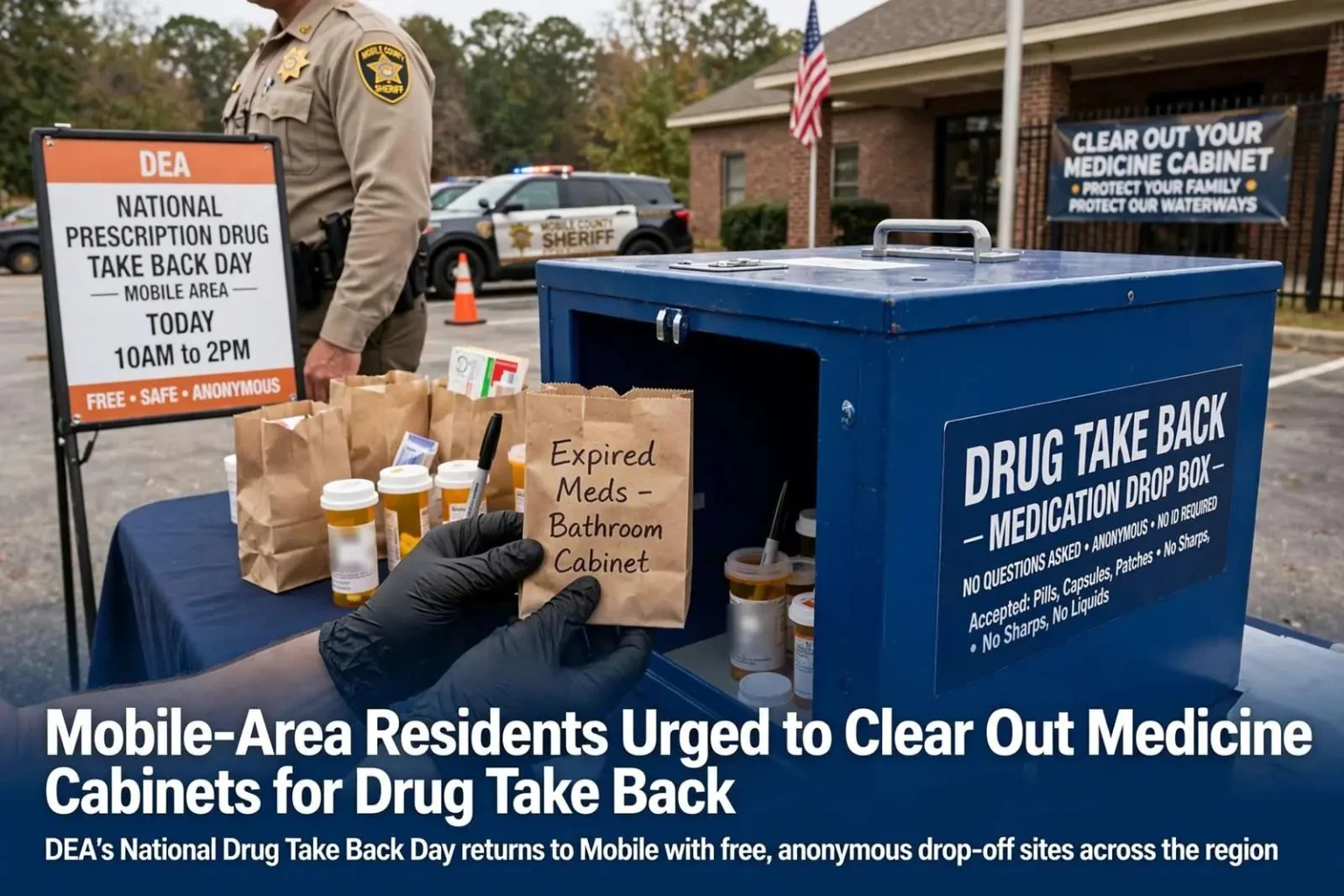
Law enforcement agencies across the Mobile area are once again asking residents to take a hard look at their medicine cabinets, as the U.S. Drug Enforcement Administration’s National Prescription Drug Take Back Day returns to the community with staffed drop-off sites open across the region. The event offers a safe, anonymous way to clear out expired, unused and unwanted prescription drugs, and officials say it remains one of the most straightforward public safety measures any household can take part in.
Unlike a curbside recycling day or a hazardous waste collection, no sorting or paperwork is involved. Residents simply drive up, hand over their medications and go. No identification is requested, no questions are asked, and no one keeps a record of who turned in what. That anonymity, organizers say, is deliberate: it removes the embarrassment or hesitation that keeps many people from disposing of medications properly in the first place.
Why It Matters
The stakes behind the small act of cleaning out a medicine cabinet are considerable. Flushed medications can contaminate water supplies, because wastewater treatment systems are not designed to filter out pharmaceutical compounds, and traces of those compounds have been detected in waterways across the country. Disposal in household trash is little better, since pills can be retrieved from the garbage or found by children and pets.
For families, the greater danger is often much closer to home. Pills left in a bathroom cabinet or on a kitchen counter are a leading source of opioid misuse, particularly among teenagers and young adults who encounter them without any plan to do so. A single leftover bottle of painkillers from a surgery or a dental procedure, forgotten for years, can be the starting point for a dependency no one in the household saw coming.
Health officials note that accidental poisonings involving medications remain a persistent problem, especially for young children who mistake pills for candy. Removing controlled substances from the home eliminates that risk entirely, which is why the take-back message is aimed at every household, not only those directly touched by addiction.
The Numbers Behind the Program
The effort has added up over the years. At last fall’s event, Americans turned in nearly 460 tons of prescription drugs — more than 900,000 pounds — at more than 5,800 sites operated by the DEA and nearly 4,800 state and local law enforcement partners, according to the Mobile County Sheriff’s Office. Those figures rank among the largest single-day collections the program has recorded.
Across its first 16 events, the program has collected almost 11 million pounds of pills, or nearly 5,500 tons. Each of those totals reflects the same network of sheriff’s offices, police departments and community organizations that staff the drop-off tables, secure the collection boxes and arrange for the drugs to be transported to incinerators approved for pharmaceutical destruction.
Alabama has for years ranked among the states with the highest rates of opioid prescribing per capita, and communities along the Gulf Coast have felt the consequences of that history acutely. Local participation in take-back events has been framed by area agencies as one practical piece of a much larger response that also includes enforcement, treatment referrals and sustained public education.
For the Mobile area specifically, the Sheriff’s Office and its partner agencies have treated the biannual event as a fixture on the community calendar, publicizing drop-off locations in the days before the collection window and reminding residents that the service is free and open to everyone.
How Take Back Day Works
The mechanics are simple. Residents gather any prescription or over-the-counter medications they no longer need, ideally leaving them in their original containers, and bring them to a staffed collection site during the posted hours. At most locations, personnel receive the medications directly from the vehicle, so participants never have to leave their cars.
Solid medications — pills, capsules and patches — are the core of what the program accepts. Residents with questions about particular items, such as liquids, inhalers or needles, should check with their individual drop-off site before arriving, since handling rules for those vary and sharps are generally directed to separate disposal channels.
Officials also encourage a measure of housekeeping before arrival. Removing or blacking out personal information on prescription labels protects the privacy of the person the drugs were prescribed to, even though the anonymous nature of the event means the information is never collected.
Year-Round Disposal Options
Residents who miss the event can still dispose of medications safely at any time of year. The DEA maintains a searchable list of permanent collection sites on its website, and many area pharmacies and law enforcement offices keep secure drop boxes on site where unused drugs can be deposited during regular business hours.
Those permanent boxes work much like the take-back tables: medications go in, no questions are asked, and the contents are collected regularly for destruction. Pharmacists at participating stores can also answer questions about which items are appropriate for the box and which require special handling.
For households holding substantial quantities of medication — those managing the estates of deceased relatives, for example, or clearing out decades of accumulated prescriptions — the permanent sites can be visited repeatedly rather than all at once, easing the burden of a single large drop-off.
Safe Storage in the Meantime
Until unused medications make it to a drop-off site, officials recommend storing them somewhere secure rather than in an unlocked medicine cabinet. A locked drawer or a lockbox kept out of sight sharply reduces the chance that a teenager, a guest or a worker in the home will encounter pills that were never meant for them.
Prescriptions should never be shared, even with a family member whose symptoms appear identical. A medication that is safe and effective for one person can be dangerous for another, and sharing controlled substances is against the law regardless of intent.
Keeping an occasional inventory of what is on hand is another low-effort safeguard. Knowing roughly how many tablets a bottle should contain makes it easier to notice when pills have disappeared — a detail that matters more than most families realize, because missing medication is often the first visible sign that someone in the household is experimenting.
Prevention Close to Home
Public health officials have repeatedly emphasized that the path into prescription opioid misuse often begins in a familiar place: the home medicine cabinet. Studies of people who misuse prescription painkillers have consistently found that a large share obtained their first pills from a friend or relative, typically free and typically without anyone’s knowledge.
That reality shapes how law enforcement talks about the take-back program. Rather than framing it strictly as an environmental service or a drug-seizure operation, area agencies describe it as prevention work — an intervention that happens before a crisis rather than after one.
It also explains why the event’s reach extends well beyond opioids. Blood pressure medications, antidepressants, antibiotics, sleep aids and common over-the-counter drugs all pose risks when they linger past their expiration dates or fall into the wrong hands, and all are welcome at collection sites.
The cumulative effect of millions of small decisions — one household deciding on an ordinary afternoon to finally clear out the cabinet — is what gives the program its scale. The tonnage is impressive, but the real work happens one kitchen drawer at a time.
The Broader Fight Against Opioid Diversion
Take Back Day sits within a much larger effort that has unfolded across Alabama and the Gulf Coast over the past decade. Communities throughout the region have pursued enforcement actions, expanded treatment and prevention education as the opioid crisis has touched households in every neighborhood and at every income level.
Area agencies have supplemented the biannual events with other tools, including medication lockboxes, drug disposal pouches and education campaigns aimed at parents. Each approach targets the same problem from a different angle: keeping legal medications out of circulation once they are no longer needed by the person for whom they were prescribed.
The twice-yearly rhythm of the national program — typically once in the spring and once in the fall — is designed to give households a recurring reminder to check for expired drugs, much like changing smoke detector batteries or reviewing insurance coverage. Officials hope the routine becomes as habitual as those other household rituals.
What Residents Should Do Now
The steps for participating are straightforward. Residents should go through their medicine cabinets and set aside anything expired, unused or no longer being taken, then bring those medications to a staffed drop-off site during the event’s posted hours. Locations are publicized by the participating agencies in advance and can also be found through the DEA’s take-back resources.
There is no cost, no paperwork and no reason to worry about getting anyone in trouble. Officers and volunteers at the sites are there to collect drugs, not to investigate the people surrendering them, and the program’s long track record has been built on exactly that trust.
Residents who cannot reach a site during the event hours are encouraged to use a permanent collection box instead, or simply hold their medications for the next take-back day. Officials ask only that people avoid the toilet and the trash, which remain the least safe disposal methods available.
A Simple Step With Lasting Value
Officials say removing opioids and other controlled substances from home cabinets is one of the simplest steps families can take to prevent accidental poisonings and diversion. It requires no special equipment, no appointment and no money — only a few minutes of attention twice a year.
For the Mobile area, each collection adds to a regional total that has grown steadily since the program’s earliest events, one bottle, one bag and one medicine cabinet at a time. Every pound of pills that leaves a home is a pound that cannot contaminate a waterway, poison a child or become someone’s first exposure to an opioid.
Residents with questions about drop-off locations, accepted items or year-round disposal options can contact the Mobile County Sheriff’s Office or search the DEA’s online directory for the closest permanent collection site.


