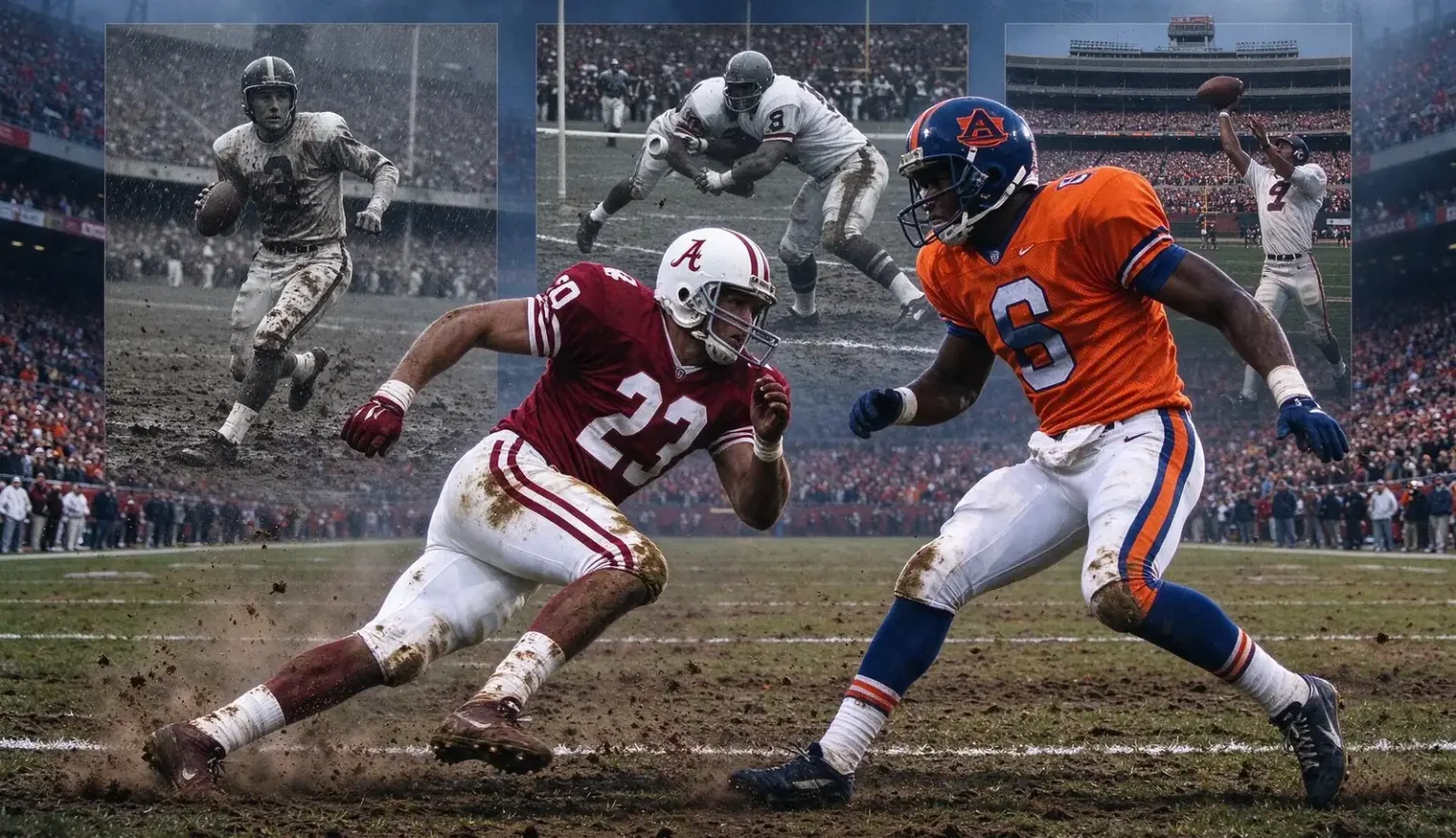
MOBILE, Ala. — Every Thanksgiving weekend, conversations around Mobile Bay drift toward the same subject. Neighbors who agree on nearly everything else split into crimson and orange, and the debates that follow can last until the next kickoff a year later. Woven through that rivalry is a remarkable thread of Iron Bowl history from Mobile and Baldwin counties: for more than six decades, players who grew up along the Gulf Coast have been right in the middle of the games Alabamians still argue about.
Some made plays that earned nicknames; others made the less glamorous plays that set up the famous ones. Together, their stories show how much of the rivalry’s lore runs through high school fields in Foley, Prichard and the neighborhoods of Mobile.
A rivalry built in Birmingham
Alabama and Auburn first met on the football field in 1893. After a dispute in the early 1900s, the series went dormant for four decades and did not resume until 1948. For much of the modern era, the game was played at Legion Field in Birmingham, a neutral site in a city whose steel industry gave the contest its enduring name, the Iron Bowl.
That changed in 1989, when Auburn hosted the game on its own campus for the first time, and again in 2000, when Alabama began hosting its home dates in Tuscaloosa. Through all of those eras, players from the Mobile area kept showing up in the box scores.
The workhorses
Paul Crane, Vigor High School, 1964
Paul Crane came out of Vigor High School in Prichard and played in an era when college players often stayed on the field for both offense and defense. At Alabama under Paul Bear Bryant, he snapped the ball at center and then lined up at linebacker, a two-way role that has all but vanished from the modern game. He was named All-SEC at linebacker in 1964 and earned All-America recognition at center the next season. Alabama’s records show him snapping the ball for the 1964 squad, which featured quarterback Joe Namath and receiver Ray Perkins.
Alabama entered that year’s Iron Bowl undefeated, but Auburn had one of the nation’s best backs in Tucker Frederickson, who would become the first overall pick in the 1965 NFL Draft. Frederickson’s short touchdown run gave the Tigers a 7-6 lead at halftime. Alabama answered when Ray Ogden took the opening kickoff of the second half back for a touchdown, and a scoring pass from Namath to Perkins later extended the lead. The Crimson Tide held on to win 21-14 and finish the regular season unbeaten. Because the major polls were finalized before the bowl games in that era, Alabama was crowned national champion. Crane did a bit of everything that afternoon, blocking on one series and tackling on the next.
Sherman Williams, Blount High School, 1994
Three decades later, another Mobile product won an Iron Bowl not with one spectacular moment but with relentless effort. Both teams came to Legion Field in 1994 without a defeat. Auburn had yet to lose under coach Terry Bowden, while Alabama, under Gene Stallings, had spent the season winning tight games.
Sherman Williams, a running back from Blount High School in Prichard, got Alabama on the board first, scoring on a 13-yard run, and kept carrying the ball all afternoon. Alabama built a 21-0 lead by halftime before Auburn rallied to within a touchdown. Williams finished with 164 yards on 27 carries. Auburn’s last chance ended on a fourth-down try that came up just short after a measurement, and Alabama won 21-14, ending the Tigers’ unbeaten run.
Legends on the biggest stage
Kenny Stabler, Foley High School, 1967
Few Iron Bowl moments are as vivid as the one Foley’s Kenny Stabler produced in a driving rainstorm at Legion Field in 1967. The field turned into a swamp, offense became nearly impossible and Auburn held a 3-0 lead deep into the game on the strength of a field goal. In the fourth quarter, Stabler, Alabama’s quarterback, broke loose on a long touchdown run through the mud. Accounts of the distance vary, with some putting it at 47 yards and others at 53, but the outcome does not: Alabama won 7-3, and the play has been known ever since as the Run in the Mud.
Stabler, nicknamed the Snake, went on to a celebrated NFL career with the Oakland Raiders. He was named the league’s Most Valuable Player for the 1974 season, led Oakland to a victory in Super Bowl XI and was inducted into the Pro Football Hall of Fame in 2016, the year after his death.
Julio Jones, Foley High School, 2009
More than four decades after Stabler, another Foley star helped decide one of the most important Iron Bowls of the century. Alabama arrived at Jordan-Hare Stadium in 2009 unbeaten and ranked No. 2, with the SEC Championship Game and a possible national title ahead. Auburn, 7-4 in Gene Chizik’s first year as head coach, jumped out quickly. Terrell Zachery raced 67 yards on a reverse for a touchdown, the Tigers then pounced on an onside kick and found the end zone again, and the Tigers led 14-0, the biggest hole Alabama faced all season.
Alabama tied the game by halftime, and Auburn regained the lead early in the third quarter on a 72-yard touchdown pass from Chris Todd to Darvin Adams. Trailing 21-20 with just over eight minutes to play, Alabama began a 79-yard march. Quarterback Greg McElroy repeatedly turned to Julio Jones, who hauled in four receptions for 33 yards during the possession, three of which moved the chains on third down. Auburn’s defense got to McElroy for a sack along the way, but Alabama kept possession. With 1:24 remaining, McElroy threw a short touchdown pass to Roy Upchurch, the first touchdown catch of Upchurch’s career, and Alabama won 26-21. The Tide went on to beat Florida in the SEC title game in Atlanta and Texas in the national championship game in Pasadena, completing a 14-0 season. Jones later became the sixth overall pick in the 2011 NFL Draft.
The plays before the famous plays
Mark Barron, St. Paul’s Episcopal School, 2009
That same 2009 game turned in part on a defensive play by a Mobile native. Mark Barron, a safety who starred at St. Paul’s Episcopal School, intercepted Todd with 4:48 left in the third quarter, his seventh interception of the season. Alabama turned the takeaway into a field goal, trimming Auburn’s lead to a single point and setting the stage for the winning drive. Barron later became a first-round NFL draft pick in 2012.
Greg Richardson, Williamson High School, 1985
Alabama fans know the 1985 finish simply as The Kick: Van Tiffin’s 52-yard field goal as time expired, giving the Tide a 25-23 victory. Less remembered is what had to happen first. Earlier in the game, Williamson High School receiver Greg Richardson had already made an impact with a lengthy punt return that led to Alabama points on a field goal.
Late in the fourth quarter, Auburn led 23-22, and Alabama had less than a minute and no timeouts. A fourth-down reverse to Al Bell had kept the Tide alive. Then quarterback Mike Shula hit Richardson over the middle. With an Auburn defender wrapped around him, Richardson kept driving toward the sideline until he got out of bounds near the Auburn 35, stopping the clock with six seconds to go. That left just enough time for Tiffin’s field goal unit to take the field and make history.
Nick Fairley, Williamson High School, 2010
In 2010, Auburn arrived in Tuscaloosa undefeated and ranked No. 2 behind quarterback Cam Newton, only to fall behind 24-0 in the first half. After the Tigers scored to make it 24-7, Alabama drove inside the Auburn 10 again, threatening to put the game away before halftime.
Nick Fairley, a defensive tackle from Mobile’s Williamson High School, stopped that threat. He broke through on second-and-goal, hit McElroy and jarred the ball loose, then fell on the fumble. Earlier in the game, Fairley had been flagged for unsportsmanlike conduct after celebrating a sack; this time he made sure of the recovery. Auburn went to the locker room down 24-7 instead of facing a larger deficit.
The second half belonged to Auburn. Newton threw a touchdown pass to Terrell Zachery and ran for another score, Alabama added a field goal, and Newton’s 7-yard touchdown pass to Philip Lutzenkirchen in the fourth quarter put Auburn ahead 28-27. The Tigers held on, completing what was then the largest comeback in Iron Bowl history, and went on to win the national championship. Fairley won the Lombardi Award that season and was selected in the first round of the 2011 NFL Draft.
Unexpected heroes
Lawyer Tillman, LeFlore High School, 1986
One year after The Kick, Auburn got its own dramatic ending, and it came from an unlikely source. Trailing 17-14 inside the Alabama 10 in the final minute, Auburn coach Pat Dye called for a reverse to a wide receiver. In the confusion of the moment, sophomore Lawyer Tillman, a product of Mobile’s LeFlore High School, ended up on the field for the play. He tried to signal for a timeout, the story goes, but the ball was snapped before he could.
Tim Jessie took the handoff and pitched it back to Tillman coming the other way, and Tillman swept around the end for the go-ahead touchdown with 32 seconds left. Auburn won 21-17. By most accounts, it was the first time Tillman had ever carried the ball in a college game.
Darrell Williams, Vigor High School, 1989
The 1989 game is remembered as a turning point for the rivalry itself. For the first time, Alabama traveled to Auburn to play at Jordan-Hare Stadium, arriving 10-0 and ranked No. 2.
Alabama led 10-7 at halftime, but Auburn took control after the break. Leading 17-10 in the fourth quarter, the Tigers mounted a 13-play, 80-yard drive capped by Darrell Williams, a freshman from Vigor High School known by the nickname Lectron, who broke tackles on a 12-yard touchdown run. Auburn won 30-20 in that first home Iron Bowl.
On the other side of the field, another Mobile product put together one of the finest defensive performances in series history. Keith McCants of Murphy High School was credited with 18 tackles, one interception and one forced fumble for Alabama, though it was not enough to win.
Neighbors on opposite sidelines
A recurring theme in these stories is how often Mobile-area players lined up against one another. In 1989, a Vigor freshman scored for Auburn while a Murphy linebacker piled up tackles for Alabama. In 2009, a St. Paul’s safety and a Foley receiver helped Alabama finish a comeback in a game in which several Auburn players from the Mobile area were also on the field. Former players from the region describe the experience as something that stays with them for life, a source of pride for their hometowns and of good-natured needling with old friends who wore the other colors.
Those friendships often outlast the playing days, and the topic of the rivalry inevitably comes up when old teammates and opponents cross paths. As one former player put it, the winner earns a full year of bragging rights, no matter how the rest of the season went.
Why the memories endure
Ask fans around Mobile Bay about the Iron Bowl and the answers often come in shorthand: Stabler in the rain, Richardson to the sideline, Tillman’s reverse, Lectron’s run, Sherman Williams grinding out yards, Barron’s interception, Julio on third down, Fairley on the loose ball.
For the Gulf Coast communities that produced these athletes, the games are more than history. They are proof that a kid from Foley, Prichard or a Mobile neighborhood could step onto the state’s biggest football stage and help decide the outcome. As another rivalry weekend arrives, those memories will be retold in living rooms, barbershops and tailgates across south Alabama, and some young player from the area may already be on the way to adding the next chapter.