With Mobile County pushing back the start of its school year amid the coronavirus pandemic, one Mobile nonprofit is stepping in to give working parents a safe place for their children to learn remotely. The Azalea City Center for the Arts has opened a supervised virtual learning program housed inside its Midtown facility, pairing daytime supervision with the arts instruction the center has long offered after school.
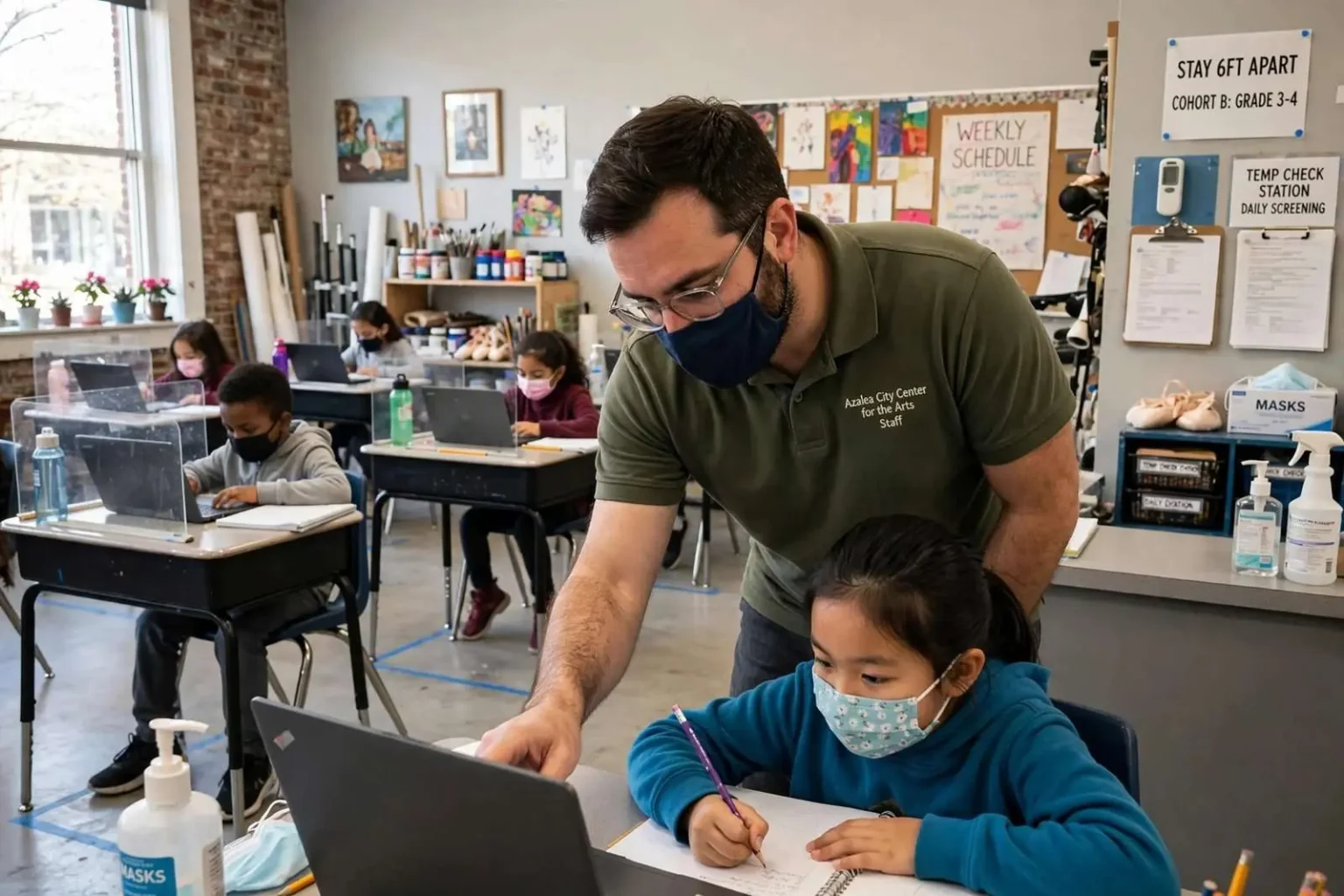
Students bring their own schoolwork and are supported throughout the day by a group of certified teachers, led by center director Christopher Paragone, who also tutors students himself. The model treats the center as a stand-in classroom: children log into their schools’ remote lessons on site, and adults with real teaching credentials circulate to answer questions, keep students on schedule and step in when the technology or the material stalls.
“One, it allows parents to go back to work if they need to go to work,” Paragone said of the program. “This is a safe environment where their kids will be. But it also provides real instruction — real in-person tutoring and assistance.” The dual promise addresses the two problems that defined the pandemic summer of 2020 for working families: childcare that vanished when schools closed, and remote learning that many parents feared would leave their children behind without in-person help.
Health and Safety Precautions
The center operates out of a roughly 10,000-square-foot building, with students spaced out into separate classrooms grouped by grade level. The space gives the program room to separate cohorts — a safeguard borrowed directly from the school-reopening guidance of the period, which emphasized keeping small, consistent groups of students apart from one another to limit any potential spread of the virus.
Staff require face masks, conduct temperature checks, and carry out regular, rigorous cleaning of the facility. The precautions mirror what Mobile County parents were being told to expect when in-person instruction eventually resumed: daily screening at the door, masks indoors, and surfaces cleaned throughout the day rather than once at closing. For families weighing whether a supervised program was worth the exposure, the protocols were the deciding factor.
The grade-level grouping also serves the learning side of the program. Children in the same grade are usually working through similar curricula, so seating them together lets the certified teachers assist several students on the same material at once — a small detail that makes a roomful of remote learners manageable in a way mixed-age groupings would not be.
From Schoolwork to Stagecraft at 3 P.M.
Once the school day wraps up around 3 p.m., the program shifts into enrichment mode. Students who stay until the center closes at 6 p.m. rotate through stations featuring puzzles, games, science experiments, and arts and crafts, and receive instruction in drama, music, singing, dance, and gymnastics. The afternoon lineup draws on the center’s existing identity: the Azalea City Center for the Arts built its reputation on arts education, and the virtual learning program slots directly into facilities and staff designed for performance teaching.
The 3-to-6 p.m. window is precisely the gap that working parents struggle to fill in normal years — the hours between the final bell and the end of the workday. In a pandemic year when the final bell itself moved home, the center’s approach extends supervision straight through it: schoolwork by day, then the kind of active, screen-free enrichment that parents of elementary-age children in particular describe as the hardest thing to replicate at home.
The structure also gives the program a natural rhythm that helps children. Morning and midday are school — quieter, seated, grade-grouped — and the afternoon opens into movement and creation. Teachers who supervise multiplication tables at noon are teaching tap or voice at four, which keeps the environment consistent for the children even as its content shifts.
Enrollment Details
Pricing varies by student age, and only a handful of spots remained open at the time of the announcement. Adding after-school care costs an extra $30 per week. The age-based pricing reflects the differing staffing demands of different grades — younger children require closer supervision and smaller groups — while the flat $30 weekly charge for afternoon enrichment keeps the add-on simple for families budgeting in an uncertain economy.
If the program reaches capacity, the center plans to maintain a waiting list. Demand outstripping seats on opening was the predictable result of a program that solved two problems at once: it gave Mobile County parents a way to return to work during a school year that began remotely, and it gave their children something neither a babysitter nor a laptop alone could provide — certified teachers in the room, and an arts curriculum waiting at 3 p.m.
What the Program Says About the Fall of 2020
The Azalea City Center’s pivot is a case study in how small nonprofits adapted to a school year nobody had planned for. Mobile County’s decision to push back the start of its year left families with a gap between the end of summer routines and the beginning of whatever instruction would look like — remote at first, with reopening plans still being negotiated. Community organizations with space, staff and educational missions became part of the de facto infrastructure almost overnight.
The center’s program also illustrates the specific bind facing working parents in a district the size of Mobile County’s. Remote learning assumes an adult at home; many households cannot provide one. A supervised program staffed by certified teachers, priced by the week with an optional after-school extension, sits in the gap between what schools were offering and what jobs required — and its near-immediate capacity crunch shows how many families were living in that gap.
For the children enrolled, the experience of the fall was unusual by any measure: school in a building that is not a school, classmates grouped by grade rather than neighborhood, temperature checks at the door, and drama, dance and gymnastics in the afternoons. But it was also, by the standards of that disrupted season, a remarkably complete version of what a school day could still look like — structure, instruction, safety and, at 3 p.m., a stage.
A Facility Built for This Moment
The center’s roughly 10,000-square-foot Midtown building proved unusually well suited to pandemic-era learning. An arts facility is, by design, a collection of separated rooms — studios, practice spaces, classrooms — built for small groups doing different activities at once. That architecture transferred to cohort-based remote learning with little modification: each grade group in its own room, doors between them, traffic managed so cohorts never mingled in the halls. What was built for rehearsals became, for the fall, a one-room-schoolhouse-per-grade.
The staffing model drew on the same assets. A center led by a director who personally tutors students — as Paragone does — has teaching depth on staff that a typical daycare does not, and the certified-teacher requirement the program advertised reflects that depth. Supervision and instruction are different services; the program’s pitch to parents was that it provided both, in a building where the afternoon staff already knew how to run a classroom of energetic children.
The Afternoon Arts Advantage
The enrichment offerings — drama, music, singing, dance and gymnastics — do more than fill time. Arts educators argue, and a growing body of practice supports, that physical and creative activity after a day of screen-based schooling helps children decompress, retain focus and stay motivated for the next morning’s lessons. For a generation of students spending their school day on video calls, an afternoon of tumbling and rehearsal is not a luxury; it is the difference between a sustainable routine and a grind.
The rotation-through-stations format also manages something remote learning struggles with: variety. Puzzles, games, science experiments and arts and crafts give each afternoon multiple changes of pace, which matters enormously to elementary-age children whose attention and energy cycle quickly. Parents picking up at 6 p.m. collect children who spent the day with peers, not parked alone in front of a screen — the outcome remote learning at home most often fails to provide.
The waiting-list plan signals that the center expects demand to persist as long as the disrupted school year does. Should Mobile County’s reopening plans shift mid-year, the program’s structure — schoolwork support by day, enrichment by afternoon — can flex with the calendar, since students bring their own schoolwork regardless of which mix of remote and in-person days their schools are running. That flexibility is the quiet strength of the model: it was built for uncertainty, week by week, and priced so that families could adjust their enrollment as the school year unfolded.
Families interested in remaining spots or the waiting list can contact the center directly, where staff can walk them through age-group pricing, the $30 weekly after-school add-on and the daily schedule from morning drop-off to the 6 p.m. closing.