
Mobile Arts Council’s ‘Art After Hours’ Networking Night Set for Oct. 20 at Host Gallery
Mobile Arts Council hosts its free Art After Hours mixer Oct. 20 from 5:30-7 p.m. at Host Gallery, 111 Dauphin St. RSVP by Oct. 17.
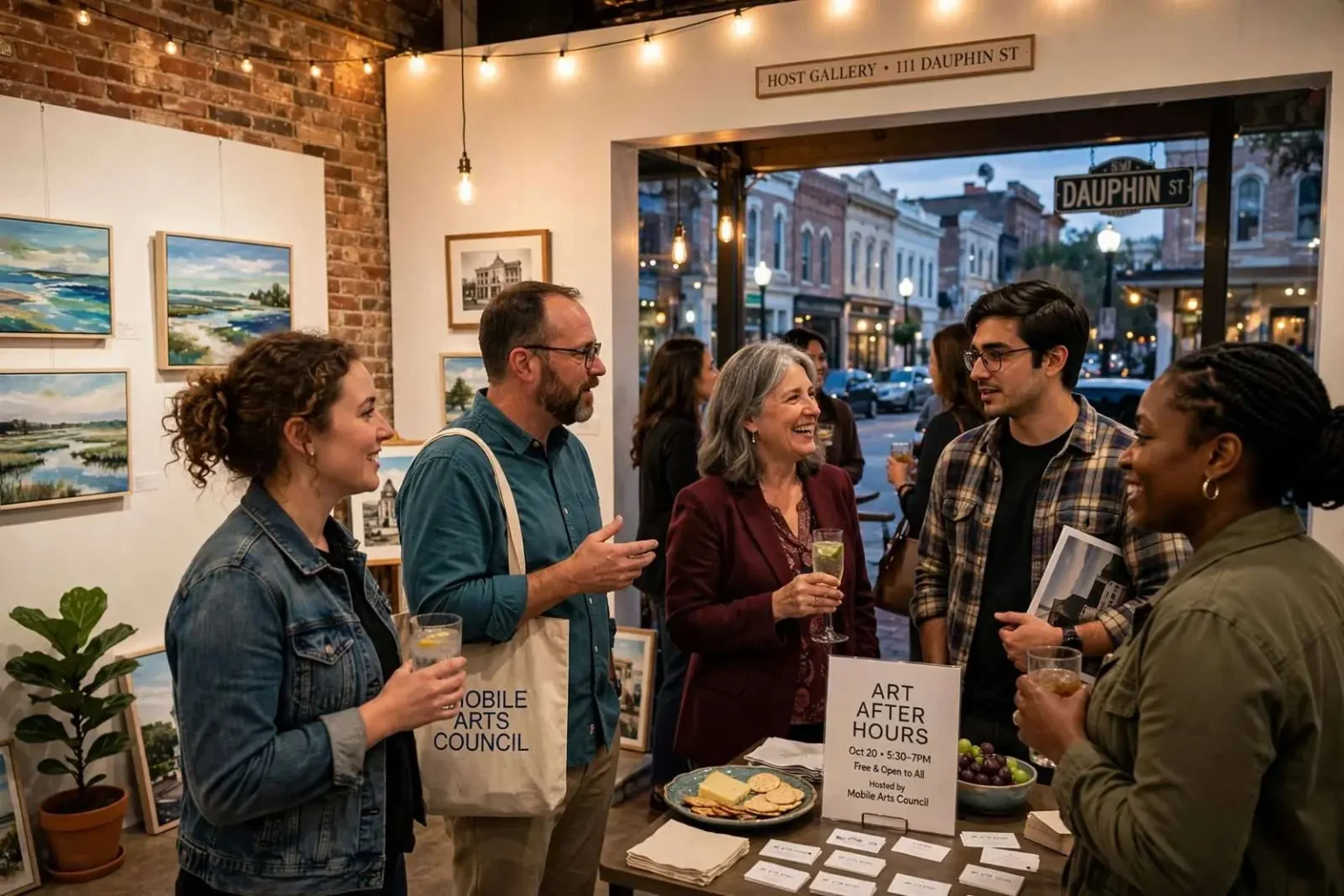
MOBILE, Ala. — Mobile Arts Council brings back its “Art After Hours” social on Thursday, October 20, from 5:30 to 7 p.m., this time hosted at the Host Gallery at 111 Dauphin St. in downtown Mobile. The free informal gathering is open to anyone involved in — or simply curious about — the visual or performing arts.
Organizers bill the evening as a chance to meet artists, make friends, talk up an organization or a personal project, and network with potential collaborators, all without formal programming. There are no speakers, no ticketed presentations, and no agenda beyond conversation: attendees drift through the gallery, look at whatever work is on the walls, and meet the people behind the Gulf Coast’s creative scene face to face.
Those planning to attend are asked to contact the Mobile Arts Council by October 17 so hosts can plan for the crowd. The series rotates among downtown venues as part of the council’s effort to keep the city’s creative community connected between gallery seasons — the quieter stretches of the calendar when openings and festivals thin out but the work of building collaborations goes on.
The Host Gallery on Dauphin Street
The Host Gallery occupies a spot along Dauphin Street, the spine of downtown Mobile’s commercial and nightlife district and the heart of the city’s gallery scene. Dauphin Street’s blocks between the cathedral and the eastern end of downtown hold a concentration of galleries, studios, bars, restaurants, and restored commercial buildings that make it the natural gathering place for Mobile’s art community — a role the street has played through decades of downtown’s decline and revival.
Hosting Art After Hours at 111 Dauphin Street puts the social event in the middle of that corridor, within walking distance of studios and venues where many attendees already spend their evenings. The gallery setting matters too: seeing art on the walls gives strangers something to talk about, and a room full of work by local artists doubles as an informal showcase for the exhibitors whose pieces hang there. For working artists, a gallery-full of potential collectors, collaborators, and employers is precisely the audience a networking night is built to attract.
What the Mobile Arts Council Does
The Mobile Arts Council has spent decades serving as the connective tissue of the city’s cultural community — a nonprofit organization that supports artists and arts organizations across Mobile County through grants, exhibitions, advocacy, and shared programming. The council’s work ranges from juried shows and gallery exhibitions to school partnership programs and support for the smaller organizations that produce the Gulf Coast’s theater, music, dance, and visual art.
Events like Art After Hours sit on the community-building side of that mission. Exhibitions and performances put finished work in front of an audience, but the collaborations that produce them usually begin in more casual settings — a conversation between a painter and a venue owner, a musician and a filmmaker, or two organizations discovering that their projects overlap. The council’s bet is that a room of creative people with nothing scheduled is one of the most productive spaces downtown, and that Mobile’s arts scene grows strongest when its members know each other by name.
The rotating venue model also serves the council’s partners. Each edition spotlights a different downtown space — a gallery, a studio, a business with wall space to share — introducing attendees to corners of the city’s creative map they might not otherwise visit. By the time the series moves to its next host, the previous venue has usually gained new visitors, and the council has added another setting to its circuit of supporting spaces.
Who Shows Up — and Why It Matters
The council’s invitation is deliberately broad: anyone involved in, or simply curious about, the visual or performing arts. In practice, that means working painters, photographers, sculptors, and ceramicists alongside actors, musicians, dancers, and writers; gallery owners and nonprofit staff; art teachers and students; and the larger group of residents who buy art, attend shows, and volunteer at festivals but make none of it their profession. That mix is the point — working artists need audiences and patrons as much as they need each other, and the community members who show up out of curiosity are the future board members, donors, and collectors that every arts ecosystem depends on.
The no-programming format is a conscious choice rather than an omission. Formal arts events — openings, receptions, award ceremonies — come with their own scripts: a person to listen to, a crowd to move through, a work to look at on cue. An event with none of those structures leaves room for the unpredictable conversations that produce the next show, the next partnership, or the next organization. Organizers describe the social as a place to “talk up” a project precisely because attending artists and organizations are welcome to use the room that way: to recruit help, float ideas, and find the people who will turn a proposal into a production.
For anyone new to Mobile’s arts community, the event functions as an open door. Breaking into a local creative scene usually requires knowing someone, and the barrier to entry for a newcomer at an unstructured social is a single introduction. The council’s staff and volunteers are on hand to make those introductions, which is one reason the organization asks attendees to register ahead of time — hosts know roughly how many people to expect, can prepare name tags and refreshments accordingly, and can keep an eye out for first-timers who arrive knowing no one.
Between Gallery Seasons
The timing of the October 20 gathering falls in the stretch the council describes as between gallery seasons — the point in the fall calendar after the summer slowdown but before the dense run of holiday shows, festival weekends, and season-opening performances fills the city’s schedule. It is exactly the window when artists are preparing new work, organizations are finalizing their season plans, and collaborations for the coming year are still open to new participants.
Downtown Mobile’s arts calendar in a typical year includes monthly art walks along Dauphin Street, juried exhibitions, theater and music seasons, and the larger festivals that draw regional crowds. Those headline events get the attention, but the quieter networking layer underneath them — the after-hours conversations, studio visits, and partnerships formed away from the stage — is what sustains the scene between them. A social like Art After Hours is designed to hold that layer together, keeping the community connected when there is no opening to attend and no performance to see.
The Practical Details
Art After Hours runs from 5:30 to 7 p.m. on Thursday, October 20, at the Host Gallery, 111 Dauphin St., in downtown Mobile. Admission is free, and the invitation extends to artists, arts organizations, and members of the public with an interest in the creative community. Attendees are asked to contact the Mobile Arts Council by Monday, October 17, so that hosts can plan for the size of the crowd.
For downtown workers, the early-evening hour makes the event an easy stop between the end of the workday and dinner along Dauphin Street; for artists, it is a chance to put a face with the names that circulate through the council’s exhibitions, grants, and programs across Mobile County. Parking along the Dauphin Street corridor and in nearby downtown lots is typically available in the evening hours, and the location places the gallery within a short walk of the restaurants and venues that make downtown Mobile a natural place to extend the night after the social ends. The two-hour window also keeps the event accessible for parents and for working artists who cannot give up a whole evening midweek but can slip away for an early drink and a few good conversations.
First-time attendees often ask what to bring to an event with no program. The honest answer is very little: business cards or contact information for anyone promoting a project, a few sentences ready about what they make or what they are looking for, and a willingness to start conversations with strangers. Artists who want feedback on work in progress can use the room to find potential mentors and critics; representatives of arts organizations can use it to recruit volunteers and board members; and patrons can use it to learn what is being made in Mobile before it reaches a gallery wall or a stage.
The council’s rotating social series has become one of the steady fixtures of Mobile’s creative calendar — unglamorous, free, and essential to the way the city’s arts community renews itself. Anyone whose October is otherwise empty of art has an open invitation to spend two hours in a gallery full of it, surrounded by the people who make the rest of the calendar happen.


