Mobile Arts Council’s John Chamblin painting sale ends Friday
The Mobile Arts Council's sale of paintings by John Chamblin at 318 Dauphin Street closes Friday, March 2.
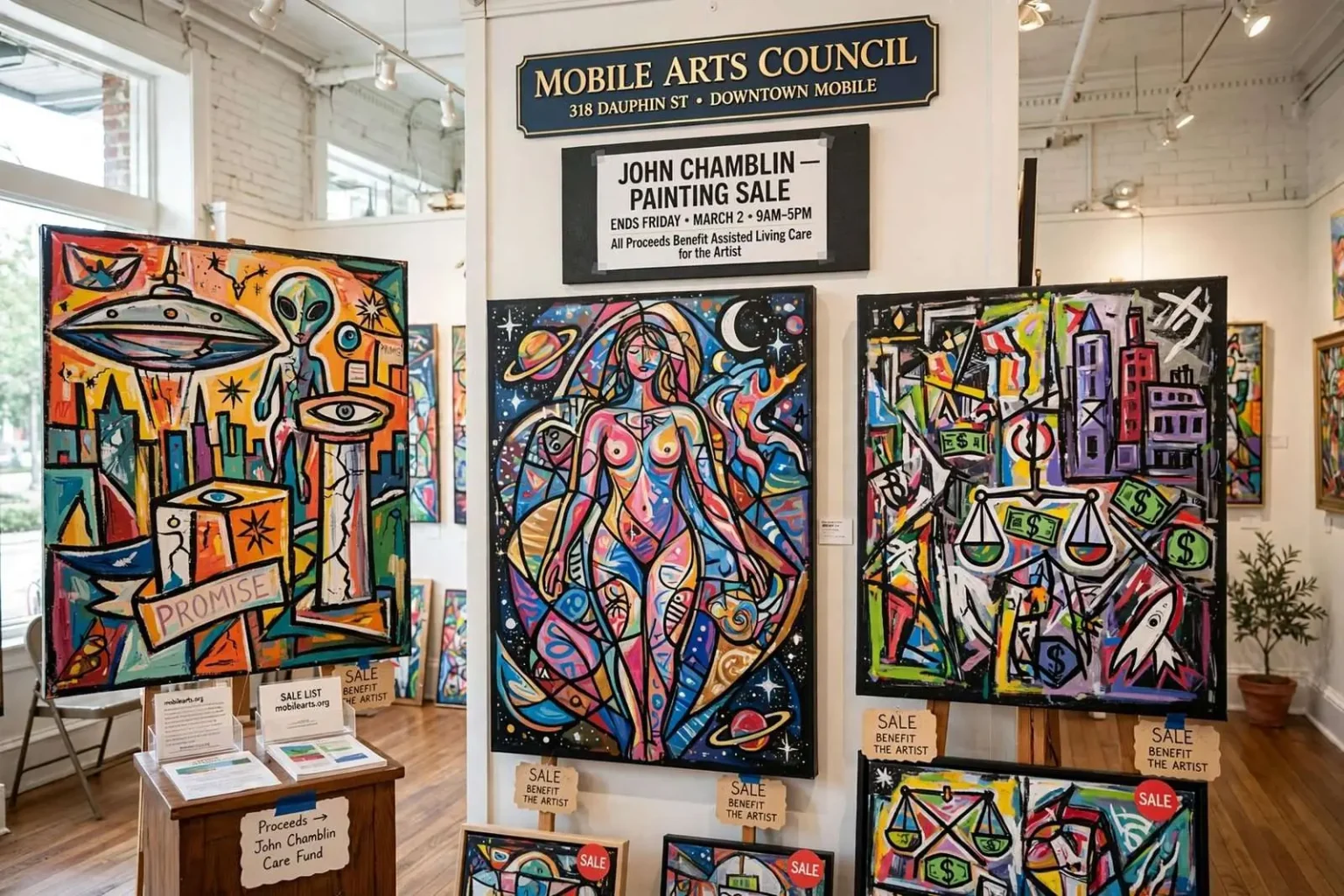
The Mobile Arts Council is hosting a sale of paintings by John Chamblin at its galleries at 318 Dauphin Street in downtown Mobile. The sale closes Friday, March 2, and the galleries are open daily from 9 a.m. to 5 p.m. For collectors and curious passersby alike, the exhibition offers an unusually complete look at a singular Alabama artist — and a chance to support him at a moment when he needs it most.
All proceeds from the sale will go to defray the costs of the assisted living expenses of Chamblin, who spent more than 40 years developing his own deeply personal vision of the world, human society and outer space. The fundraising purpose gives the sale a poignancy that ordinary gallery shows lack: every canvas that leaves the gallery directly supports the artist who made it, and the works on view represent a career’s worth of output gathered together rather than scattered across private collections and storage.
Chamblin’s work often reached beyond direct observation, focusing instead on what he intuited as truth, whether in the form of a model or in his examination of corporate and political systems that he believed had disrupted the precepts of the American Dream. That conviction — that painting could diagnose the world rather than merely describe it — runs through the decades of work on the gallery walls. Where many regional painters built careers on landscapes and portraits drawn from life, Chamblin used the canvas as a place to test ideas: about power, about belief, about what modern society promised its citizens and where it fell short.
A career built on personal symbolism
Chamblin drew on a wide range of influences, from Matisse and Picasso to the Abstract Expressionists. The lineage shows in the work’s structure. From the French modernists he took an appetite for color and form liberated from strict representation; from the Abstract Expressionists, the belief that a painting could carry emotional and intellectual weight through gesture and composition alone. But Chamblin filtered those influences through an imagination entirely his own, producing paintings that never quite resemble anyone else’s.
His canvases, always full of personal symbolism, touched on social, religious and political subjects, as well as female nudes, aliens and spaceships, and his ideas about alien life forms. The mixture is disorienting on first encounter — the sacred beside the science-fictional, the political beside the sensual — but it reflects a coherent inner world. For Chamblin, the possibility of life beyond Earth was not a novelty but a serious subject, one more strand in a lifelong inquiry into what humans believe, what they worship and what they are hiding from themselves. The recurring figures and motifs across his decades of work reward the kind of extended viewing a single-artist exhibition makes possible.
He worked in bright, vivid colors recalling the Fauves and strong black lines related to Rouault and Kline. The comparison is precise. The Fauves — the early-20th-century French painters whose wild, non-naturalistic color earned them the nickname “the wild beasts” — treated paint as an emotional instrument rather than a descriptive one, and Chamblin’s palettes operate the same way. Georges Rouault’s heavy black contours, which gave his religious paintings the gravity of stained glass, and Franz Kline’s sweeping black-and-white abstractions both echo in Chamblin’s line work, which often structures his crowded, symbol-laden compositions the way lead lines hold a window together.
Why this sale matters
The Mobile Arts Council said the sale offers one of the few opportunities for the public to see the range and diversity of Chamblin’s vision gathered in a single show. That breadth is the point. An artist who spent four decades moving among social commentary, religious imagery, fantasy and abstraction is difficult to summarize from a single canvas or two; only a room full of work, spanning the years, shows the themes that persisted and the styles that evolved. Visitors to the Dauphin Street galleries can trace the constants — the vivid color, the black line, the personal symbols — while watching the ideas shift from decade to decade.
The sale format also means the works are available to take home, at prices set to move them for the artist’s benefit. For Mobile’s collecting community, it is a rare chance to acquire significant work by a locally significant painter while the full arc of his career is on the wall; for first-time buyers, it is an accessible entry into original art with a story attached. Every purchase feeds directly into the fund supporting Chamblin’s care.
Images of some of the pieces are being featured on the council’s Facebook page and website, mobilearts.org, giving prospective buyers a preview before they visit. The online previews have extended the sale’s reach beyond walk-in traffic, letting area art lovers survey the exhibition from home and identify the pieces they want to see in person. As with any sale of this kind, availability changes as works sell, so the online listings and the gallery floor can look different from one day to the next.
The Mobile Arts Council on Dauphin Street
The Mobile Arts Council, a nonprofit supporting the arts in south Alabama, has long been a fixture on Dauphin Street in downtown Mobile, hosting exhibitions, programs and events for the region’s artists. Its galleries sit in the heart of the city’s downtown entertainment district, a block of historic storefronts that comes alive on the monthly LoDa Artwalk, when galleries, studios and businesses open their doors for an evening of browsing and street traffic. For decades the council has served as a hub for that ecosystem — a place where working artists exhibit, where emerging talent gets a first show, and where the public can encounter art without admission fees or gatekeeping.
The organization’s mission reaches well beyond its gallery walls. The council administers grants and programs for area artists and arts organizations, coordinates community events, and advocates for the role of the arts in Mobile’s civic and economic life. A sale like Chamblin’s fits squarely within that mission: it uses the council’s exhibition space and reach to serve an artist of the region at a moment of genuine need.
Seeing it before Friday
With the sale closing Friday, March 2, the remaining days of daily gallery hours — 9 a.m. to 5 p.m. — are the last chance to see the exhibition in full. Morning visits offer a quiet gallery and time with individual canvases; the lunch hour and late afternoon tend to draw the heaviest traffic, particularly as the closing date approaches.
For those who knew Chamblin’s work in its day, the show is a reunion; for those encountering it for the first time, it is an introduction to one of the more uncompromising artistic visions the region has produced. Either way, the sale accomplishes what the best gallery shows do: it puts a body of work together in one room, gives it a purpose beyond decoration, and invites the public to look closely — this time, with the knowledge that looking closely is also a way of giving back to the man who made it all.
Art as a life’s ledger
Exhibitions built around a single self-taught or regionally rooted visionary often ask viewers to adjust their expectations, and Chamblin’s show is no exception. These are not paintings designed to match a sofa. They are dense, opinionated and unafraid, made by an artist who treated each canvas as a statement that needed to be made. The symbols recur with the insistence of a personal language: figures and forms that mean one thing in one painting and accrue new meanings across the span of the exhibition, until a visitor who walks the room twice begins to read them the way one learns the vocabulary of any artist’s world.
That quality — work that rewards attention rather than demanding it — is precisely what the Mobile Arts Council’s galleries are suited to. The Dauphin Street space, with its accessible downtown location and steady foot traffic, has a way of converting curiosity into engagement. A passerby who ducks in to escape the street for ten minutes often leaves having spent an hour with a single artist’s universe, and the council’s daily, no-appointment gallery hours make that kind of accidental discovery part of the neighborhood’s rhythm.
The timing of the sale, closing on a Friday, also places its final days at the front edge of the weekend, when downtown Mobile is at its busiest. Diners and bar-goers who arrive in the evening may find the galleries closing their doors for the day, which makes a daytime visit the reliable option for anyone planning to see the full exhibition before the works are dispersed to their new owners.
Once the sale ends, the exhibition comes down and the canvases scatter into private collections across the region, as these shows always do. What remains is the record: a four-decade career documented in one final gathering, a community that showed up for one of its own, and the quiet satisfaction — for those who bought a piece — of knowing the painting on their wall helped carry the artist through the years that followed it. The Mobile Arts Council’s galleries at 318 Dauphin Street remain open daily from 9 a.m. to 5 p.m. through Friday, March 2.