Mobile attorney arrested, charged with harassment
A Mobile attorney was arrested and charged with harassment after a complaint was filed in Mobile Municipal Court; the allegations are pending in court.
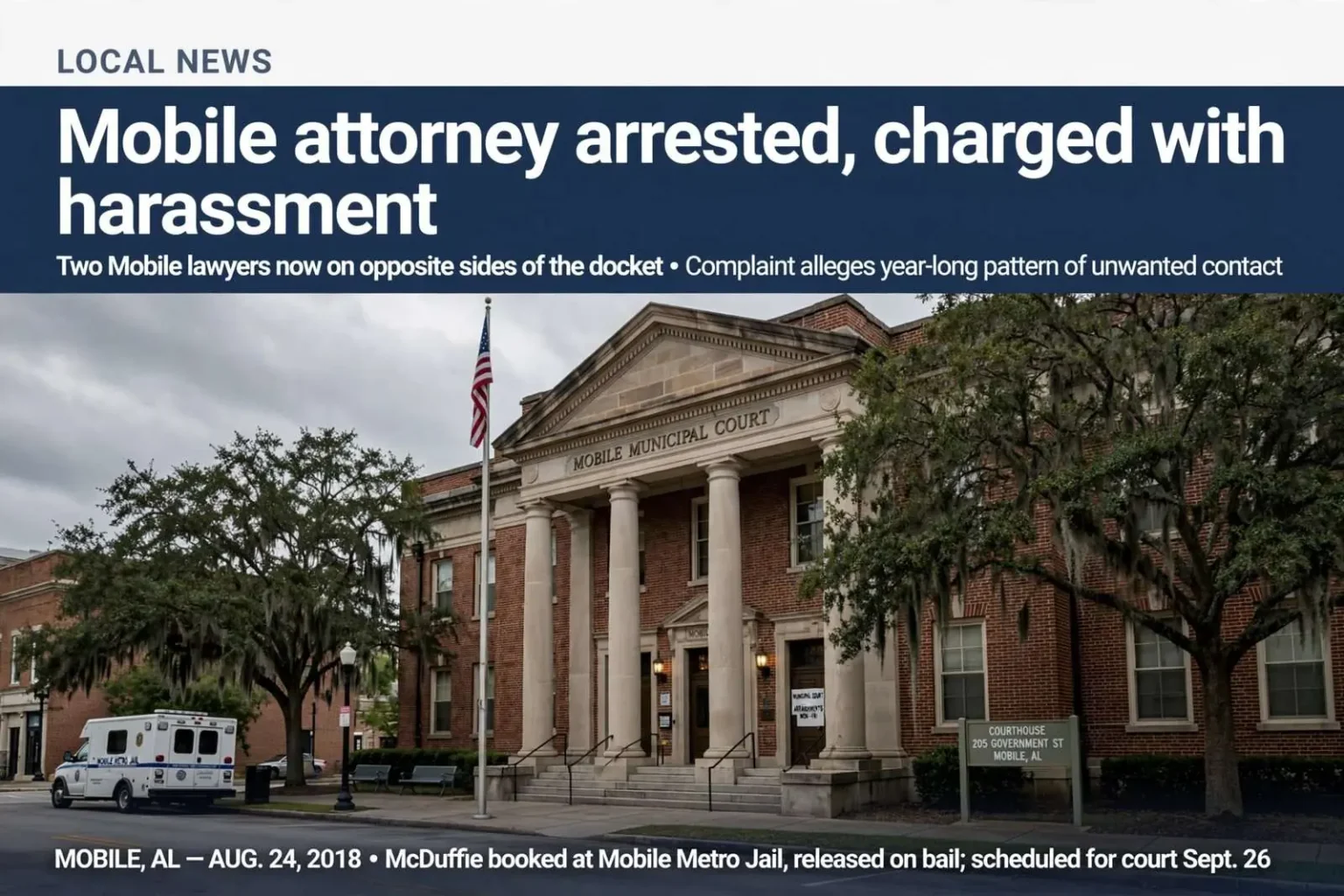
A Mobile attorney has been arrested and charged with harassment. According to a complaint filed in Mobile Municipal Court, Michael Hilding McDuffie is accused of harassing another local attorney, Lindsay Mims. The complaint, dated Aug. 24, 2018, alleges the behavior continued for more than a year and included repeated unwanted contact and inappropriate comments that alarmed the victim. McDuffie was booked into the Mobile Metro Jail on Monday just before 3:30 p.m. and posted bail about 40 minutes later, according to the complaint. He is scheduled to appear in Mobile Municipal Court on Sept. 26. The allegations have not been proven in court.
The case stands out for its setting: two members of the same local bar, practicing in the same courts, with one accused of waging a year-long campaign of unwanted contact against the other. Harassment charges built on a pattern of repeated behavior are different from a single-incident dispute, and the complaint filed in August laid out an alleged course of conduct that stretched across more than twelve months before police made the arrest.
What the Complaint Alleges
The complaint filed Aug. 24 in Mobile Municipal Court describes repeated unwanted contact and inappropriate comments directed at Mims over a period lasting more than a year, conduct the complaint says alarmed the victim. Harassment under Alabama law can cover a range of behavior, but the essence of the charge is a course of communication intended to harass, annoy or alarm another person — and a documented pattern, rather than a one-time exchange, is typically what separates a harassment charge from a barroom argument or a heated professional disagreement.
Because the complaint is the starting point of the case rather than its conclusion, the details it contains remain allegations. The document dates the conduct, names both parties and states the period over which it allegedly occurred, and the court process that follows — from the Sept. 26 appearance through any trial — will test whether the evidence supports what the complaint asserts.
The Arrest and Quick Release
The arrest itself moved quickly through the booking process. McDuffie was booked into Mobile Metro Jail just before 3:30 p.m. Monday, and by roughly 40 minutes later he had posted bail and been released, according to the complaint. The brief stay at the jail reflects how misdemeanor cases like harassment move through Mobile’s system: bail schedules set standard amounts for common charges, allowing arrestees who can post the amount to be released the same day, often within hours of booking.
That speed is by design rather than exception. The mobile jail intake processes arrestees through fingerprinting, photographs and paperwork, and a defendant facing a misdemeanor charge with a set bail amount can complete the process in under an hour when payment is arranged. The speed of release does not reflect the weight of the charge — it reflects a system calibrated to move low-level cases efficiently while the court process unfolds on its own calendar. Release on bail pending trial is the norm for most misdemeanor defendants, with the court date serving as the guarantee of the defendant’s return to the system.
Attorneys on Both Sides of the Docket
What makes the case unusual is that both the accused and the alleged victim practice law in Mobile. The city’s legal community is close-knit; attorneys appear before the same judges, work the same courthouse halls and often sit across the table from one another in cases for years. A criminal complaint between two members of that community ripples further than it would between strangers, raising questions about professional relationships, court appearances where both may be present, and how the local bar absorbs a dispute that has moved from the professional register into the criminal one.
Mobile Municipal Court, where the complaint was filed and where McDuffie is scheduled to appear Sept. 26, handles misdemeanors, municipal ordinance violations and traffic cases arising within the city. Harassment cases filed there proceed like other misdemeanors, with an arraignment followed by pretrial proceedings and, if the case is not resolved, a trial.
What Happens at the Sept. 26 Appearance
McDuffie’s scheduled appearance in Mobile Municipal Court on Sept. 26 will be the first public step in the case after the arrest. At an initial appearance, a defendant hears the charge formally, enters a plea and learns the schedule for what follows. In misdemeanor cases that are not resolved at the first setting, subsequent dates address discovery, motion practice and any negotiation between the prosecution and the defense.
Harassment is a misdemeanor under Alabama law, and the penalties upon conviction can include fines and jail time, though first-offense cases with no prior record often end in other outcomes, from dismissal to pretrial diversion. None of those possibilities has been reached here; the case exists so far as a complaint, an arrest and a court date, and each step that follows will be public record in the municipal system.
The Presumption That Remains
The allegations have not been proven in court, and that fact is the frame around everything else in the case. A complaint is an accusation made under oath at the start of a process, not a finding, and McDuffie is entitled to the presumption of innocence that applies to every criminal defendant regardless of profession or the nature of the charge. The court proceedings that begin Sept. 26 are the mechanism by which the allegations will be tested, evidence weighed and a resolution reached.
For Mims, the complaint describes a year of conduct that alarmed her, and the case now moves forward under the protections the process provides to alleged victims, including the ability to be heard as the case progresses. For McDuffie, the arrest and charge are the beginning of a legal process he will navigate as a member of the same profession that will be watching how it unfolds. The bail he posted within roughly 40 minutes of booking released him pending trial, with the municipal court’s standard conditions applying until the case concludes.
Cases between members of the same bar also draw attention from professional oversight bodies. The Alabama State Bar regulates attorney conduct, and criminal charges against a lawyer can trigger separate review processes that operate independently of the criminal case, weighing whether the alleged conduct violates the professional conduct rules that govern all licensed attorneys. Those proceedings follow their own timeline and can result in outcomes ranging from no action to discipline, depending on what the criminal case reveals.
Members of the public following the case through the municipal docket will see each step recorded as it comes.
The year-long period described in the complaint also matters for how such cases are evaluated. Conduct that persists for more than a year, documented in a complaint filed with the court, presents a different picture than a single disputed encounter, and prosecutors who review harassment cases look at the duration, the frequency of the contact and the effect on the person receiving it. Those same factors will be at the center of the evidence if the case proceeds to trial.
Repeated unwanted contact is a pattern courts see often enough that the legal system has built specific tools around it. Beyond the criminal charge itself, a person who alleges a course of harassment can seek protective orders that make further contact a separate offense, and documentation of the pattern — messages, calls, witness accounts — forms the backbone of both the criminal case and any civil protection. The complaint filed in August establishes the timeline the rest of the case will be measured against, and each additional month it covers strengthens the picture of sustained conduct rather than isolated incident.
The profession of both parties adds a practical dimension to the proceedings. Attorneys charged with crimes must disclose certain matters to the bar, and the municipal case will run alongside whatever professional obligations follow. Court schedules, client matters and the routine overlaps of a legal practice mean the two lawyers may encounter each other in professional settings while the case is pending, a situation courts handle through standard scheduling and, where appropriate, conditions of release.
Mobile’s legal community has seen the case move quickly from a quiet filing to an arrest to a scheduled court date, all within a span of weeks. The Sept. 26 appearance in Mobile Municipal Court will be the first public accounting of the allegations, and the weeks that follow will determine whether the case is resolved early or proceeds through the full process the misdemeanor system provides.
What remains constant through all of it is the standard: allegations in a complaint are not findings, an arrest is not a conviction, and the outcome of the case will be determined in the courthouse where both the accused and the alleged victim have spent their careers.