Mobile Author Watt Key to Headline History Museum’s May Learning Lunch
Mobile author Watt Key, whose novel "Alabama Moon" won national acclaim, will headline the History Museum of Mobile's May 13 Learning Lunch, part of a busy month for local arts that also includes an MSO season finale, a new downtown mural and a children's theater production.
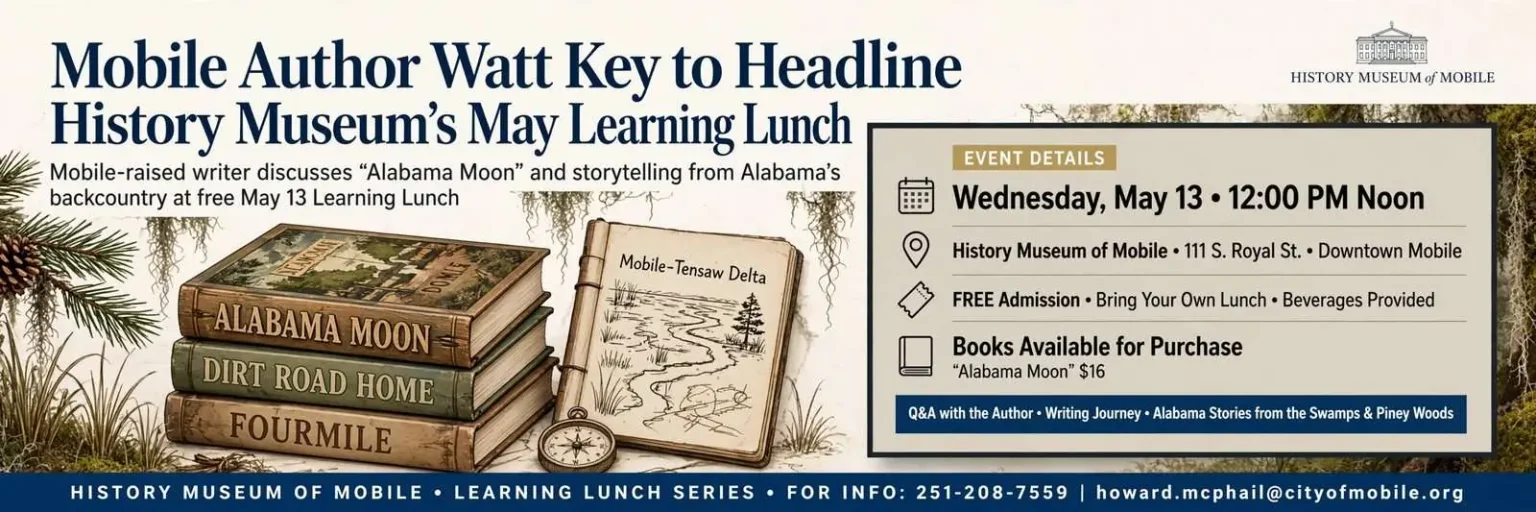
Mobile-raised author Watt Key will be the featured guest at the History Museum of Mobile’s monthly Learning Lunch series on Wednesday, May 13, at noon, giving local readers a chance to hear from the writer behind some of the most acclaimed young adult fiction to come out of south Alabama in recent years. The Learning Lunch format is a familiar one to downtown regulars: guests bring their own meals, settle into the museum’s meeting space, and hear an hour of talk from a speaker whose work touches on the history and culture of the Gulf Coast region. Key’s appearance puts the spotlight on a different kind of local heritage, the living tradition of storytelling that has grown out of the swamps, piney woods and small towns of south Alabama.
Admission to the event is free. The museum provides complimentary beverages, and attendees are encouraged to bring their own lunch. Copies of Key’s work will be available for purchase at the program, including his best-known novel, “Alabama Moon,” which will be sold for $16. For readers who have followed his books since the debut, or for newcomers who want to hear how a Mobile native became one of the most recognized names in young adult fiction, the noon program offers a rare opportunity to hear the author describe the journey in his own words.
A Mobile Native Who Found His Stories in the Alabama Backcountry
Key grew up in Mobile and went on to earn his undergraduate degree at Birmingham-Southern College, one of the private liberal arts institutions that anchor the city’s academic landscape. He then returned home to complete an MBA at Spring Hill College, the Jesuit college whose campus sits along Old Shell Road in the Spring Hill neighborhood. By his own account in earlier interviews about his career, the path to publication was anything but direct. He was working as a computer programmer when he began sending his manuscripts to publishers, a pursuit that eventually launched a full-fledged literary career rooted in the landscapes and wildlife of the Alabama backcountry.
That background shows in his fiction. Key’s novels consistently put young protagonists into the wilder corners of the state, places where a wrong turn on a county road or an afternoon in a bottomland swamp can become the setting for a survival story. The Mobile Delta, the Tombigbee watershed, the longleaf pine country and the small river towns of south Alabama supply the settings that national reviewers have praised as vividly realized and authentic. For a region often described by outsiders in broad strokes, Key’s books offer a version of south Alabama written by someone who grew up in it, hunted and fished in it, and learned its waterways firsthand.
“Alabama Moon” and National Recognition
Key’s debut novel, “Alabama Moon,” became a breakout success. The book earned the 2007 E.B. White Read Aloud Award, an honor given to titles recognized for excellence in reading aloud to children, and the 2006 Parents’ Choice Award, one of the most established seals of approval in children’s publishing. Time magazine later included the book on its list of the Top 100 Young Adult Novels of All Time, placing a story set in the Alabama woods alongside the landmark titles of the genre.
The novel follows a boy raised in an isolated Alabama wilderness camp by a survivalist father, and after his father’s death he must find his way in a world he has never known. Its blend of survival detail, humor and heart made it a staple on school and library shelves, and the story has since been translated into eight languages, carrying Key’s Alabama-rooted storytelling to readers around the world. That kind of reach is unusual for any debut, and rarer still for a book whose setting is so distinctly regional. Translations have spread the novel’s pines, creek beds and county backroads to markets where few readers have ever seen a south Alabama swamp, yet the story has continued to find audiences abroad.
The success of “Alabama Moon” also established the pattern that has defined Key’s career: stories that take young readers seriously, put them in real danger, and trust them to handle honest endings. Teachers and librarians across Alabama have used the book in classrooms, and its recognition from national organizations helped open the door for the novels that followed.
A Growing Catalog of Alabama Stories
Key followed that debut with the companion novel “Dirt Road Home” in 2010, then “Fourmile” two years later, both continuing to draw praise from critics and young readers alike. “Dirt Road Home” returns to the world of “Alabama Moon” and follows the character Hal Mitchell, an outsider at a harsh South Alabama boys’ home who refuses to be broken by it, picking up the thread of survival and perseverance that made the first book resonate. “Fourmile” shifts the setting but keeps the stakes personal, telling the story of a boy on an Alabama farm whose encounter with a drifter sets in motion a story of trust, danger and conscience.
Together the two follow-ups confirmed that Key’s first success was not a fluke. Reviewers continued to single out his ear for regional dialogue and his willingness to write about hardship without softening it, qualities that made the books useful far beyond entertainment. In classrooms, the novels offer young readers in south Alabama something they rarely see: their own landscape, weather, speech and way of life presented as the center of a serious story rather than a backdrop.
His catalog is set to grow further this year. “Among the Swamp People” is slated for a September 2015 release, and “Terror at Bottle Creek” is expected to follow in January 2016. The former promises more of the backcountry storytelling that has become his signature, while the latter, set in the aftermath of a hurricane in the Mobile-Tensaw Delta, puts a boy and his friends against a rising storm surge and an escaped predator, a premise that will be immediately recognizable to Gulf Coast readers who have lived through the region’s hurricanes.
What He Will Talk About at the Learning Lunch
At the May 13 program, Key will discuss his path to publication and his approach to storytelling. That story, from a programmer sending unsolicited manuscripts to publishers until one said yes, to an award-winning author whose work now appears on national “best of” lists, offers a practical look at how a writing career actually gets built. Aspiring writers in the audience will hear about persistence, rejection and revision; readers will hear about where the ideas for his novels come from and why the Alabama backcountry keeps pulling him back as a setting.
The book sale at the event adds a further draw. Copies of Key’s work will be available for purchase, including “Alabama Moon” for $16, giving attendees the chance to have a signed copy from a writer whose books have become fixtures of Alabama reading lists. Museum staff say author events in the Learning Lunch series typically draw a mix of longtime supporters, students and curious first-time attendees, and a hometown author with national credentials is expected to be a strong draw.
How to Attend
The event is free to attend, though guests are encouraged to bring their own lunch; the museum will provide complimentary beverages. No reservation details were listed beyond the contact information below, so those with questions are encouraged to call ahead. The History Museum of Mobile is located at 111 S. Royal St. in downtown Mobile, in the historic complex that serves as one of the city’s most recognizable civic landmarks.
Those seeking more information about the Learning Lunch series can contact Howard McPhail, the museum’s Curator of Minority History, at 251-208-7559 or [email protected]. McPhail coordinates the speaker lineup for the series, which has become one of the museum’s most reliable monthly programs, drawing downtown workers, students and history enthusiasts over the lunch hour.
A Museum Program With Deep Local Roots
The History Museum of Mobile has long served as the city’s front porch for the past, housing collections that trace the area from its colonial founding through its roles in the cotton economy, shipbuilding and the modern port city it became. Its Learning Lunch series extends that mission into the present, using the lunch hour to bring historians, authors, archaeologists and community leaders before a public audience. Speakers have covered subjects ranging from colonial Mobile and the Civil War to civil rights, hurricanes and the people who shaped the city’s neighborhoods.
The format is deliberately accessible. Free admission and a bring-your-own-lunch policy mean the barrier to attending is low, and the noon slot fits the schedules of downtown office workers as easily as retirees and students. Over the years the series has built a loyal following precisely because it asks little of its audience and delivers an hour of substantive conversation about the region. A session devoted to a living local author whose work has carried Mobile’s name onto national book lists fits squarely within that tradition.
Why Key’s Work Resonates on the Gulf Coast
Part of what makes Key’s appearance notable is how closely his fiction maps onto the physical world his audience lives in. The Mobile-Tensaw Delta, one of the largest river deltas and wetland systems in the United States, spreads across hundreds of thousands of acres just north of the city, and its swamps, oxbow lakes and tupelo gum bottoms form the setting for much of his work. Readers who have paddled the Bartram Canoe Trail, hiked the boardwalks at Five Rivers Delta Resource Center or simply grown up around the creeks and sloughs of Mobile County will recognize the world Key writes about, down to the mosquitoes, the mud and the sudden changes in weather.
His books also tap into a broader regional tradition. Alabama has produced a rich line of writers who drew on the state’s landscapes and speech, and Key’s young adult novels carry that tradition into a genre where regional authenticity is often rare. For the students, teachers and parents who make up a large share of the Learning Lunch audience, the chance to hear an author explain how he turns a real place into fiction is a lesson in both literature and local identity.
A Homecoming for a Hometown Author
For Key, the May 13 program amounts to a homecoming. He built his career from Mobile, studied at two of the city’s colleges, and set his novels in the country around it, yet much of his national recognition has unfolded far from home. Bringing him before a hometown audience closes that loop, giving the people who knew him as a Mobile kid, a Spring Hill MBA candidate or a programmer in a local office the chance to see what those manuscripts became.
The timing also fits a stretch of momentum in his career. With two new books scheduled for release within the coming year, the Learning Lunch appearance lands at a moment when interest in his work is climbing. Attendees will hear about the books that made his name, the two that are on the way, and the craft behind stories that have been translated around the world while staying rooted in a single patch of Alabama.
The History Museum of Mobile’s Learning Lunch with Watt Key begins at noon on Wednesday, May 13, at 111 S. Royal St. Admission is free, guests should bring their own lunch, and beverages will be provided. Copies of the author’s books, including “Alabama Moon” at $16, will be available for purchase. For more information, contact Howard McPhail at 251-208-7559 or [email protected].