Mobile and Baldwin Counties Offered Early Voting for 2008 Election
Archived WKRG coverage detailed the limited early-voting locations available in Mobile and Baldwin counties before the 2008 election.
Historical election-administration report, published from archived local news coverage.
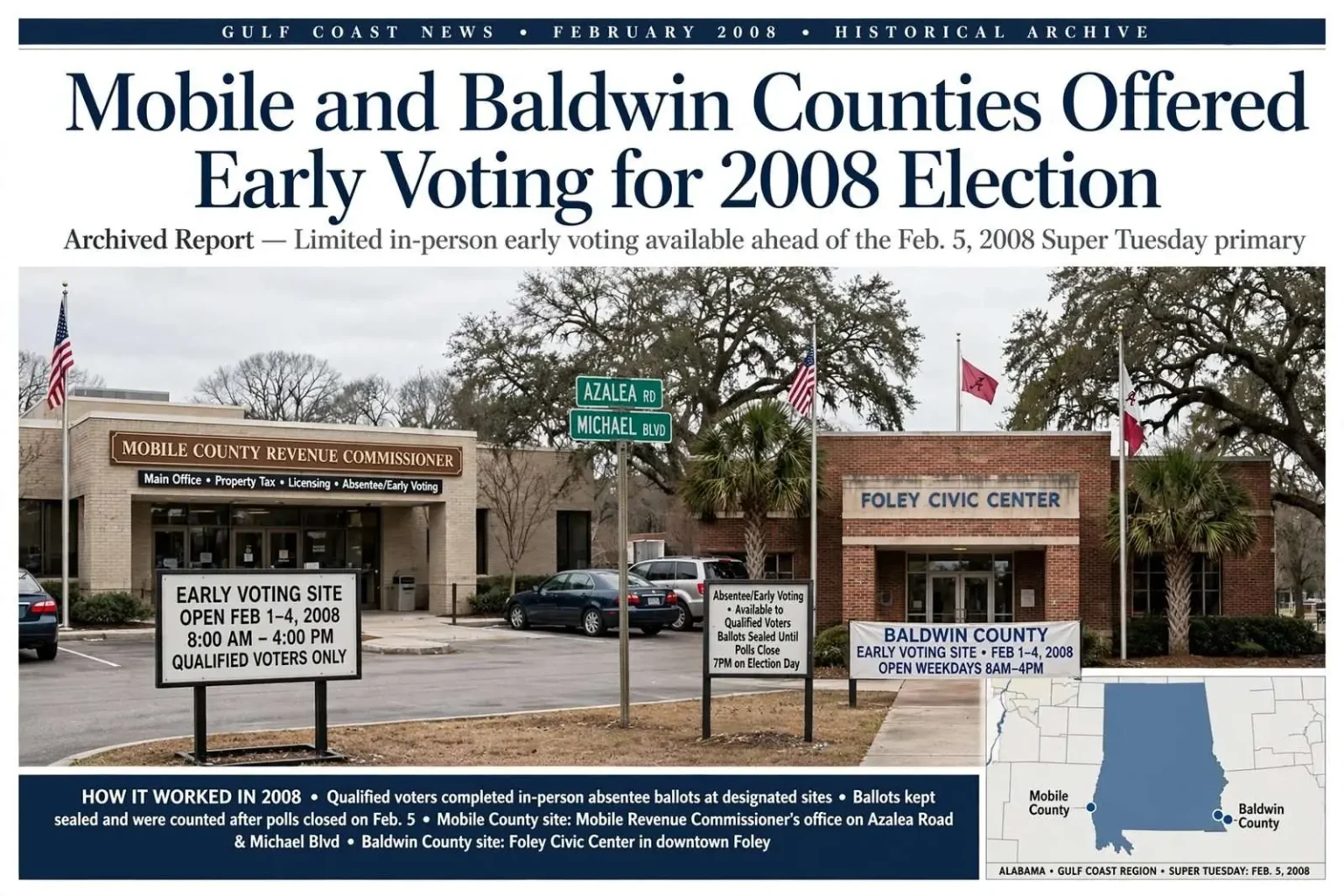
Before the Feb. 5, 2008, election, voters in Alabama’s two most populous Gulf Coast counties had an option that many of their neighbors did not: early voting. According to an archived local news report, Mobile and Baldwin counties offered limited early-voting locations ahead of the presidential primary, giving residents a window to cast ballots in person before election day. In Mobile County, early voters could use the Mobile Revenue Commissioner’s main office, located at Azalea Road and Michael Boulevard in west Mobile. In Baldwin County, early voting was available at the Foley Civic Center, the long-serving community venue in the heart of Foley’s downtown district.
The timing mattered. Alabama’s primary fell on Super Tuesday, the early-February date when a large group of states voted simultaneously and effectively narrowed the field in both parties’ presidential contests. Turnout on a single Super Tuesday can be enormous, and election officials across the country had spent years looking for ways to spread demand over multiple days. Early voting — letting qualified voters cast a ballot at a designated office or site during business hours in the days before the election — was one of the tools available under Alabama law, and the two coastal counties put it to use for the 2008 cycle.
How early voting worked in Alabama
Alabama’s framework for voting before election day has traditionally been narrow compared with states that embrace weeks-long early-voting periods. The state’s election code allows in-person absentee voting for qualified voters who complete an absentee ballot application stating a permitted reason, such as being out of the county on election day, illness, work obligations or membership in the armed forces. Voters who qualify may appear at the absentee election manager’s office — in most counties an office within the county courthouse complex or another designated government building — mark their ballot there, and submit it on the spot.
That is essentially what the 2008 report described. In Mobile County, the Revenue Commissioner’s main office served as the site where early voters could take care of their ballots, a practical choice because the building was already a well-known government service location on Azalea Road, one of the busiest commercial corridors in west Mobile. In Baldwin County, the Foley Civic Center filled the same role for the county’s growing southern end, sparing voters in communities like Foley, Gulf Shores, Orange Beach, Elberta and Summerdale the drive to the county seat at Bay Minette.
The mechanics of early balloting were designed with security in mind. According to the report, ballots cast early would remain sealed until polls closed on election day. That meant an early ballot was not counted the moment it was cast; instead, it was stored securely and joined the counting stream with the rest of the election-day returns. The sealed-until-closing rule is a common feature of absentee and early voting nationwide, intended to ensure that no partial results leak out before the polls close and that all ballots are treated uniformly in the canvass.
Why the 2008 election drew unusual attention
The February 5, 2008, primary arrived at a moment of exceptional political energy. Both major parties had competitive presidential contests, and Alabama voters would help settle a contest whose results echoed across the South. For local officials, a high-profile presidential primary brings predictable logistical pressures: long lines at peak hours, heavy calls to the probate judge’s office and circuit clerk’s office, and heightened interest from first-time voters, including college students at the University of South Alabama and Spring Hill College in Mobile and coastal residents who had recently moved to Baldwin County’s fast-growing communities.
Early voting options, limited as they were, served as a pressure valve. A voter who knew he or she would be out of town on election day, working a shift, or managing a family conflict could handle the ballot in advance at a convenient office. For older voters and those with health limitations, the ability to complete the process in a shorter trip during weekday hours was meaningful. Election officials have long noted that spreading voters across multiple days reduces the chance that a single surge, machine malfunction or storm will disrupt an individual’s chance to participate.
Geography played a role in how the two counties approached the task. Mobile County, with a population approaching 400,000 at the time, concentrated its early-voting service at one main office, betting that most voters within the metro area could reach the Azalea Road location without difficulty. Baldwin County, whose population had been growing rapidly and whose residents stretch across more than 1,500 square miles from Bay Minette to the coast, chose the Foley Civic Center to serve the southern half of the county. Neither approach offered a full network of sites — this was early voting in a limited form, not the multi-site model larger states use — but both gave Gulf Coast voters an option beyond the traditional one-day window.
Word of the early-voting option spread through the usual channels of Gulf Coast civic life: notices at public libraries, announcements from party organizations preparing for their own primary participation, and coverage in local newspapers and broadcasts. County officials generally make such arrangements public well in advance, because early voting only eases election-day congestion if voters actually know about it. In both counties, the sites operated during regular weekday business hours, which meant voters needed to plan a trip during the working day — one of the very constraints that broader early-voting proposals in later years sought to relax by adding evening and Saturday hours.
What voters needed to know
Under the procedures described in the archived report, a voter planning to cast an early ballot needed to appear at the designated location during the early-voting period, complete the required application, and vote on site. The ballot then entered the sealed custody chain until polls closed on election day. Standard identification requirements applied, and the ballot a voter cast early counted exactly like one cast at a neighborhood precinct. Polls in Alabama open at 7 a.m. and close at 7 p.m. on election day, and the counting of sealed early ballots begins as part of the overall tally once voting ends.
Local election administrators in both counties — the probate judge and election officials who oversee the process — have historically urged voters to double-check their precinct and registration status before any major election. Alabama’s voter registration deadline falls well before election day, and a voter who moved since the last election needs to update registration to avoid a provisional ballot. Those fundamentals were as true in 2008 as they are now.
The legacy of the 2008 experience
The 2008 election became one of the most discussed election cycles in modern Alabama history, and the coastal counties’ experience with early voting fed into a longer-running statewide conversation about expanding access. Lawmakers over the years have periodically debated bills that would create broader no-excuse early voting in Alabama, citing the models of neighboring states such as Florida, Georgia and Tennessee, all of which operate multi-week early-voting calendars with numerous sites per county. Alabama’s statutes, by contrast, continue to center on absentee voting with stated reasons, though the state did later adopt provisions — such as accommodations during the COVID-19 pandemic in 2020 — that temporarily widened access for certain voters.
For the communities involved, the practical details of the 2008 arrangement are a window into how local government actually works. The Mobile Revenue Commissioner’s office is an elected county office responsible for property appraisal mapping and tax collection functions, and its main office on Azalea Road handles thousands of in-person transactions a year — which made it a natural, familiar place to host early voting. The Foley Civic Center, likewise, has served Baldwin County for decades as a gathering place for everything from civic events to disaster-related functions, and its location along U.S. Highway 98 made it accessible to voters across southern Baldwin.
The sealed-ballot procedure described in the report also illustrates a principle that still governs absentee and early voting everywhere: custody and counting are deliberately separated in time. An early ballot is verified when it is cast, stored under the responsibility of election officials, and only opened and counted when the law allows — in this case, when polls closed on election day. Observers from the parties are entitled to watch the process, and the chain of custody is documented, measures designed to give every voter confidence that an early ballot carries the same weight as one dropped into a scanner at a precinct.
Today, anyone planning to vote in a current election should rely on official, up-to-date information: the Alabama Secretary of State’s office, the Mobile County Probate Court’s election division, and the Baldwin County Probate Office publish current deadlines, locations and absentee requirements for each election cycle. Locations and procedures change over time, and the 2008 arrangements described here belong to that year’s election alone. This article documents election procedures and locations from 2008 only and is not a notice about any current election.