Mobile Bands Rally at Boondocks for Sims/Andrews Benefit
Mobile bands including Mudbucket played a March 2011 benefit at Boondocks for the families of Selma Sims and Kathy Andrews.
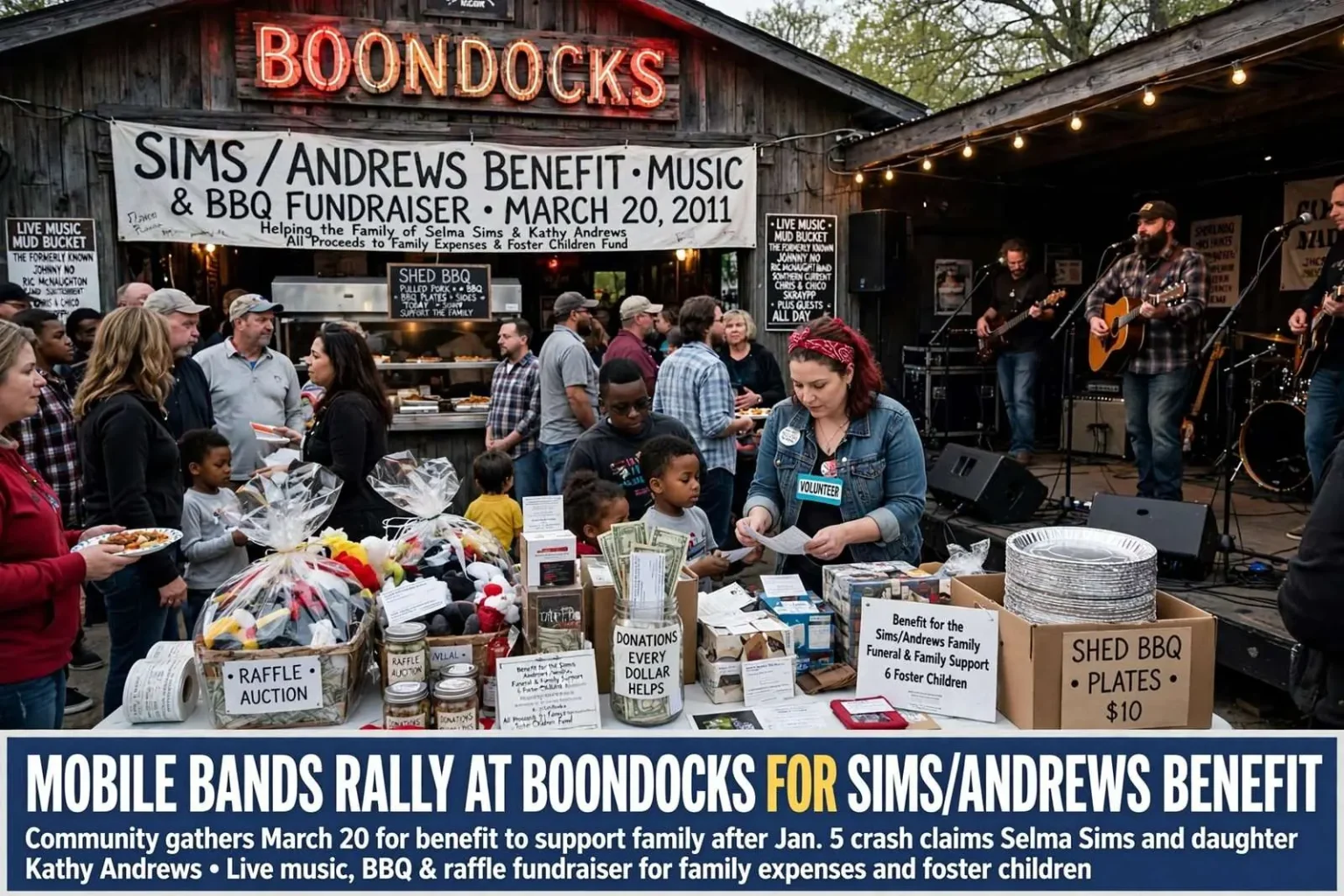
The Mobile music community came together on Sunday, March 20, 2011, for a benefit at Boondocks organized to help the families of Selma Sims and her daughter Kathy Andrews, who were killed in a January car crash that authorities attributed to a drunk driver. The crash occurred January 5, 2011, at the intersection of Old Shell Road and University Boulevard, a busy west Mobile crossing. Two and a half months after the wreck, the loss was still raw for the family and the wide circle of coworkers, friends, and fellow musicians who knew the two women — and the benefit aimed to answer the practical burdens that follow such a sudden loss with the resources the community could muster.
Selma Sims was a 20-year employee of Mobile’s Answer Service and the mother of two daughters, Kathy Andrews and Miranda Sims Taylor. Her daughter Kathy Andrews was a full-time stay-at-home mother caring for six foster children. The shape of the two women’s lives — one a longtime fixture of a local business, the other devoting her days to some of the community’s most vulnerable children — is what made the crash reverberate so widely. A drunk driving accident that takes a mother and daughter together leaves behind two grieving households at once, and in this case one of them included six foster children whose daily care had vanished overnight.
With funeral and family expenses outpacing the families’ means, organizers solicited donations as well as raffle and auction items from the community in the weeks before the show. The Sunday benefit at Boondocks gathered all of those threads in one place: live music from an afternoon-to-evening roster of local acts, barbecue plates for sale, raffle tickets, auction tables, and collection points for direct donations. The event was kid-friendly, and families were welcome — an appropriate choice for a tribute to a woman who had spent her days raising children, and a practical one for a community full of parents who wanted to attend but could not easily arrange a night out.
A Full Slate of Local Acts
Organizers lined up an afternoon-to-evening roster of local acts for the fundraiser, including Mudbucket, The Formerly Known, Johnny No, the Ric McNaughton Band, Southern Current, Chris and Chico, and SKRAYP, with additional local artists joining throughout the day. The lineup read like a cross-section of the Mobile scene’s several orbits — rock bands, singer-songwriters, duos — pulled onto one stage for a single cause. Starting in the afternoon and running into the evening gave each act room to play a full set without rushing the changeovers, and it let attendees come and go across the day as family schedules allowed.
Benefits of this scale require the kind of coordination only a close-knit scene can manage. Each band on the bill donated its set; the venue donated the stage and the sound; volunteers staffed the raffle and auction tables and the donation points. The acts involved play regularly across Mobile’s clubs and festivals, and many shared band members, fans, and friendships, which made assembling the bill a matter of phone calls among friends rather than formal booking. The additional artists who joined as the day went on filled gaps and kept the music continuous from the first set to the last.
The music served as both attraction and memorial. Between sets, the stage became a place for the community to remember the two women, and the performers — many of whom knew the family — played to a crowd that included their coworkers and relatives. For the families, the sight of a packed room on a Sunday afternoon was a measure of how widely the loss had been felt; for the musicians, the benefit was the scene doing what it has done repeatedly when tragedy touches its own or its neighbors: turning its one marketable skill into direct help.
Plates, Raffles, and Every Dollar Counted
Beyond the music, Shed BBQ plates were sold to raise money, adding a straightforward fundraiser to the day’s lineup — food that needed no explanation and sold itself to a hungry Sunday crowd. The raffle and auction tables carried donated items from area businesses and individuals, and organizers had spent the preceding weeks collecting them, an effort that itself mapped the reach of the family’s friendships across the city. Direct donations were accepted throughout the day for those who wanted to give without buying. Every mechanism on hand, from the plate sales to the raffle tickets, was aimed at the same goal: covering the funeral bills and family expenses that the crash had left behind.
The choice of a Sunday made the event accessible to the widest possible audience. Weekend benefits compete with each other in Mobile’s busy spring season, but a Sunday afternoon-to-evening slot avoided the Saturday-night crush and welcomed the church-and-family crowd, parents with young children, and the older coworkers who had worked alongside Selma Sims for two decades at the Answer Service. Kid-friendly events also send a message about who is being honored: with six foster children suddenly without the mother who cared for them, a benefit that turned children away would have missed the point of the day.
The crash itself became part of the evening’s unspoken backdrop. An intersection on Old Shell Road, one of west Mobile’s main east-west corridors, where a drunk driver ended two lives in January was the reason the community filled Boondocks in March. Benefits like this one have a way of putting a face on statistics that otherwise stay abstract — every attendee knew that the funds they raised would not bring the two women back, but would help the daughters, the foster children, and the extended family face the bills and the weeks ahead without the added weight of financial crisis.
The Families the Benefit Was For
Understanding what the day meant requires understanding what was lost. Selma Sims had spent twenty years at Mobile’s Answer Service, the kind of tenure that makes a person part of a workplace’s daily fabric, and she raised two daughters in the city. Kathy Andrews had chosen the hardest unpaid job there is — a full-time stay-at-home mother to six foster children, the steady presence in the daily lives of children whose own circumstances had already been upended. Miranda Sims Taylor, the younger daughter, was left to grieve her mother and her sister at the same time, and the benefit stood squarely behind the family members who remained.
The outpouring for the March 20 show reflected how those lives had been lived. Twenty years of coworkers, the network around six foster children, the friends of two grown daughters, and the musicians who donate their Sundays whenever the call goes out — all of it converged on one venue for one afternoon. Community benefits in Mobile follow a familiar grammar: a venue offered, bands volunteered, plates and raffle tickets sold, a bucket passed. What varies is the crowd, and the crowd for Sims and Andrews filled the room with the people whose lives the two women had touched.
The funds raised went toward funeral expenses and family needs that had already outpaced the families’ means by the time organizers began soliciting donations. No single benefit erases a loss like that, but the March 20 event at Boondocks accomplished what these gatherings exist to do: it converted a community’s sympathy into practical help, it gave the grieving a room full of supporters on a difficult Sunday, and it sent the families forward knowing that the city they had served — as an employee of twenty years and as a mother to the community’s most vulnerable children — was prepared to serve them in return.
The roster of performers told its own story about the breadth of Mobile’s music community. Mudbucket, a band with deep roots in the local club circuit, anchored the bill, while The Formerly Known and the Ric McNaughton Band brought their own followings through the door across the afternoon. Johnny No and Southern Current represented the singer-songwriter side of the scene, Chris and Chico the duo tradition that has long thrived in Mobile’s smaller rooms, and SKRAYP closed out the named lineup with a harder-edged set for the evening crowd. The variety was deliberate: organizers wanted every corner of the scene represented so that every corner of the audience had a reason to attend, and the additional artists who joined throughout the day kept the stage busy from start to finish.
Boondocks proved a practical host for an event of this size. A room that regularly handles full-band bills has the sound equipment, the staff, and the layout that a multi-act benefit requires, and its familiarity to the local music crowd meant nobody needed directions. The venue’s willingness to open on a Sunday for an all-day fundraiser — surrendering what would ordinarily be a quiet day of business — was itself a contribution to the families, one of many that went uncounted but not unnoticed.
The Shed BBQ plate sales deserve particular mention as the quiet workhorse of the fundraising day. Music draws a crowd, but food raises money steadily across hours; a plate sold every few minutes from early afternoon through the evening adds up faster than nearly anything else a benefit can offer. Combining the plate sales with raffle drawings spread through the day gave attendees multiple ways to contribute at every price point — a plate here, a raffle ticket there, an auction bid for those able to give more, and a straight donation for anyone who simply wanted to hand something to the family.
What the Day Left Behind
By the time the last band finished on March 20, the benefit had done more than raise money. It had gathered, in one room on one afternoon, the two most important things a family facing sudden loss needs: financial help toward the bills piling up, and the visible presence of a community that refused to let the family carry the weight alone. The raffle and auction donations came from businesses and neighbors who would never meet the foster children their gifts would help; the musicians played without pay to a crowd that included strangers and lifelong friends alike; and the families left with both their burdens lightened and their loved ones’ lives honored in public.
The day also carried a lesson that Mobile’s music community has demonstrated repeatedly in moments like this one. When a crash on Old Shell Road took Selma Sims and Kathy Andrews on January 5, the first calls made among their friends were the kind that set benefits in motion — calls to venues, to bands, to anyone who could donate a plate of barbecue or a raffle prize. Ten weeks later that network delivered an afternoon of music, food, and solidarity. It is a response the scene has mounted before for other families, and the turnout at Boondocks suggested it will mount again, because in Mobile’s music community the benefits are not occasional charity but an established habit of taking care of their own.