Mobile-Born Band Perry Among Alabama Artists Earning ACM Award Nominations
The Band Perry, a Mobile-born family trio, earned four ACM Award nominations alongside fellow Alabama-connected artists in 2011.
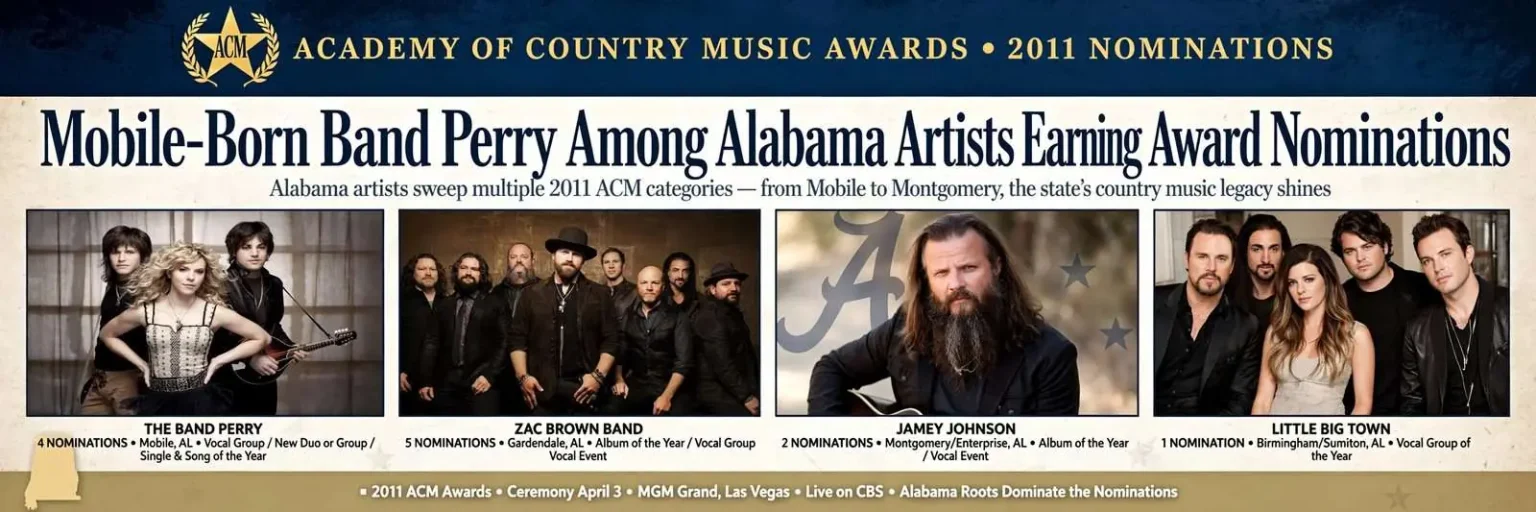
Several musicians with deep Alabama roots earned nominations for the 2011 Academy of Country Music Awards, announced at a press conference in Nashville in early February of that year. The nominations put the state’s fingerprint on one of country music’s biggest nights, with artists who were born, raised or shaped in Alabama appearing across categories from single of the year to vocal group of the year.
The Academy of Country Music Awards have honored the genre’s best since the mid-1960s, and the nominations each winter set the stage for a spring ceremony that draws the industry’s biggest names to Las Vegas. For artists with Alabama ties, the 2011 list represented an unusually strong showing, and it came at a moment when the state’s contribution to country music was already impossible to overlook.
Alabama’s place in the country music tradition runs deep, from the honky-tonk legends who came out of the state’s small towns to the bands that dominated the genre’s charts in the 1980s and beyond. Radio stations across the Gulf Coast and the Tennessee Valley have long treated the genre as a homegrown product, so nominations like these resonate with listeners who feel they are rooting for their own.
The Band Perry leads Alabama nominees
The Band Perry, a family trio originally from Mobile, picked up four nominations across major categories. The group was recognized as a contender for top vocal group of the year and top new vocal duo or group of the year. Their breakout hit “If I Die Young” earned nods in both the single record of the year and song of the year categories, cementing the trio’s rapid rise in the country music world.
The group’s story began in Mobile, where the siblings who make up the trio grew up before launching the band that would carry their name to arenas and award shows. Their blend of country, pop and rock arrangements, anchored by a lead voice that could move from tender to theatrical within a single song, made them one of the genre’s fastest-rising acts of the period.
“If I Die Young” became the kind of song that defines a career, dominating country radio for months and crossing over to pop audiences with a message that connected across age groups. Earning nominations for both the single and the song reflected the two sides of that achievement — the recording itself and the writing behind it — and put the Mobile-raised trio in competition with the industry’s established stars.
The top new artist category recognition carried its own weight. Award shows use their new-artist honors to anoint the acts expected to carry the genre forward, and The Band Perry’s presence on that shortlist confirmed what radio programmers had already concluded: the group’s ascent was one of the strongest debuts of the year.
For listeners along the Gulf Coast, the nominations felt local. The Band Perry’s Mobile origins gave the region a direct stake in the ceremony, and local media had followed the trio’s climb from regional stages to national tours with the attention usually reserved for sports champions.
The Zac Brown Band, whose drummer Chris Fryar hails from Gardendale, led all nominees with five categories. Their album “You Get What You Give” was up for album of the year, while the collaboration “As She’s Walking Away” featuring Alan Jackson earned nominations for single record of the year, song of the year, and vocal event of the year. The group was also nominated for top vocal group of the year.
Fryar’s presence behind the kit gave the band another Alabama connection. The Gardendale drummer came up through the state’s club and touring circuit before joining the Atlanta-based ensemble, and his role in the group’s tight, genre-spanning sound earned the band a reputation as one of the most reliable live acts in the business. Drummers rarely receive headline attention, but band members with Alabama roots noted the state’s presence at the top of the nomination list.
The Zac Brown Band’s nomination haul reflected a remarkable commercial and critical run. The group’s blend of southern rock, beach-country grooves and jam-band improvisation had filled amphitheaters across the country, and the album nomination confirmed that the band’s success rested on full records rather than isolated hits. Their collaboration with Alan Jackson, a country legend whose own career includes deep Southern roots, paired the band with one of the genre’s most respected traditionalists.
The vocal event category, which recognizes collaborations between artists, suited the band’s approach. Their willingness to pair with established stars on single tracks built bridges between audiences and generations, and the three nominations for “As She’s Walking Away” showed how broadly that strategy had succeeded with both radio and the Academy’s membership.
Jamey Johnson, born in Enterprise and raised in Montgomery, received two nominations. His ambitious double album “The Guitar Song” was nominated for album of the year, and his collaboration with Colt Ford on “Cold Beer” earned a nod for vocal event of the year. Johnson’s path through Alabama ran from the Wiregrass town where he was born to the capital city where he was raised, and his music carried the state’s country tradition through a period when mainstream Nashville was drifting toward pop production.
“The Guitar Song,” released as a two-disc set with paired themes of darkness and redemption, stood out in a field of conventional albums. Critics praised its songwriting and its refusal to chase trends, and Johnson’s traditional style — baritone vocals, steel guitar and story songs in the classic mold — made him a favorite of listeners who wanted country music to sound like country. His nomination put Montgomery and Enterprise on the awards map alongside the state’s bigger musical cities.
The collaboration with Colt Ford connected Johnson to a different corner of the market. Ford’s country-rap recordings occupied a niche that purists had once dismissed, but the pairing found common ground in songs built for working audiences, and the vocal event nomination showed the Academy’s willingness to recognize the genre’s expanding edges.
Together, the nominations from Johnson and the Zac Brown Band gave Alabama presence in three of the show’s most prestigious album and collaboration categories, an unusually broad spread for a state of its size in a genre dominated by Texas and Tennessee.
Little Big Town also earned a nomination for top vocal group of the year. Band member Jimi Westbrook is from Sumiton, while Karen Fairchild and Kimberly Schlapman first crossed paths as undergraduates at Birmingham’s Samford University. The group’s Alabama chapter began in earnest when its members’ paths converged in the state, and the four-part harmonies that became the band’s signature were honed through years of touring before the group broke through on the national charts.
Samford University’s role in the story is a point of pride in Birmingham. The chance meeting of two future bandmates as undergraduates grew into a partnership that would carry the group to the Grammy stage and the top of the country charts, and the university’s alumni have followed the band’s career as evidence of the city’s place in the music industry’s creation stories.
Little Big Town’s nomination came in the same category as The Band Perry’s and the Zac Brown Band’s, meaning Alabama-linked artists accounted for three of the contenders for top vocal group of the year. The overlap made the category one to watch for state fans, who would have a dog in the fight no matter which act took the trophy.
The vocal group field has historically been one of the Academy’s most competitive, populated by bands whose longevity depends on touring audiences and radio consistency. That three of the nominees traced their roots to Alabama — one formed in Mobile, one anchored by a Gardendale drummer, one born from a Samford meeting — underscored how thoroughly the state had woven itself into the genre’s modern landscape.
The state’s tradition in the genre gave the 2011 showing its historical resonance. Country music has drawn from Alabama since the genre’s earliest commercial recordings, and the artists who emerged from the state built reputations on songwriting and musicianship that Nashville came to depend on. Each new generation of nominees extends that lineage, and the 2011 list showed the pipeline running as strong as ever.
Local pride in the nominations translated into attention across the state’s media. Radio stations in Birmingham, Mobile and Montgomery promoted the home-state ties, and fans organized support for the artists in the run-up to the ceremony. In an industry where awards momentum can shape touring and radio play, that visible support mattered to the nominees’ careers.
Winners were set to be announced on April 3 during a ceremony broadcast live on CBS from the MGM Grand Garden Arena in Las Vegas. The venue and the network underscored the scale of the event, which pairs the Academy’s traditional fan-voted categories with performances from the genre’s biggest stars. For the Alabama nominees, the night offered a national stage on which the state’s country music legacy — from Mobile to Gardendale to Sumiton to Enterprise — would be represented on every ballot that mattered.
Whatever the outcome on April 3, the nominations themselves marked the year’s strongest statement yet of Alabama’s continuing influence on country music, and they gave the state’s listeners a spring full of reasons to tune in.