Six Broadcasts a Day: A Mobile Broker’s Life on the Radio and in the 1974 Bear Market
A longtime Mobile stockbroker recalls the years he read market reports over WLPR, the punishing bear market of 1974, and the new options game that helped keep his family afloat.
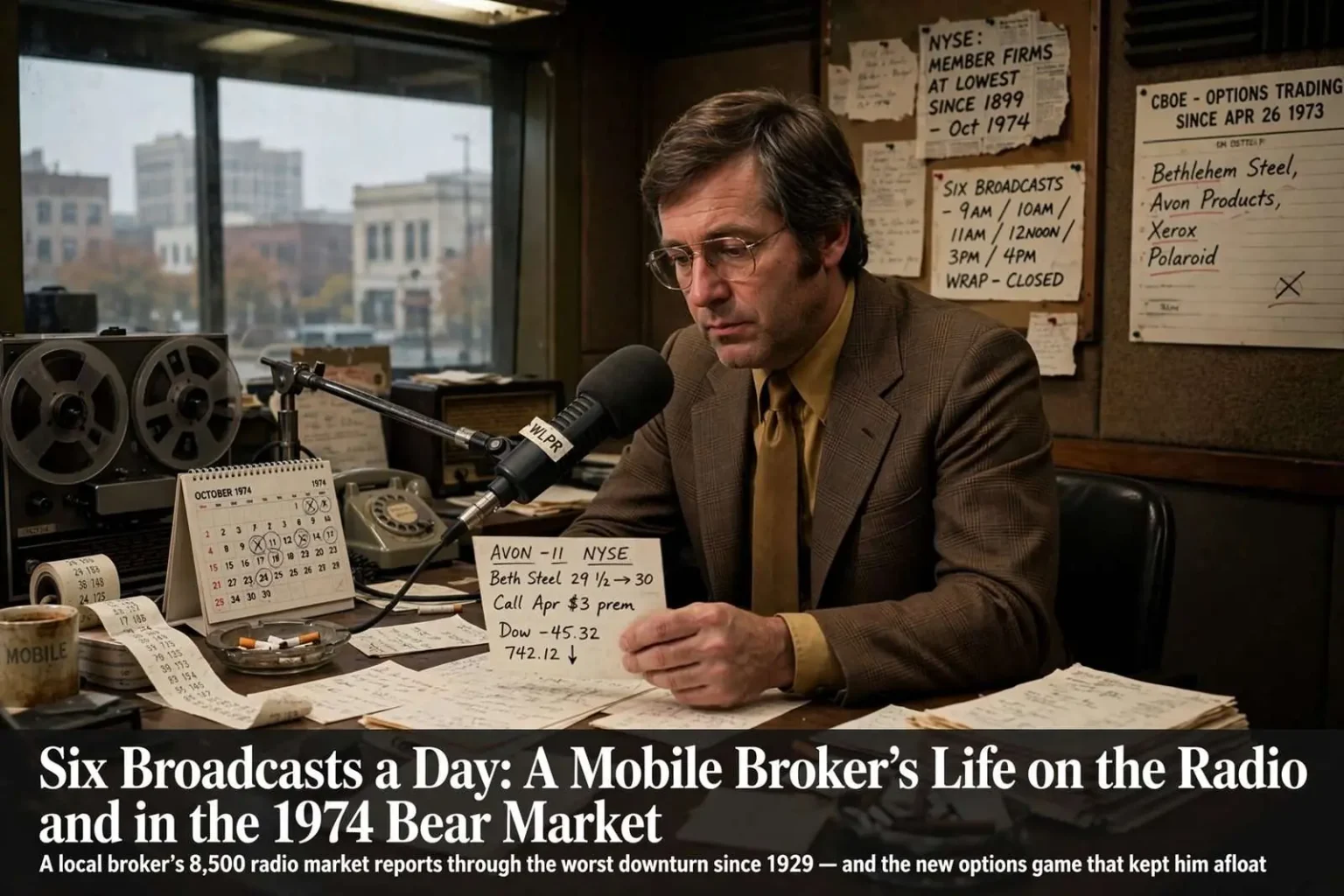
Long before cable television turned the closing bell into a nightly spectacle, Mobile got its stock market news the same way it got its weather and its ball scores: over the radio, from a neighbor who happened to work downtown. In an installment of a memoir series recalling life in a bygone Mobile, a veteran local stockbroker describes how, in 1966, he took on a sideline that would define him in the public mind for the better part of two decades.
He began delivering market reports for radio station WLPR — at first a two-minute update every hour, plus a five-minute wrap-up after the close, six reports a day in all. The load was later trimmed to four, but he kept at it, day after day, with only rare exceptions.
By his own estimate, he filed roughly 8,500 market reports over the course of his broadcasting sideline.
Not Your Standard Network Delivery
These were not solemn recitations of the Dow.
The broker made a point of avoiding the pompous cadence of the network business desks. A typical opening might tweak a familiar advertising slogan: if the doorbell rings and you hear the words “Avon Calling,” he warned listeners, you had better come quick — she may be calling for help, with Avon Products down eleven points on the New York Stock Exchange.
It was extemporaneous, he concedes, and some of it was awful. But it was never stuffy, and Mobile listened.
Stores and offices across the city piped the station’s soothing music through their public address systems, which meant the market reports rode along with it into showrooms, waiting rooms and back offices. The proof came on the rare mornings he missed a slot, when the telephone calls came cascading in: What happened?
I didn’t hear you at ten o’clock. The visibility cut both ways.
The broadcasts were an unpaid assignment, and they plainly generated business for him and for his colleagues. Yet a good many listeners assumed broadcasting was his job, never realizing that, like every other broker in the office, he lived or died by the orders he wrote.
The Fall of 1974
The account turns darker as it reaches the autumn of 1974, a stretch the writer describes as the worst bear market of his nearly 23 years in the business — rivaled, in his view, only by the 1929-32 collapse, depending on which yardstick one chose. Brokerage houses were failing across the country, and the number of New York Stock Exchange member firms had fallen to its lowest level since 1899.
The damage was personal as well as professional. His earnings had tumbled to less than half of what they had been just two years earlier.
His own portfolio was battered, with a 1973 paper loss he preferred not to contemplate and an almost equally grim deficit through most of 1974. All of this arrived at the precise moment he was putting three children through college at a cost of roughly $10,000 a year, with household expenses climbing right along with tuition.
New Products, and a New Game in Town
What carried him through, he writes, was business from sources that had not existed two years earlier. Insurance was one — then a novel offering at his firm and rare among brokerage houses.
The other was the Chicago Board Options Exchange, launched in 1973 and known to traders of the day simply as the CBOE. He was fascinated by it, and he put the largest share of his investable funds to work there.
His approach was conservative by the standards of the era. He would buy a stock at what he judged a reasonable price and then sell someone else the right to buy that stock from him at a somewhat higher price, months down the road, pocketing a premium for the privilege.
He offers a plain-English example: buy 200 shares of Bethlehem Steel at 29 1/2, then sell options letting a buyer take the stock at 30 through the end of April, collecting $3 a share. The $5,900 outlay becomes an effective $5,300 after the $600 credit.
If the stock drifted sideways, he kept the premium and could sell the option again. If it rose, the shares were called away at a profit.
If it fell, he stayed in the black until the stock dropped below 26 1/2. “You couldn’t miss,” he writes, “unless the market went way down.” The market went way down.
Taking Stock
By the end of October 1974, he tallied his realized and unrealized capital gains together with dividends and interest and arrived at a return on invested cash of 9.13 percent — a figure he acknowledges would shrink considerably once compounding was accounted for. Bernard Baruch, the legendary financier and presidential adviser whose name was then shorthand for market genius, would not have been impressed.
But he took the reading at what he hoped was a temporary bottom, and he allowed himself the hope that lifting the figure to 12 percent within a few months would more than erase two years of losses. It is an oddly familiar posture for anyone who has ever held on through a downturn: the ledger open, the arithmetic honest, and the optimism stubborn.
About the Early Options Market
The Chicago Board Options Exchange opened on April 26, 1973, trading call options on just 16 stocks. Bethlehem Steel and Avon Products were among the next group of stocks added to the list. Listed put options did not arrive until 1977, so early traders like the author mostly bought calls or, as he did, wrote calls against stock they already owned.