Passed Over at 48: A Mobile Broker’s Account of Losing the Manager’s Job He Had Earned
In the next installment of his recollections, a Mobile stockbroker described reaching the top of his profession in 1968, then being displaced as office manager the following year by a younger man with better connections.
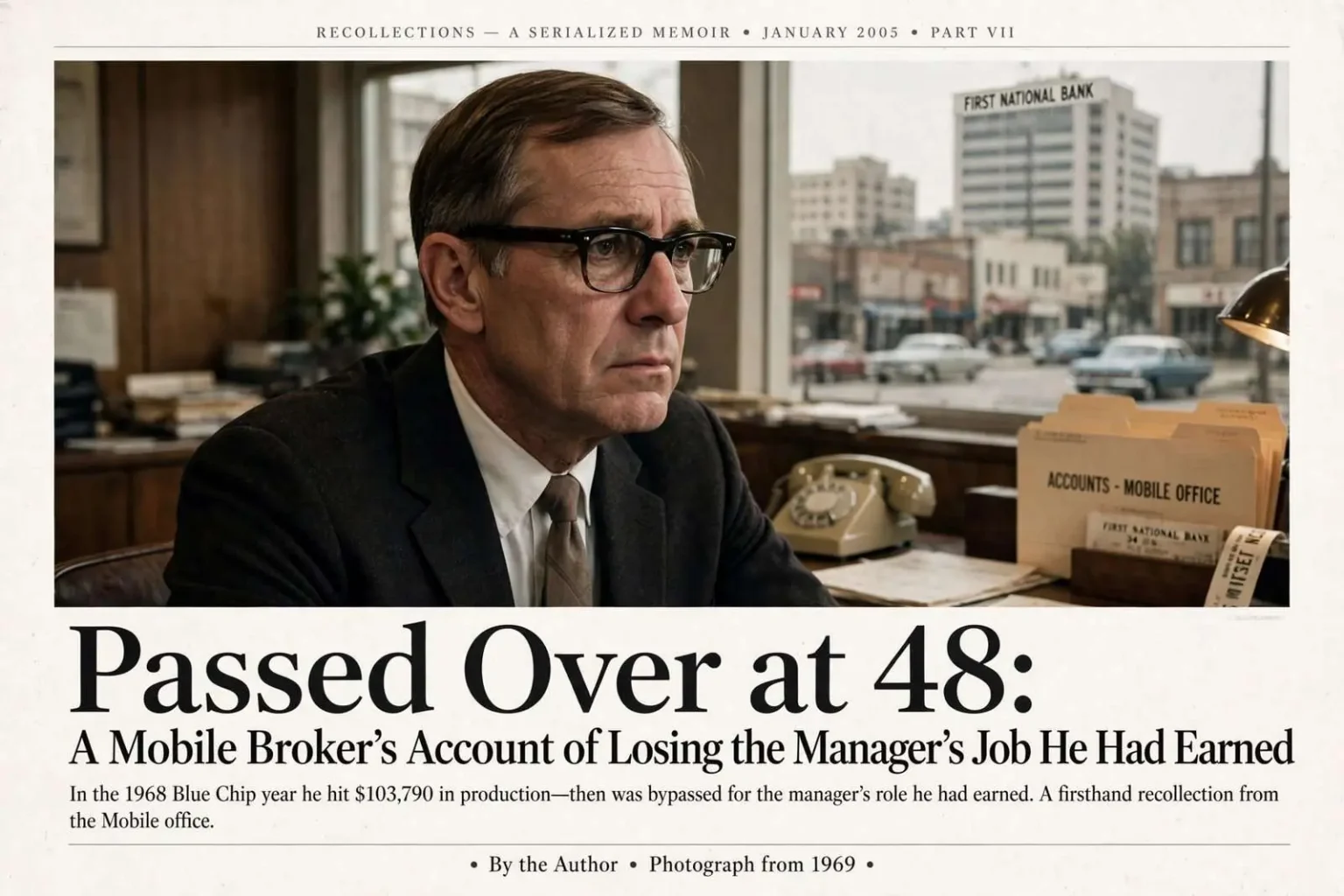
The installment of this serialized recollection published in January 2005 is the one in which a Mobile stockbroker’s career reaches its peak and, almost immediately afterward, its most bitter disappointment.
Getting His Money’s Worth
The firm’s owner, the parsimonious old man of earlier installments, got his money’s worth.
In 1963 and 1964 the author produced a great deal of business and was paid, by his own calculation, a payout ratio barely better than 20 percent. He would have done better financially had he never left his old firm.
The problem was the contract: a capped amount for production, supplemented by a small percentage of office profits. It was not, he wrote, a good working arrangement at all.
The old man died in 1964. His successor — called here Joe P. — took over, and the Mobile office’s situation improved immeasurably. Production soared, and this time the author’s pay reflected it.
He liked the new man for obvious reasons and for less obvious ones. Joe P. had come to New Orleans from a New York trust company a few years earlier. He did not know much about the brokerage business, having started at the top, but he was a gentlemanly fellow with a fine personality and a genuine regard for his fellow man.
The two hit it off from the start, and the author valued the friendship for the rest of his life — even though Joe P. was to be the instrument of considerable grief.
The Blue Chip Year
As 1968 opened, the Mobile office moved into swanky new quarters on the ground floor of the new 34-story First National Bank Building, by a wide margin the most impressive structure in the city and, for a generation of Mobilians, the building that defined the downtown skyline. At the cocktail party that opened the office, the author told Joe P. that he intended to reach $100,000 in production that year — the benchmark achievement in the trade, which brought membership in the firm’s Blue Chip Club and, usually, the right to buy company stock at book value. He made it.
His total for 1968 was $103,790. The stock, characteristically, did not arrive on time.
Someone simply forgot him. He was allowed to buy his 100 shares a year later — at $24, rather than the $18 they had been priced at in the year he actually earned them.
The Man From New Orleans
Three months into 1969, Joe P. told the author that he was sending a younger broker — called here Bob F., roughly 30 years old and one of the top producers in the New Orleans regional office — over to Mobile for a few days to work in the office and make an assessment of it.
The author knew immediately what that meant. Someone, somewhere, had decided that Bob F. was to have a manager’s job in the region. Of the available offices, Mobile’s was the most vulnerable: the other two were held by the late owner’s son-in-law and by another man with powerful family connections.
Both were capable. But it was not capability that protected them.
Joe P. came over in June and delivered the news.
Pressed for a reason, he would only say, “It’s for the good of the firm.” The author had the distinct impression that his friend wanted to tell him something and could not bring himself to do it — that he was under some compulsion to find a place for the younger man, from a source the author never identified.
‘I Was Not Ruthless Enough’
He tormented himself for the better part of a month.
His self-assessment is the most striking passage in the installment, and it is worth quoting in substance: he had not been selfish enough. He had not asked for or taken everything he could have gotten.
He had given up accounts to help others. He had kept struggling men on when he could easily have cut their throats and replaced them.
Perhaps, he concluded, that was precisely why he was not fit for a manager’s job. The decision was, in truth, foregone.
At 48, starting over somewhere else was a near-impossibility. Forty-eight-year-old account executives, as he put it, are not in that much demand.
He told Joe P. he would stay on as an account executive.
What the Younger Man Did
Bob F., in the author’s estimation, was a salesman pure and simple — one of the best he ever knew — and possessed the ruthless quality that so often pays. Men who did not cut the mustard did not get a second chance.
Another bear market arrived in 1969 and business was poor for everyone. But after the market bottomed in May 1970, the Mobile office recovered faster than most in the firm.
Its high-water mark came when nine of its ten account executives qualified for a trip to Mexico awarded to top producers in a company mutual fund contest — the best percentage of eligibility of any office in the firm. Bob F. moved on to greater things in early 1973. The manager’s job then went to the author’s old co-manager.
He supposed he had not been considered at all — and suspected he knew why. He had cooperated with Bob F. at all times. But his feelings, he thought, had probably showed through.