Mobile Church to Honor Former Fairhope Police Chief With Black History Sunday Service
Bethesda Christian Center's Black History Sunday service honored former Fairhope Police Chief Joseph Petties, an elder at the Mobile church.
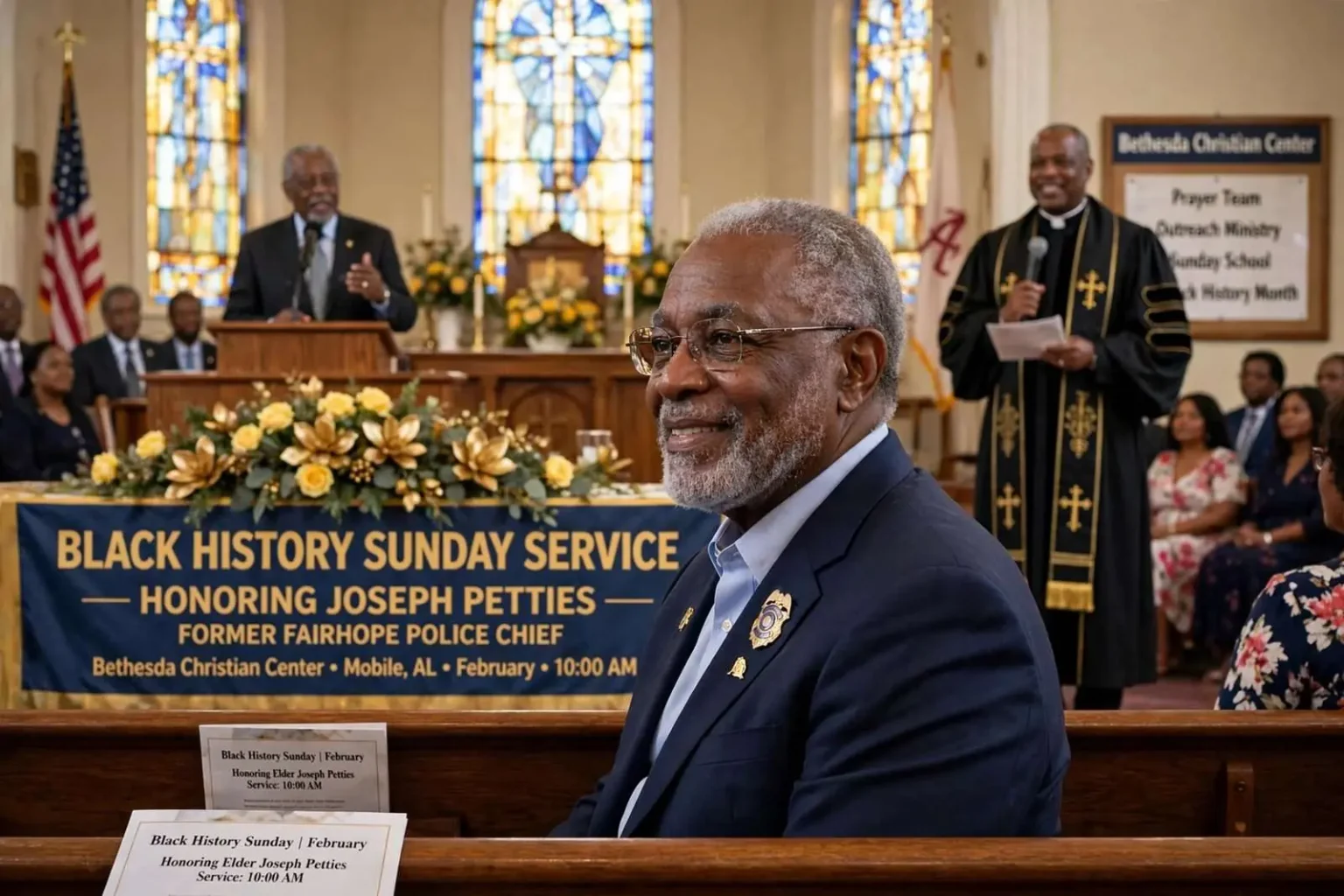
MOBILE, Ala. — Bethesda Christian Center in Mobile paid tribute to one of its own during a Black History Sunday service, honoring Joseph Petties, the former police chief of Fairhope. The 10 a.m. service blended the congregation’s celebration of Black history with a personal salute to a member whose career of public service and whose daily walk of faith have run side by side for years.
Petties is more than a familiar name in Baldwin County law enforcement — he serves as an elder at the Mobile church. Organizers noted that he makes the regular commute from Fairhope to teach Sunday School and lead services, crossing Mobile Bay week after week to fulfill the duties of a lay leader. He is also part of the church’s prayer team and outreach ministry, roles that put him in the middle of the congregation’s spiritual life rather than at its edges.
The honor carried particular weight during a Black History Month observance. Black churches across Alabama have historically been the anchor institutions of their communities — places of worship, but also centers of education, civic organizing and recognition of community achievement. Services like Bethesda Christian Center’s Black History Sunday keep that tradition alive by lifting up members whose lives embody the community’s story.
The 10 a.m. service featured former Mobile Mayor Sam Jones as a featured speaker, while Bishop Norman Hutchins of Dover, Delaware traveled in as guest psalmist, bringing a musical dimension to a morning that celebrated faith, history and service in equal measure.
A career in Baldwin County law enforcement
Petties retired from the Fairhope Police Department in the summer of 2018 after a career leading the Baldwin County city’s police force. Fairhope, a city of roughly 20,000 residents perched on the bluffs of the eastern shore of Mobile Bay, is one of Baldwin County’s signature communities — a tourist destination famous for its flower-lined streets, its pier and its arts scene, and a fast-growing city whose police department handles everything from downtown festival crowds to the traffic pressures of a resort town.
Leading that department made Petties one of the relatively few Black police chiefs to lead a municipality in Baldwin County, a distinction that gave his story resonance well beyond his own congregation. Chiefs in communities of Fairhope’s size are responsible not only for operations — patrol, investigations, dispatch coordination — but for the department’s standing in the town, its recruitment and its relationship with schools, businesses and churches. A chief’s tenure is measured in the everyday trust between officers and residents.
The commute Petties continues to make from Fairhope to Mobile is, in itself, a small portrait of the connection between the two sides of Mobile Bay. The Bayway and the toll-free routes across the water carry thousands of workers between Baldwin and Mobile counties every day, and church members who heard his story heard a familiar one: the commitment of crossing a bay, week in and week out, to keep a promise to a congregation.
The church and the man it honored
At Bethesda Christian Center, an elder’s work is a hands-on ministry. Teaching Sunday School means preparing lessons and showing up early; serving on the prayer team means being available for members in crisis; participating in outreach means carrying the church’s work into the neighborhoods around it. Congregations across Mobile rely on lay leaders who hold full-time careers and still give their mornings, evenings and weekends to the church, and Petties’s years in law enforcement gave his ministry a particular credibility with members who look to the church for guidance in hard times.
The combination of a police career and a church vocation is a familiar pairing in Black communities across Alabama, where generations of officers, deputies and state troopers have also served as deacons, elders and Sunday School teachers. The two roles share a common thread: both are built on showing up for people on their worst days, and both depend on being a steady, known presence in the community long before a crisis arrives.
Sam Jones brings a mayor’s perspective
Former Mobile Mayor Sam Jones appeared as the service’s featured speaker, adding a civic dimension to the morning. Jones served as mayor of Alabama’s third-largest city, leading Mobile through years of downtown revitalization and major public projects, and he has remained a visible figure in the city’s civic and community life since leaving office. Mayors and former mayors are familiar guests at Mobile’s historic Black churches, where the relationship between city hall and the congregation has long been one of the most important channels between local government and the community.
A speaker of Jones’s stature at a church service honoring a retired police chief made for a natural pairing: both men spent careers in public service, and both understand the weight that rests on the people who wear a badge or hold an office. For the congregation, the presence of a former mayor underscored the scale of the honor being paid to Petties — this was not only a church celebration but a community recognition.
A psalmist from Delaware
Bishop Norman Hutchins, the service’s guest psalmist, traveled from Dover, Delaware, to join the celebration. The role of the psalmist in the Black church tradition is a treasured one: the musician who leads the congregation into worship, carries the morning’s emotional arc, and connects the spoken word to the sung heritage of gospel music. A visiting psalmist from out of state signals that a congregation regards a service as an occasion, and Bethesda Christian Center’s members were treated to a morning of gospel music at the hands of a bishop whose ministry is rooted in that tradition.
Music has always been inseparable from Black History observances in the church. The hymns, spirituals and contemporary gospel songs that fill such services are themselves a living archive — forms of music that grew out of the experiences of Black Americans and that carry history in a way spoken words alone cannot. pairing that music with the story of a member’s life of service is precisely the kind of observance that keeps Black History Sunday meaningful rather than routine.
Black history told through living members
The choice to honor Petties during Black History Sunday reflects a broader pattern in how Alabama’s churches observe the month. Rather than confining the celebration to national figures, many congregations center the stories of their own members — the educators, veterans, first responders and business owners in the pews — as living examples of the community’s progress and perseverance. A retired police chief who crosses the bay every week to teach Sunday School is, in that framework, exactly the kind of history the observance is meant to celebrate.
For the young people of Bethesda Christian Center, the service offered a model close at hand: a man who spent his career in law enforcement in one county and his ministry in another, and who found in both the same calling to serve. The tribute closed a morning that connected the church’s celebration of Black history to the present-tense life of one of its own leaders.
Organizers said the congregation’s gratitude was simple — for a chief’s years of service to Fairhope, and for the years of teaching, praying and outreach he continues to give to the church in Mobile. The commute from Fairhope continues, the Sunday School lessons continue, and the congregation that honored him remains, as it has always been, glad to be the place he crosses the bay to reach.
The Sunday ritual across Mobile Bay
The drive from Fairhope to the church in Mobile is one that many eastern shore commuters know in reverse, but for a church elder it carries a different rhythm. Sunday mornings mean leaving Baldwin County early enough to prepare a Sunday School lesson, greet arriving families and be in place before the first note of the service. The regularity of that commitment — not a guest appearance but a standing duty, week after week — is what congregation members pointed to when they described why the honor was fitting.
Leaders like Petties form the backbone of congregations everywhere in coastal Alabama. Pastors set the vision of a church, but elders, deacons, teachers and ministry team members are the ones who keep it functioning: visiting the sick, teaching the children, answering the late-night phone calls and showing up for the outreach projects that connect a congregation to its neighborhood. When a church chooses to honor a member, it is usually that quiet reliability, more than any single achievement, that it has in mind.
The observance also gave the church a chance to draw the line between its history celebration and its present life. Black History Sunday in congregations across Mobile and Baldwin counties typically weaves together music, spoken reflection and recognition of members, and the message to younger members is consistent: the history being honored is not distant. It sits in the pews, teaches the Sunday School class and leads the prayer.
As the service closed, the congregation had honored both halves of Petties’s life at once — the career that made him a known name in Baldwin County law enforcement, and the ministry that makes him a known presence in a Mobile church. Both, members said, are examples worth marking.