Ferrill McRae’s Retirement Opened a Mobile Circuit Judgeship — and the Juvenile Bench Stirred Too
The retirement of one of Mobile County's best-known circuit judges created a rare open seat, and three Republican names surfaced almost immediately. A juvenile court race was taking shape as well.
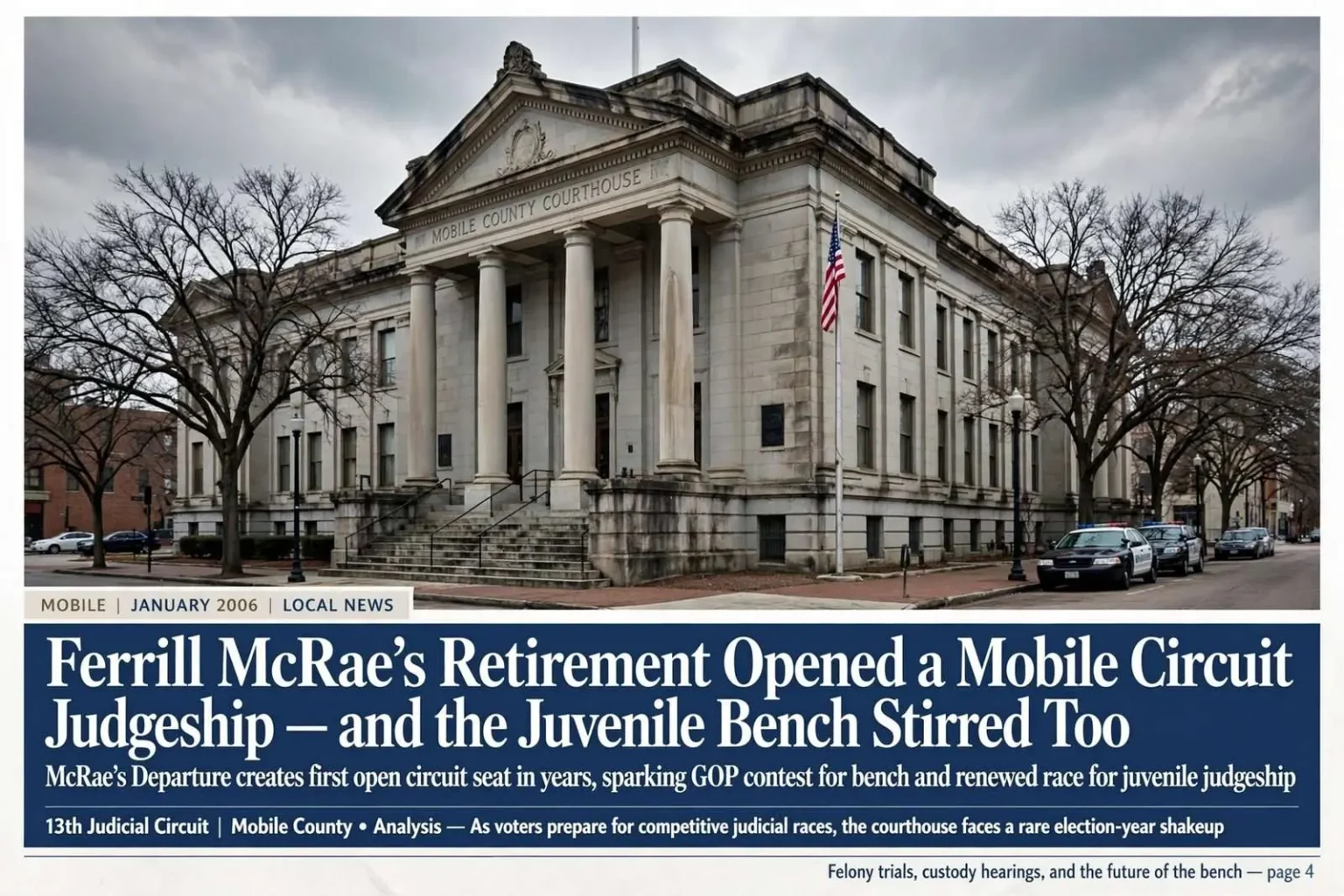
MOBILE — Open seats on the Mobile County circuit bench do not come along often. Incumbent judges tend to be re-elected, frequently without opposition, and vacancies are more often filled by gubernatorial appointment between elections than by a contested campaign. So the retirement of Circuit Judge Ferrill D. McRae — one of the most familiar and most talked-about figures in the county’s justice system — created something close to an event. McRae’s departure meant an opening on the local circuit bench in that year’s elections, and the speculation about who would seek it began before the seat was cold.
For voters who follow the courthouse, the suddenness of the opening was part of the story. Judicial vacancies in Mobile County typically arrive through two doors: a death, a resignation or a retirement that allows the governor to appoint a successor, or the rare retirement timed to an election year that lets the electorate choose. McRae’s exit opened the second door, and in a county the size of Mobile — where the 13th Judicial Circuit handles one of the heaviest caseloads in Alabama — a genuinely open circuit seat draws attention from every corner of the local bar.
Three names at the Republican table
Three prospective Republican candidates were mentioned publicly for the seat during a meeting of the local GOP executive committee in Mobile: veteran attorney Robert Smith, longtime Republican lawyer Duncan Crow and District Judge George Hardesty. The executive committee meeting functioned, in practice, as an early audition — a room where would-be candidates could take the temperature of the party’s activists months before any qualifying deadline forced a decision.
Two of the three had been down this road recently. Crow and Smith had both sought the judicial vacancy created by the death of presiding Circuit Judge Bob Kendall. Smith made the short list of names sent forward for consideration, but Gov. Bob Riley ultimately appointed Sarah Hicks Stewart to that seat. For candidates who fall short of an appointment, an open election is the second path to the same destination, and both men were positioned to take it.
The Kendall vacancy offered a preview of how these contests unfold in Alabama. When a presiding judge dies in office, the bar’s names go forward, the governor’s office screens them, and the lawyers who miss the cut are left with a choice: wait for the next opening, which may be years away, or run when one finally arrives. Smith and Crow had each spent political capital on the appointment process, and neither had reason to shrink from an election that rewarded the same credentials — trial experience, party loyalty and years of visibility in the local legal community.
Stewart’s appointment also illustrated the stakes of the screening process. A gubernatorial appointee arrives on the bench with the incumbency advantage that makes judicial seats so hard to dislodge, and she becomes the presumptive favorite when the next election arrives. For the runners-up, the arithmetic is unforgiving: every seat that is filled by appointment is one fewer seat available at the ballot box. That is why an open seat created by a retirement — with no appointee to run against — was regarded by ambitious lawyers as the cleanest shot at a circuit judgeship Mobile County had offered in some time.
What a circuit judge in Mobile actually does
The seat at stake was no ceremonial post. Circuit judges in Mobile County preside over felony criminal trials, multi-million-dollar civil litigation, divorces and estate disputes, and the county’s most complex dockets. A circuit judge serves a six-year term, and the decisions made in those courtrooms — sentencing, damages, custody of children — reach more families in a year than most public officials touch in a career. That is part of why the candidates being discussed were all lawyers with long local résumés rather than newcomers: the county’s voters, and its bar, expect a circuit judge to arrive already knowing the courthouse from the inside.
Hardesty’s interest carried its own consequence. A district judge who moves up to circuit court leaves a district seat behind, and the chain reaction that follows can reshape a courthouse. That calculation was not lost on anyone counting seats that winter. If Hardesty ran for and won the circuit post, his district judgeship would fall vacant mid-term, and the governor would then be in the market for a new district judge — a process that would set off its own round of resumes and short lists. If he ran and lost, the county would have a district judge who had gambled a safe seat and come up short. Either outcome rippled beyond the single race, which is precisely why courthouse observers treated Hardesty’s deliberations as a story about several seats rather than one.
The same arithmetic applied in reverse to the lawyers beneath him. Every assistant district attorney, every family-law practitioner and every senior partner weighing a run had to ask not just whether they could win the open circuit seat, but whether the field would include a judge with the head start of incumbency somewhere else on the ballot.
The juvenile bench draws a familiar name
A second judicial contest was taking shape on the juvenile side. Mobile attorney Jeff Glidewell was considering a second try for the juvenile judgeship. As the Democratic nominee in 2004, Glidewell had lost to the Republican incumbent, Circuit Judge Pam Millsaps. Glidewell, 45, had maintained a general legal practice in Mobile since 1986, giving him nearly two decades of courtroom work across the civil and family matters that dominate practice in a mid-sized Southern city.
A rematch narrative comes with built-in advantages. Glidewell had already run countywide, already built a donor list and already absorbed the lessons of a losing campaign — the doors knocked, the precincts carried and lost, the message that did or did not land. Challengers who return for a second attempt usually arrive with a clearer theory of the race.
He would not have the lane to himself. Chip Herrington had already confirmed that he would seek the judgeship as a Democrat, and Mobile County Assistant District Attorney Edmond Naman was reportedly weighing a run for the same seat. The prospect of a contested primary on the Democratic side changed the character of the race entirely: instead of conserving resources for a general election against an incumbent, the party’s candidates would first have to spend months and money against each other.
The juvenile court’s docket is among the least glamorous and most consequential in the system. Its judges decide custody and dependency matters, delinquency cases and the removal of children from unsafe homes. The office draws candidates who have spent careers in family law, in prosecution, or in both, and the field was shaping up accordingly — a general practitioner of nearly twenty years, a lawyer stepping forward from private practice, and a prosecutor whose daily work brought him before the same judges he might one day join.
For the families who appear in juvenile court, the identity of the judge matters in ways that are hard to overstate. Dependency hearings can determine whether a child stays with parents, moves to relatives or enters foster care. Delinquency dispositions can set a teenager on a path toward rehabilitation or toward the adult system. The judges who make those calls hold a kind of authority over Mobile County families that no other office on the ballot quite matches, and the candidates converging on the race had each built careers around that corner of the law.
Why the juvenile seat draws prosecutors and family lawyers
The pattern of the field — a family-law-adjacent general practitioner, a private attorney and an assistant district attorney — reflects the nature of juvenile work. Prosecutors bring experience with abuse and neglect petitions, which the state files through the district attorney’s office. Family lawyers bring fluency in custody standards and the social-service apparatus that surrounds dependency cases. Both backgrounds translate directly to the bench, and both are the credentials party activists weigh when a judicial seat opens. The 2006 field was shaping up as a contest between those two professional pedigrees, with each candidate able to argue that his career had been preparation for exactly this docket.
What made all of this a political story rather than merely a legal one is a feature of Alabama’s system: judges here run in partisan elections. A candidate for circuit judge must first win a party primary, then a general election, and must raise the money to do both. Judicial campaigns in Alabama ask lawyers to solicit contributions from the very attorneys who will one day appear before them, a dynamic that has drawn criticism nationally but remains the law of the state — and it means that an open seat sets off a fundraising scramble as well as a policy-free contest of reputations.
In a county where Republican strength had been growing steadily through the 1990s and into the 2000s, the practical effect was that the GOP primary had become the contest that mattered most for many judicial seats — which is precisely why the party’s executive committee meeting doubled as an informal candidate showcase. Mobile County had voted Republican in top-of-the-ticket races for years, and judicial races had followed the same drift. A Democrat seeking a Mobile County judgeship in that era needed either a divided opposition or a crossover message; a Republican needed mainly to survive a primary filled with other well-credentialed lawyers.
That is why the meeting of the executive committee mattered more than its procedural significance suggested. The activists in the room would not formally nominate anyone, but their early impressions shape who qualifies, who consolidates support and who reads the room and waits for a better cycle. For Smith, Crow and Hardesty, the meeting was a first test of whether their interest would be received as serious or quixotic.
McRae leaves a landmark behind
McRae, for his part, had been a fixture. Elected and re-elected over decades, he had presided over some of the county’s most closely watched trials and had accumulated the kind of local reputation — admired by some, criticized by others, known to nearly everyone — that few judges anywhere acquire. In a courthouse where judges rotate through criminal, civil and domestic dockets, a long tenure builds a catalog of rulings that lawyers cite, complain about and remember, and McRae’s had grown long enough that his retirement marked a genuine generational change on the bench.
His exit removed a landmark from the courthouse and handed the county’s lawyers an opportunity they had been waiting years to see. Open judicial seats are the lottery tickets of a legal career: most lawyers will buy none, and the ones who hold one hold it for a day before the field assembles. The speculation that followed McRae’s announcement was the courthouse doing what courthouses do — counting votes that had not yet been cast and allies who had not yet been asked.
What came next
The qualifying deadline would settle the speculation soon enough. Until then, the courthouse traded names, weighed which candidate might clear the field, and watched to see whether a district judge would gamble a safe seat on a promotion. The scenarios multiplied: a Hardesty run that opened a district seat; a Glidewell-Herrington primary that tested the Democratic bench’s depth; a Naman entry that would put a prosecutor in a family-court race; a Smith or Crow campaign aimed at converting a near-miss appointment into an elected term.
For ordinary voters, the practical takeaway was simpler. Two judgeships — one circuit, one juvenile — would be on the ballot with no incumbent or an open field, meaning residents of Mobile County would have more actual say over who sat on the bench than in most election years combined. Judicial races rarely advertise, rarely debate and rarely register in public attention, but the people elected that year would handle felony sentencing, dependency cases and the county’s biggest civil disputes for six-year terms.
It was, in the ordinary run of Mobile County politics, a very interesting January.