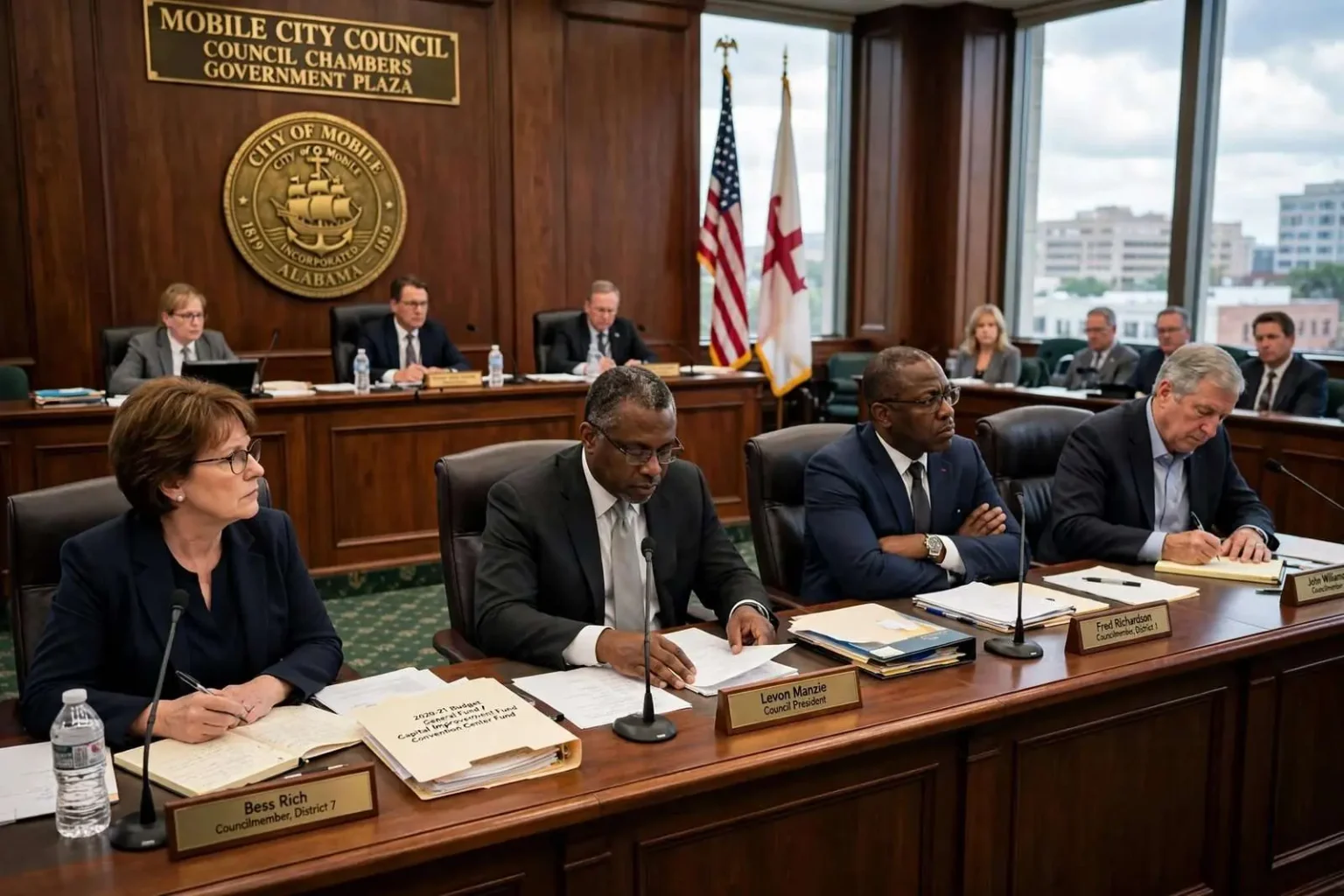
Mobile City Council members voted Tuesday to approve the city’s 2020-21 general fund, capital improvement fund and convention center fund budgets, capping off a meeting marked by lengthy and at times contentious debate over how capital dollars should be divided among the city’s seven council districts.
The budget package passed 6-0, with one abstention. Councilman Fred Richardson declined to support the measure after his push to amend the capital improvement portion failed to gain traction in the form he wanted. Richardson had sought to redirect $1 million from a vehicle-settlement line item into a new line item he wanted to call the St. Stephens Road revitalization program.
The vote closed out a budget season conducted under unusual strain: a fiscal year beginning with the city still absorbing the economic shock of the coronavirus pandemic, and a council weighing years of accumulated district wish lists against a capital budget that could not come close to funding them all. The general fund and its companion funds set spending for everything from public safety to parks to the city’s convention operations, but it is the capital improvement fund — the pool that builds fire stations, repaves roads and renovates parks — where the city’s choices about its own geography become concrete.
The amendments that framed the debate
Before the final vote, council members Bess Rich and Richardson both requested changes to the capital improvement fund. Rich’s amendment succeeded, restructuring $880,000 originally set aside for synthetic turf at Medal of Honor Park into three categories: $400,000 for resurfacing, $400,000 for new sidewalks, and $80,000 for beautification work along Grelot Road.
Richardson’s objection centered on what he described as an imbalance in capital funding across council districts. He argued that Mayor Sandy Stimpson’s proposed 2020-21 capital improvement budget included no money for District 1, which Richardson represents, even as other districts received funding for projects such as a new fire station at Langan Park, budgeted at $970,000.
“For him to give money to four or five districts and not give any money to District 1, is unacceptable,” Richardson said, noting that a fire station had previously been built in District 1 with city funds. “I’m saying that it’s just unjustifiable.”
Richardson also renewed his push for dedicated funding toward St. Stephens Road, pointing to the corridor’s status as part of U.S. Highway 45 — a route he argues deserves greater capital investment given its heavy local traffic.
St. Stephens Road runs northwest from downtown Mobile through the heart of Richardson’s district, one of the oldest thoroughfares in the city and a corridor whose history stretches back to the early territorial roads that connected the port to the Alabama interior. Richardson had spent years arguing that the road carried traffic volumes more typical of a state highway while its commercial frontage deteriorated — and that a corridor with that history, in a district that historically received a fraction of the capital projects its population justified, was the natural test case for a serious city commitment.
A procedural squall over a motion
The push to formally amend the budget hit a procedural snag when Councilman John Williams interjected that no motion had actually been made. Richardson insisted he had made one, and the two went back and forth before council president Levon Manzie asked Richardson to restate his motion for the record. Rich seconded it once Richardson clarified his request.
The exchange was brief by the standards of the evening but telling. Parliamentary precision matters in budget votes because amendments, once adopted, become binding line items — and a $1 million transfer, if it had been made formally and seconded without objection, could have moved the capital budget in a direction the administration had not proposed. By requiring the motion to be restated clearly, the council ensured the $1 million question got a full airing rather than a hasty vote.
Rich’s caution: apples to oranges
Rich used the moment to note that her own district had likewise been left out of new park funding in the proposed budget, even though several other districts received allocations for park improvements.
“If we look at that list, there are park improvements in the majority of the districts but not in all the districts,” she said. “The district that I represent did not get chosen, but I’ve been working with discretionary (funds) and CIP funds over the last number of years to make those improvements at Medal of Honor Park, and it’s been very successful for the most part.”
Her District 7, in West Mobile, had grown for decades on the strength of park investment and infrastructure — Medal of Honor Park among the busiest recreational facilities in the city — and Rich’s argument was that her district’s needs had been met piecemeal, through years of discretionary allocations, rather than through the marquee line items other districts enjoyed.
She cautioned colleagues against approving Richardson’s proposed $1 million transfer without more detail on where the money would ultimately be spent.
“Taking money from a line where we won’t know what we’ll be doing at this point when we’re moving a million (dollars) from one line (item) is not keeping it apples to apples, it’s doing apples to oranges. It would make it difficult for the council to make a good decision,” Rich said.
Rich added she was glad to see money allocated generally for the St. Stephens Road corridor in the new budget, but said a full-scale project there was unlikely to move forward within the current fiscal year given how many details remained unresolved. “There were too many unknowns,” she said of what the project would ultimately require.
Her caution reflected the practical mechanics of capital budgeting. A corridor revitalization project — design work, right-of-way questions, coordination with the state over a U.S. highway, and construction phasing that touches hundreds of properties — cannot be safely launched by a transfer adopted in a single meeting. Moving the money without a plan, in the council’s arithmetic, risked either stranding it or forcing the city to rush a project that had not been designed.
The vote, and the tension underneath it
With the amendments settled and Richardson’s transfer rejected, the council moved to the budget itself. The 6-0 vote with one abstention — Richardson’s — gave the administration the spending plan it had proposed, with the capital improvements largely intact and the debates of the evening recorded in the minutes rather than in the numbers.
The abstention was the mildest of Richardson’s historic forms of protest, but its meaning was clear. The disagreement reflects a recurring tension on the council over how the city divides limited capital dollars among Mobile’s seven districts each budget cycle, a dynamic that has surfaced repeatedly in past years as members balance citywide infrastructure priorities against calls for more equitable, district-by-district investment.
It is a tension built into the structure of the city’s government. Mobile’s seven single-member districts each elect a council member responsible for delivering visible results inside district boundaries, while the mayor proposes budgets built around citywide priorities and the professional judgment of department heads. Every budget season, those two imperatives collide: what the city needs, measured asset by asset, and what each district believes it is owed.
The 2020-21 budget was written in the shadow of a pandemic recession that threatened the very revenues — sales taxes and lodging taxes chief among them — that fund the city’s work, giving members an additional reason to protect the administration’s structure rather than unwind it mid-year. St. Stephens Road, Medal of Honor Park and the district-by-district ledger will all return with the next budget cycle, as they have every year; the only difference is which project lists have grown or shrunk in the meantime.
For District 1, the outcome meant another year without a marquee capital project, a result Richardson has pressed against in budget seasons past and made clear he would press again. District 1 spans much of the city northwest of downtown — neighborhoods including Maysville, Orange Grove and the Crichton area — where residents have long argued that decades of disinvestment show up in everything from drainage to street conditions, and where a rebuilt commercial corridor like St. Stephens Road would carry visible, immediate meaning.
Whether the council’s stated concern about equity translates into future budgets will depend less on any single September meeting than on the mechanics that produced this one: administration-drawn project lists, council amendments that redistribute at the margins, and district advocates who must persuade seven colleagues that their corridor’s need outranks everyone else’s. The 2020-21 budget did not resolve that contest. It simply recorded another round of it — a mayor’s plan adopted nearly intact, one district’s $1 million request deferred as too vague, another district’s park project restructured toward cheaper fixes, and seven members’ competing definitions of fairness preserved for the next year’s ledger.