Mobile City Council Returns to In-Person Meetings at Government Plaza
The Mobile City Council returns to in-person meetings May 26 after remote sessions since April 14, with limited seating and emailed public comments.
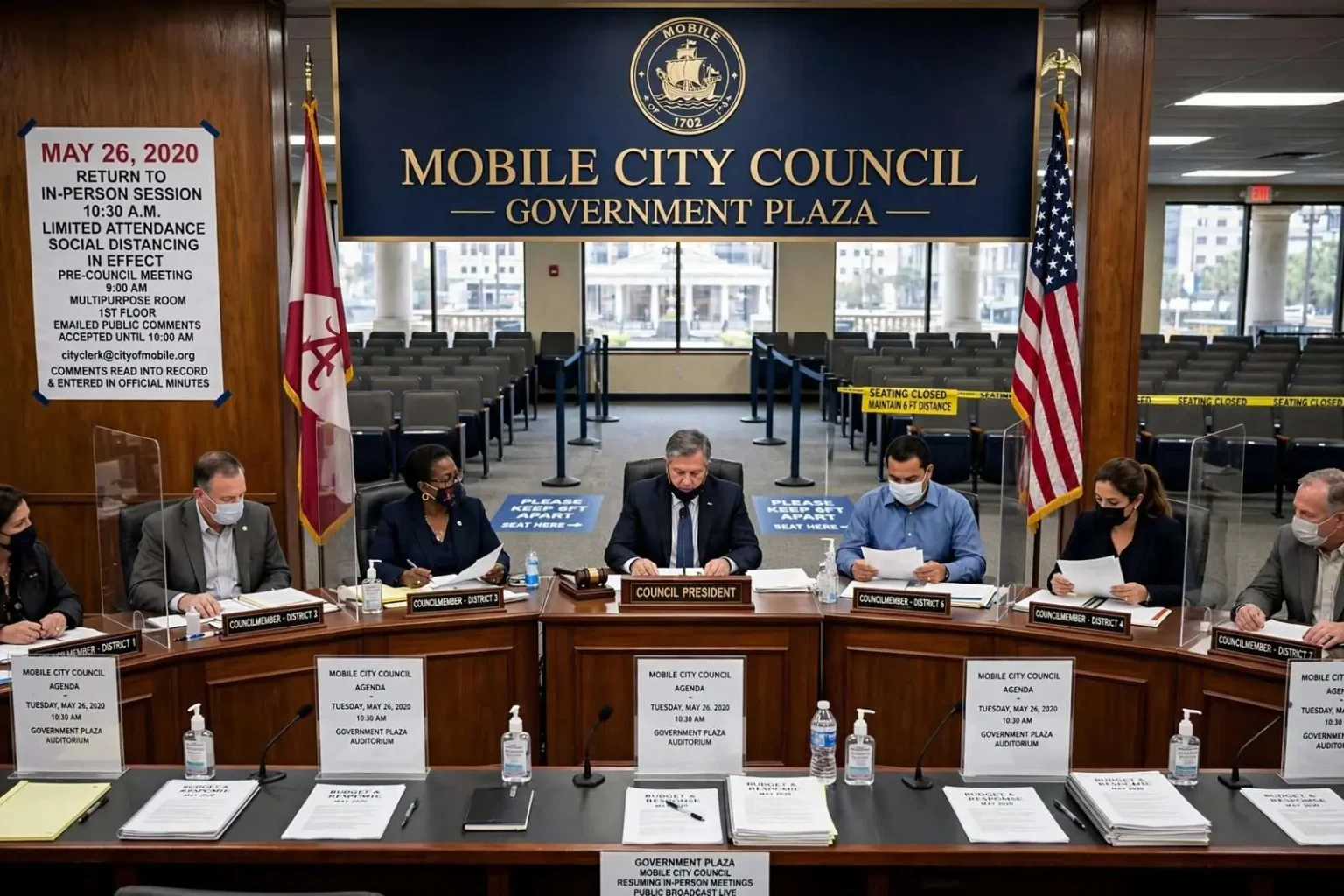
After more than a month of meeting remotely, the Mobile City Council is going back to its regular chamber. The return marks the end of an extraordinary experiment in governance by video conference, one adopted in the early weeks of the coronavirus pandemic when cities across Alabama and the nation abruptly had to figure out how to conduct public business without the public — or even the officials themselves — in the same room. For Mobile, the resumption of in-person meetings at Government Plaza restored one of the city’s most familiar civic rituals: the Tuesday council session where ordinances are passed, contracts are awarded and residents get their three minutes at the microphone.
The council, which had gathered virtually since April 14 during the coronavirus pandemic, will resume in-person meetings at Government Plaza. The month of remote meetings had tested both the technology and the traditions of Mobile’s legislative body. Council members participated by video, staff managed agendas digitally, and the public followed along through the city’s broadcast channels — workable, but a far cry from the chamber dynamics where a councilman’s raised eyebrow or an audience member’s murmur can change the course of a debate. The remote period also highlighted how much of local legislation depends on the informal exchanges that happen before and after formal sessions in the hallways of Government Plaza.
The Schedule for the Return
The return session is set for Tuesday, May 26 at 10:30 a.m. in the auditorium at Government Plaza, with the pre-council meeting at 9:00 a.m. in the Multi-Purpose Room on the building’s first floor. The two-room arrangement is itself a measure of the pandemic’s continuing grip: instead of packing council members, staff and spectators into the regular council chamber, the city spread the proceedings across two floors of the Government Street complex, using the auditorium’s larger capacity to allow the elected officials and essential staff to sit with distance between them while the smaller pre-council work session convened downstairs.
The pre-council meeting, a Mobile institution that most large cities lack, is where the council’s seven members informally bat around the agenda — asking staff questions, floating concerns and often signaling how contentious an item will be before it ever reaches the formal session. Holding it in the Multi-Purpose Room rather than its usual space preserved that tradition while respecting the spacing requirements that had made the chamber itself temporarily unsuitable for a full complement of officials and staff. Residents who follow city government closely know the pre-council session is often where the real debate happens; its continuation, even in a different room, mattered to those readers of the city’s business.
Limited Attendance, Open Channels
Attendance is being limited so people can keep proper social distance inside the chamber. The limitation applied the public health guidance of the moment — spacing that reduces the risk of coronavirus transmission in enclosed spaces — to a body whose meetings are, by state sunshine law, open to the public. Residents accustomed to walking into Government Plaza and taking a seat would now find capacity controlled, with the city managing how many members of the public could be present at once.
Residents who stay home are not shut out entirely: the city is accepting public comments by email at [email protected] up to 30 minutes before each meeting. The email channel was the pandemic’s practical compromise with the Alabama Open Meetings Act, which guarantees the public’s right to address governing bodies but had never contemplated a chamber with restricted seating. Thirty minutes before the gavel was the cutoff — a deadline that gave the city clerk time to assemble the comments and the council president time to acknowledge them during the session without derailing the agenda.
Those comments will be acknowledged during the session, distributed to council members and entered into the official minutes. That three-part treatment gave emailed comments real standing in the city’s legislative record. Acknowledgment during the session preserved the public’s visibility into who was speaking to the council and about what; distribution to council members ensured the comments were actually read by the people whose votes they sought to influence; and entry into the minutes made them part of the permanent record of the meeting — the same standing, in written form, that a spoken comment at the podium carries. For residents dealing with the council on rezonings, nuisance cases, or neighborhood concerns, the email route meant their voices could still reach the dais even from a living room.
What the Remote Month Had Taught
The six weeks of virtual meetings — from April 14 through May — had produced their own lessons, visible in how the city structured the return. Broadcast meetings, digital agendas and email comment systems built in a hurry became permanent parts of the city’s toolkit, and the hybrid arrangements put in place for the May 26 return reflected a new understanding: that public meetings could continue under almost any conditions, but that nothing fully replaces the chamber. Cities across the region watched one another’s experiments, and Mobile’s combination of limited in-person attendance plus robust remote participation became a model for the balance other Gulf Coast governments struck as they, too, came back.
The May 26 agenda itself arrived at a moment heavy with consequence. Late May 2020 found Mobile, like every American city, managing a pandemic budget shock — sales tax receipts, the city’s financial lifeblood, cratering with the shutdown — while preparing for a summer of reopening decisions. The council’s docket in that period carried the economic and public health measures the crisis demanded, making the return to in-person deliberation more than procedural housekeeping: the city’s most consequential decisions in a generation were being weighed by a body that had spent the spring deliberating through screens.
Government Plaza and the Council’s Home
Government Plaza, the city-county complex on Government Street, has been the council’s home since the 1990s, housing both the Mobile City Council and the Mobile County Commission under one roof — an arrangement that concentrates the region’s government in a single downtown building and, during the pandemic, concentrated its health risks as well. The auditorium and Multi-Purpose Room pressed into service for the return session are flexible spaces designed for exactly this kind of adaptation, allowing the city to reshape its meeting footprint without leaving its home.
Reading the Return Correctly
It is worth being precise about what the May 26 session did and did not represent. The council was not declaring the pandemic over, and the arrangements in place — spacing, capped attendance, email comments — were acknowledgments that the risk remained. The return was a calibrated step: restore the deliberative process that remote meetings strained, while keeping the safeguards that public health guidance required. City officials had spent the remote month learning which precautions were practical at scale, and the two-room, limited-attendance format was the result — government adapting in real time to a crisis that had no precedent in most council members’ tenures.
For Mobilians who watch the council closely, the practical effects were modest but real. The meeting remained broadcast, so viewers at home lost nothing in observability. The loss was the spontaneous participation — residents who decide on a Tuesday morning to walk downtown and speak — and its replacement was the 30-minute email deadline, which traded immediacy for accessibility. Whether that trade serves the public well became a lasting question of pandemic-era governance, debated in city halls across Alabama ever since. Mobile’s answer at the time was pragmatic: keep both doors open, in whatever form the moment allows.
The Council’s Role in a Crisis
The return session also restored the full weight of the council’s legislative function at a critical moment. Mobile’s strong-mayor form of government concentrates administration in the mayor’s office, but the council holds the purse and the pen: it appropriates money, approves contracts, amends the budget and passes the ordinances through which city government acts. A council that could not meet in person was a council that could not hold its public scrutiny of the administration’s pandemic spending to its usual standard. Resuming in-person sessions restored that check at the very time the administration was making emergency expenditures and revenue assumptions that would shape the city’s finances for years.
The procedures adopted for the return — acknowledged email comments, distributed to members, entered into minutes — were themselves small exercises in legislative craft, reconciling the Open Meetings Act’s demands with a transformed environment. They reflected the work of the city clerk’s office, the attorney’s office and the council president in preserving public participation mechanisms under constraints no one had planned for. That the city could stand up the hybrid arrangement within days of deciding to return said something about institutional resilience: the forms of democracy in Mobile bent under the pandemic, but did not break.
When the council convened in the auditorium at 10:30 that Tuesday morning, with the pre-council work done downstairs and emailed comments in hand, the city’s legislative branch was visibly back — changed by what it had been through, spaced out in a borrowed chamber, but conducting the public’s business in public once again.