Mobile City Council Set to Vote on Lana Pafenbach as Next City Clerk
The Mobile City Council is poised to appoint Lana Pafenbach as the city's next clerk, succeeding Lisa Lambert after her 32-year tenure with the municipality.
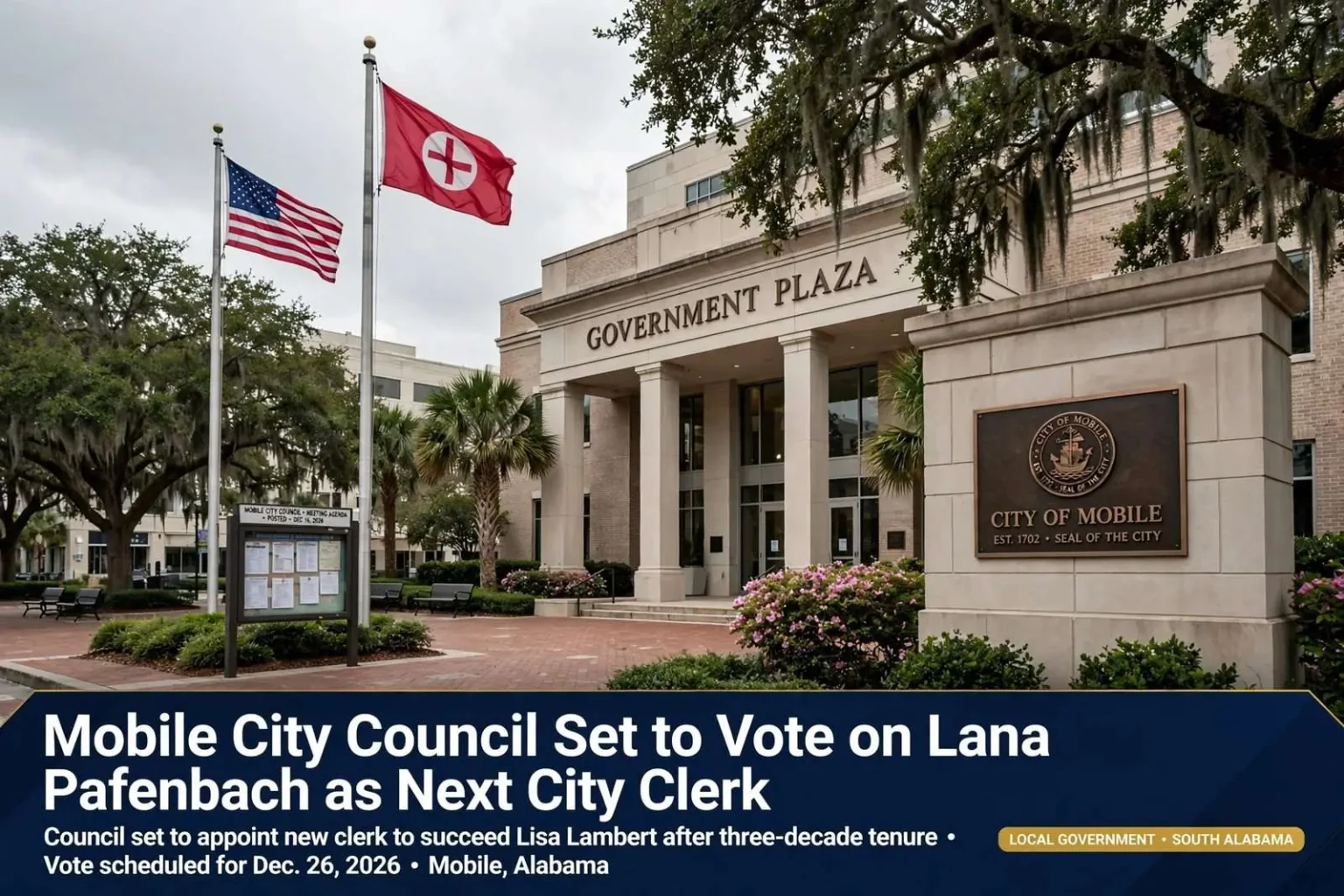
The Mobile City Council is poised to vote on appointing Lana Pafenbach as the city’s next clerk, replacing Lisa Lambert, who recently concluded a three-decade tenure with the municipality. Under the council’s proposed resolution, Pafenbach would officially assume the position on Dec. 26, 2026. The vote will fill one of the most consequential administrative posts in Mobile city government, the office responsible for keeping the official record of everything the council does. A change at the top of the clerk’s office arrives as the city continues to manage steady growth, major public works projects, and the routine business of a municipality that ranks among the largest in Alabama.
City clerk appointments rarely draw large crowds to Government Plaza, but the position touches nearly every interaction residents have with their local government. Ordinances, resolutions, meeting minutes, contracts, and official correspondence all pass through the clerk’s office, and the clerk serves as the point of contact for residents seeking public records. The incoming clerk will inherit both the daily responsibilities of the office and the expectations of a community that has grown accustomed to consistent, professional administration across successive administrations.
What a City Clerk Does in Alabama Government
In Alabama municipalities operating under the mayor-council form of government, the city clerk occupies a uniquely important place. The office is generally charged with attending council meetings, recording the proceedings, maintaining the city’s code of ordinances, and certifying official actions. Clerks also administer oaths, manage the publication of legal notices required by state law, and serve as the custodian of the city seal, which authenticates everything from proclamations to intergovernmental agreements.
The clerk’s responsibilities extend well beyond the council chamber. Election duties for municipal races, business license records, and the retention of documents that date back generations all fall within the office’s scope. Because the clerk’s records form the legal memory of the city, accuracy and continuity matter enormously. A transition from one long-serving clerk to a successor therefore involves more than a change of personnel; it involves the careful transfer of institutional knowledge built up over years of meetings, annexations, zoning decisions, and capital projects.
Across south Alabama, clerk’s offices in cities such as Prichard, Saraland, Satsuma, Chickasaw, and Creola perform similar functions at smaller scale, and their counterparts in Baldwin County municipalities including Daphne, Fairhope, and Foley do the same on the Eastern Shore. The position is one of the few in city government that serves every elected official rather than a single office, which is why councils typically weigh clerk appointments with unusual care.
A Three-Decade Tenure Comes to a Close
Lisa Lambert recently concluded three decades of service with the City of Mobile, a span during which the city saw dramatic change in its downtown, its port operations, and its neighborhoods. Thirty years in municipal government means the outgoing clerk worked alongside multiple mayors and many different council members, adapting to new technologies that transformed how records are kept and how meetings are conducted. Paper minutes and physical filing systems gave way to digital archives and online portals during her tenure, and residents came to expect faster access to the documents that govern their city.
Long tenures like Lambert’s are increasingly uncommon in municipal administration, where career mobility often moves professionals between cities and states. Continuity of that length provides institutional stability, particularly for a city that must maintain unbroken legal records through hurricanes, economic shifts, and leadership transitions. The council’s proposed resolution acknowledges that transition by setting a specific date, Dec. 26, 2026, for Pafenbach to officially assume the position, providing a clear timeline for the handoff of duties and records.
How the Appointment Process Works
The council’s action takes the form of a proposed resolution, the standard legislative instrument municipal bodies use to make appointments and set policy. In Mobile’s mayor-council structure, the seven-member council represents individual districts across the city and meets regularly at Government Plaza downtown, where it considers ordinances, resolutions, and appointments. A resolution to appoint a city clerk must clear the same public process as any other council action, including placement on the meeting agenda and a recorded vote.
Residents who follow the process can watch each step. Council agendas are published in advance of each meeting, and the minutes of prior sessions are posted once approved. Meetings are broadcast and recorded for residents who cannot attend in person, a practice that has become standard among larger Gulf Coast municipalities and that grew especially important as audiences adapted to remote viewing options in recent years. The appointed clerk will herself be responsible for maintaining that system of public records going forward, making the office both the subject and the steward of the city’s transparency practices.
Appointments of this kind typically follow a period of internal review, in which council members evaluate candidates’ experience with municipal law, records management, and election administration. The city clerk must work closely with the council president’s office, the mayor’s administration, and every individual council district, so familiarity with Mobile’s distinctive government structure is a practical necessity. The resolution’s scheduled effective date gives the city time to complete that transition methodically rather than in a rush.
Local Decisions in a State and Federal Context
Local and state government decisions frequently shape how Mobile, Baldwin County, and the broader region grow and govern themselves. City and county governments along the upper Gulf Coast hold regular public meetings, with agendas and minutes typically posted online and broadcast or recorded for residents who cannot attend in person. State-level decisions in Montgomery and federal actions through the state’s congressional delegation also shape funding, infrastructure, and regulatory matters for the Mobile region, and are regularly reported on alongside local government activity.
The layering matters in practice. A municipal clerk’s office in Mobile coordinates with state agencies on matters ranging from municipal elections conducted under Alabama election law to the publication requirements set by the Alabama Code. Federal grants that fund everything from port infrastructure to public safety equipment flow through city government and generate records the clerk’s office must track and retain. The result is an office that sits at the junction of three levels of government, translating requirements handed down from Montgomery and Washington into the daily paperwork of a city of nearly 200,000 residents.
Mobile County, the second-most populous county in Alabama, contains a wide range of municipalities alongside unincorporated areas governed by the county commission. The city clerk’s office in Mobile is the largest such operation in the county, and its handling of council records, legal notices, and document requests sets a benchmark that neighboring cities frequently follow.
The Regional Economy Behind City Hall
The local economy along the upper Gulf Coast is built on a mix of long-standing industries, retail, and tourism that drives hiring and traffic across the region. The Mobile area’s economy includes major employers in aerospace, steel, shipbuilding, logistics, healthcare, education, and the port, alongside a broad base of small businesses that serve residents and visitors. Each of those sectors generates municipal business — permits, licenses, contracts, and incentive agreements — that flows through city government and, ultimately, into the records maintained by the clerk.
Commercial activity at the Port of Mobile, one of the busiest deepwater ports on the Gulf of Mexico, ties the city to national and international trade routes. Manufacturing and logistics operations along the Mobile River corridor support thousands of jobs, while the city’s healthcare systems and higher education institutions anchor a service economy that reaches deep into Baldwin County. Municipal government sits at the center of that activity, and the council actions recorded by the clerk’s office — from zoning approvals to incentive packages — shape the conditions under which regional employers operate and expand.
Mobile and Baldwin County together form a single regional economy, with commuters, students, and shoppers moving daily across the bay, and with shared concerns about transportation, schools, public safety, and growth that play out in both counties’ public meetings and local news coverage. The Baldwin Bridge and the older Bankhead and Cochrane-Africatown crossings carry that daily flow, and decisions made in Mobile’s council chamber — on road projects, transit coordination, and waterfront development — echo across the water. A city clerk’s office that keeps those decisions well documented serves residents on both sides of the bay.
Where the Story Fits in South Alabama
Mobile is the third-largest city in Alabama, situated at the head of Mobile Bay where the Mobile River meets the Gulf of Mexico. Founded by French colonists in 1702, it is the oldest city in the state and the site of the original capital of French Louisiana. Today the city serves as a major regional hub for shipping, aerospace, steel manufacturing, and healthcare, and is home to the University of South Alabama and Spring Hill College. That history gives the clerk’s office a particularly rich archive to steward, one that stretches from the colonial era through the modern port economy.
News from across south Alabama frequently highlights the ways in which local decisions in city halls, county commissions, school board meetings, and state offices in Montgomery interact with daily life for residents from Saraland to the Eastern Shore and from downtown Mobile to the Gulf beaches. Long-running coverage of the Port of Mobile, the Brookley aeronautics complex, and the industrial corridor along the Mobile River connects stories about steel, shipbuilding, aerospace, and shipping into a single regional narrative. A personnel change at the top of the clerk’s office fits squarely within that coverage, even when it arrives without controversy, because the office underpins the public record on which all of those stories depend.
Local school systems, including Mobile County Public Schools and the Baldwin County Public Schools system, are among the largest employers in the region and are a focus of ongoing community attention, particularly around school construction, teacher staffing, and student performance. Municipal governments and school systems intersect regularly on issues such as resource officers, crossing guards, and property tax debates, and the minutes of those discussions live in the clerk’s records.
Hurricane and severe-weather preparedness is a recurring topic for residents across the coast, with annual public drills, sandbag distributions, and updates from local emergency management agencies as the Atlantic hurricane season progresses each year. Emergency declarations, mutual aid agreements, and recovery contracts are all official actions that the clerk’s office must document, a responsibility that becomes especially visible in the aftermath of any major storm.
How Residents Can Follow the Vote and Its Aftermath
Residents who want to follow ongoing coverage of the issues that affect their community can typically find it in the daily local newspaper, on regional television stations, and in a growing number of local digital outlets that focus specifically on the cities and towns of south Alabama. The council’s agenda, once the resolution is formally placed on it, will be available through the city’s standard publication channels, and the vote itself will appear in the minutes recorded by the very office at the center of the appointment.
For now, the process moves forward on the timeline the resolution lays out: a council vote on the appointment, followed by Pafenbach’s official assumption of the position on Dec. 26, 2026. Between those dates, the city will manage the transfer of an office that three decades of continuous service left in established routines. When the new clerk takes the post, the meeting minutes, ordinance books, and public records of the City of Mobile will pass into new hands — and the daily work of documenting how the city governs itself will continue as it has for generations.