Mobile Conga Player “Doc” Handy Brings Family Legacy to Gulf Coast Jazz Festival
Mobile mail carrier Terry 'Doc' Handy, a self-taught conga player, performed at the Gulf Coast Ethnic & Heritage Jazz Festival in his late brother's honor.
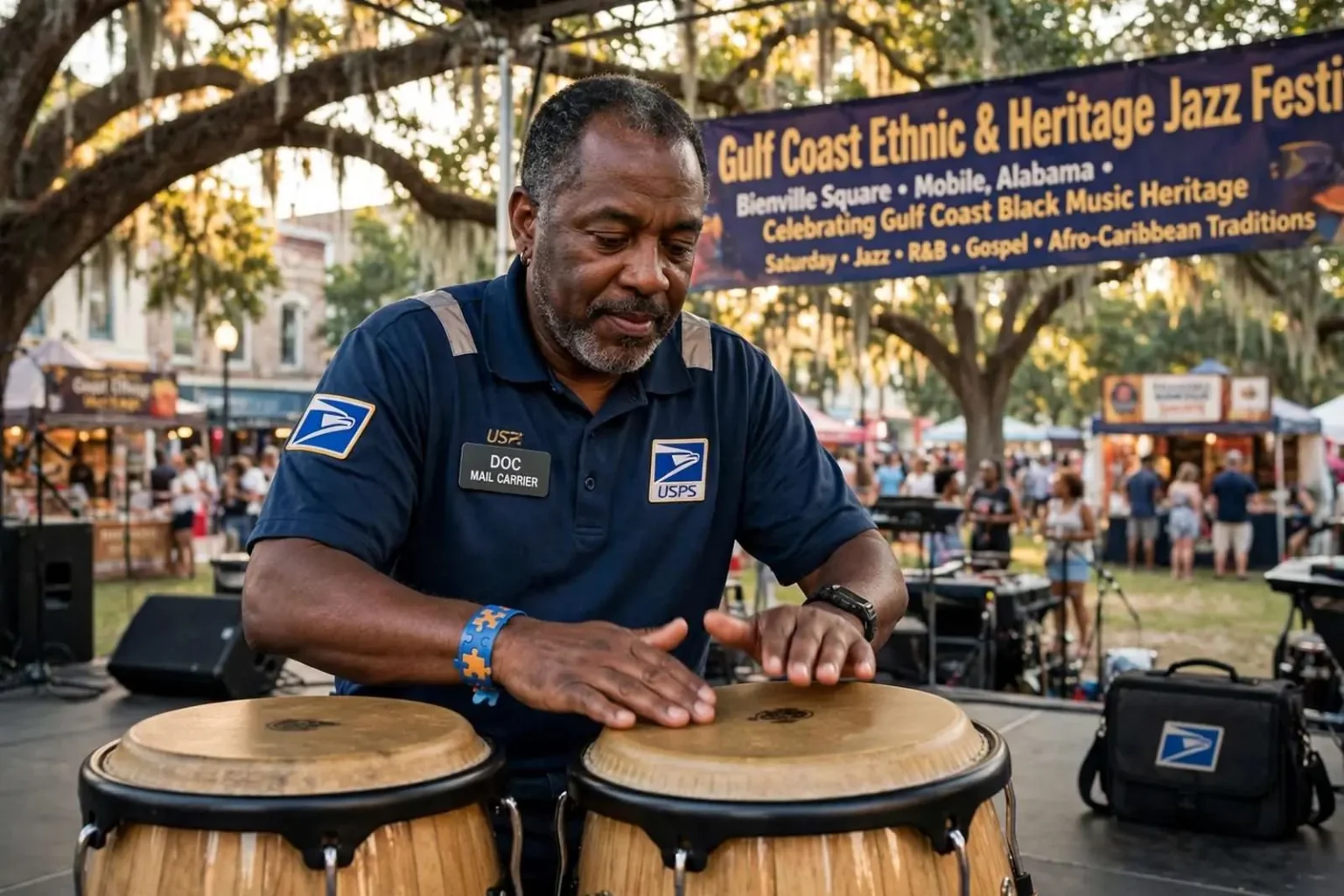
Terry “Doc” Handy, a Mobile mail carrier and self-taught conga player, performed Saturday in Bienville Square as part of the Gulf Coast Ethnic & Heritage Jazz Festival, continuing a musical path that traces back to a junior-high choir class and a family bond forged through rhythm. Handy, now 50, first picked up the congas at Kirby-Smith Junior High School, where a teacher asked for volunteers to play the Cuban hand drums for a choral production. “My hand just happened to go up faster than the other three,” he said.
An uncle in New York later noticed his interest and bought him his own pair of drums — the kind of small, faraway act of encouragement that sets a life on course. A raised hand in a choir room and a gift from an uncle hundreds of miles away turned out to be the two starting blocks of a career that has run through Army bases in three countries and onto festival stages in his hometown.
The festival itself is a fitting stage for that story. Held in Bienville Square, the oak-shaded park blocks from Mobile’s waterfront, the Gulf Coast Ethnic & Heritage Jazz Festival celebrates the musical traditions that run through the Gulf Coast’s Black communities — jazz first among them, but with room for the R&B, gospel and Afro-Caribbean currents that feed it. Handy’s congas sit at exactly that crossroads, and a Saturday afternoon crowd in the square got the full measure of a player who learned his instrument everywhere but a classroom.
A Bond Through Music
Handy has credited much of his musical drive to his late brother, Theron, who he said had autism and a remarkable gift for piano. “My brother is my biggest inspiration,” Handy said. “He passed away in 2003, but he was what you would call a savant. He was very gifted and could play Chopin on the piano.”
The image stays with anyone who hears it: two brothers, one who could read nothing and play everything, the other learning rhythm by hand and by ear. Handy now wears an autism awareness bracelet in his brother’s memory and has performed at fundraising events for autism causes, including one held by the Jessica Green Foundation at Camp Milton — a way of keeping Theron’s influence present in the work long after the piano fell silent.
A graduate of Raines High School, Handy played congas in the school’s stage band in the 1970s while listening to Parliament, Earth Wind & Fire and other R&B acts of the era — music he said always traced back to jazz roots. The observation is more than nostalgia. The funk and R&B that filled radios in the 1970s carried the same rhythmic ancestry as the jazz played on festival stages, and a percussionist who grew up on both learns early that the groove and the swing are cousins.
Twenty-One Years in the Army
Handy said his real education on the congas came during a 21-year career in the U.S. Army, where he was stationed in Germany, Korea and Panama. Soldiers from Puerto Rico first showed him the proper technique while he was stationed in Berlin, and he went on to play alongside musicians from across Latin America and West Africa. “My growth started when I went overseas. That’s when I learned how to play congas the right way,” Handy said.
“One of my most interesting experiences was when I played with the Africans — the Gambians — in Germany. It was just interesting to sit down and discover that we had a lot more in common than we didn’t have in common.” The lesson he took from those sessions is the one the congas themselves teach: the hand patterns of Cuba, Puerto Rico and West Africa are members of the same family, separated by centuries and an ocean, and a player who sits down with all of them can hear the conversation continue.
Military service has long been one of the unlikely conservatories of American music, and Handy’s story fits the pattern. A soldier who ships out with a self-taught talent meets players from every corner of the world, absorbs their techniques in clubs and barracks jam sessions, and comes home carrying traditions he could never have learned in Mobile alone. Twenty-one years of that education gave him a command of the instrument no single teacher could have offered.
Building a Local Music Career
Since returning to the Mobile area, Handy has performed at venues including the Ritz Theatre and has released two albums. His debut, “Kinfolks,” came out in 2007 and was featured on the soundtrack of the film “Welcome Home Roscoe Jenkins” — a crossover moment that put a Mobile percussionist’s work into a national movie’s soundtrack and gave the local scene a story worth telling.
Last year he teamed with 25-year-old Mobile jazz and gospel drummer John Lumpkin Jr. to record a second album, “Clue Paradise,” which Lumpkin said is currently being reviewed by composer David Baker, artistic director of the Smithsonian Jazz Masterworks Orchestra. The pairing itself says something about Handy’s reach: a conga player in his late 40s collaborating with a drummer half his age, bridging the generations of Mobile’s jazz and gospel communities on a single record.
Lumpkin said Handy stands out among conga players for blending swing and bebop into a genre more typically associated with Afro-Latin and salsa music. “He’s one of the first conga musicians that I’ve met who likes to swing,” Lumpkin said. The distinction matters to musicians. Most conga playing lives in the Latin tradition, where the patterns lock to a clave and the groove stays vertical; swing pulls the music horizontally, pushing and pulling against the beat the way a bebop drummer does. Handy plays both languages at once, which is exactly what makes him unusual.
Handy, who is married, said he hopes his music continues to open doors — both for himself and for the west Mobile neighborhood where he grew up. “I grew up in Brentwood, and you hardly ever hear anything good about Brentwood,” he said. “Maybe this will help change that.” It is a modest ambition with a long reach: a mail carrier from a neighborhood better known for its struggles, standing on a downtown stage showing the city what his part of town produces.
The Day Job and the Drums
The routine that sustains Handy’s music is as unglamorous as it is disciplined. He carries mail by day — a city route, walking miles with a bag — and builds his playing life around it: rehearsals, recordings, festival dates and benefit performances fitted into evenings and weekends. The dual life is common among working musicians in a city Mobile’s size, where few players live on music alone, but Handy wears it as a credential rather than a compromise. The job pays the bills; the drums pay the soul.
It also connects him to the city he plays for. A mail carrier walks every street on his route, knows the porches and the families, and greets half the town by name — and when that same man takes the stage at Bienville Square, the audience is partly composed of people whose mail he has carried. Few performers have a more direct line to their community, and few communities get to watch one of their own build a recording career from the neighborhood outward.
The Saturday performance in Bienville Square capped a half-century journey that began with a raised hand in a junior-high choir room. Handy is 50 now, with two albums behind him, a brother’s memory on his wrist and a city’s musical traditions in his hands. The festival stage where he played is a short walk from the streets where he learned to listen — and if the drums say what he hopes they say, Brentwood’s story is being told in swing.
Jazz on the Gulf Coast
The festival that hosted Handy’s Saturday set occupies a special place in Mobile’s cultural calendar. The city that claims Mardi Gras as its birthplace has an equally deep claim on Gulf Coast music — a port city where the same shipping routes that brought cargo up the Mobile River brought musical traditions from the Caribbean, Latin America and West Africa, and where Black neighborhoods kept those traditions alive through churches, school bands and clubs. A jazz festival in Bienville Square is that history performing itself in public, one Saturday at a time.
The congas fit that story precisely. The instrument came north from Cuba and took root in American jazz during the big-band era, and its African ancestry makes it one of the clearest audible links between the Gulf Coast’s jazz tradition and the rhythms of the Caribbean basin. A Mobile-born player who learned the drums from Puerto Rican soldiers in Berlin and Gambian musicians in Germany has, in a real sense, retraced the instrument’s whole journey — and then brought it home.
Handy’s collaboration with John Lumpkin Jr. points to where that homecoming goes next. The younger drummer’s grounding in jazz and gospel gives the partnership its engine, while Handy’s congas add the Afro-Latin and West African vocabulary he collected across two decades overseas. If “Clue Paradise” wins the attention of listeners as far from Mobile as the Smithsonian’s orbit, it will be because two Mobile musicians found a sound that carries — and because a self-taught player decided, fifty years ago in a choir room, to raise his hand.
The door Handy hopes his music opens runs both ways. Every festival date, film credit and recording session makes the case that the city’s overlooked neighborhoods produce artists of national caliber, and every young percussionist watching a mail carrier take a downtown stage sees a working proof that the route is real. “Maybe this will help change that,” he said of Brentwood’s reputation. On a Saturday afternoon in Bienville Square, with the congas talking and the oaks overhead, it was hard to argue the point.