Twenty-Five Years On, Mobile Weighs Whether Its Convention Center Delivered
A quarter century after Mobile bet its downtown revival on a waterfront convention center, business and civic figures offered a candid, divided verdict on whether the gamble paid off.
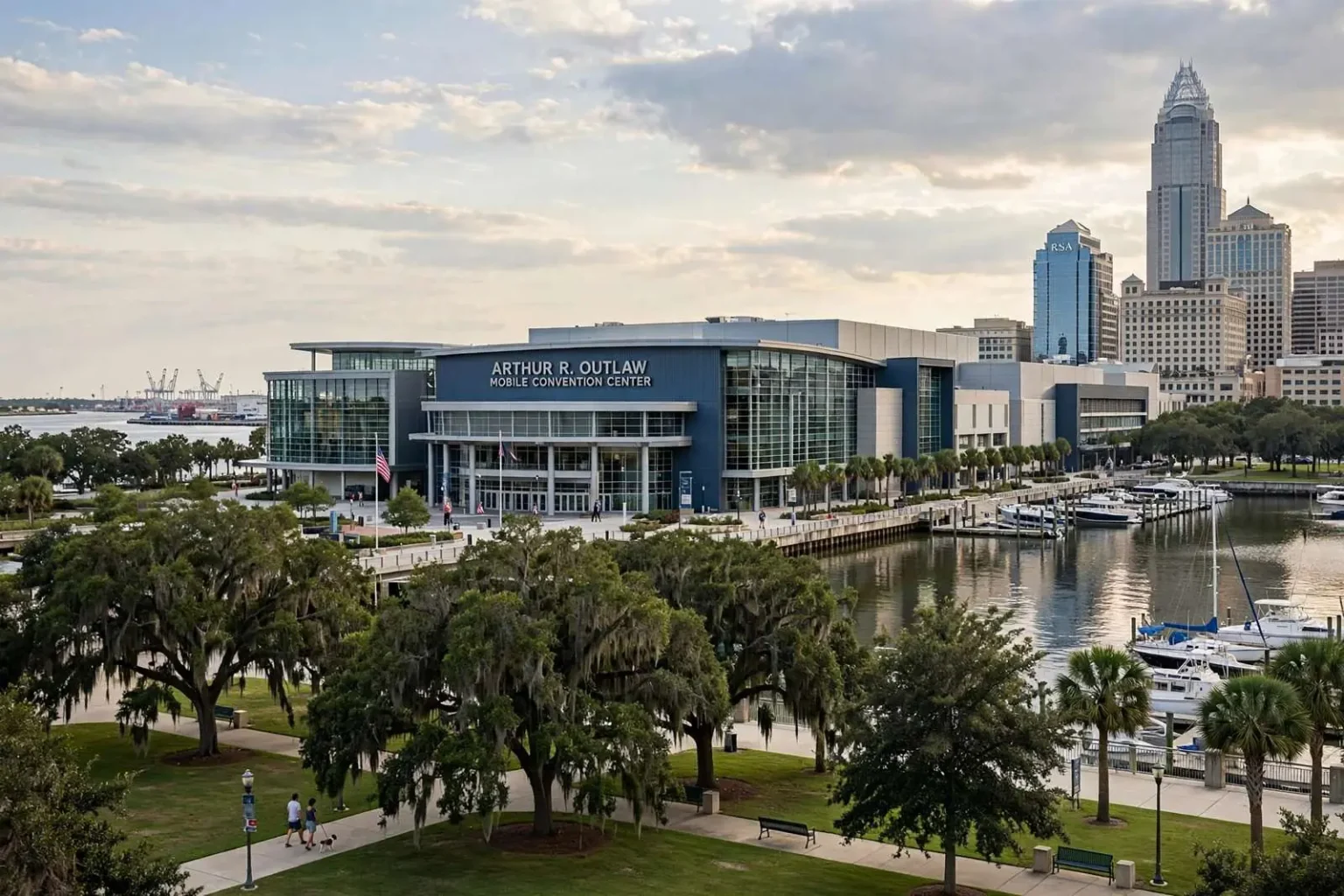
Twenty-five years after Mobilians rallied behind a new mayor-council government and a bold vision for downtown, the city took stock of the decision that came to define that era: the construction of a waterfront convention center on the old banana docks at the foot of Government Street. The building rose where cargo ships once lined up to unload fruit from Central America, and on its anniversary the question the city kept returning to was blunt — did it deliver?
A gamble that reshaped City Hall
Mayor Arthur Outlaw and the inaugural City Council settled on the center as the centerpiece of their plan to revitalize a downtown that many described as being in a death spiral. Retail had drained toward the suburbs, hotels had gone quiet, and the riverfront itself was cut off from the city behind working docks and warehouses. A sparkling facility on the river, paired with a commitment to the convention and visitor industry, would bring “heads in beds,” the thinking went — filling hotel rooms and restaurants with conventioneers and anchoring a new economy around the water.
To pay for it, the city adopted an additional one percent sales tax on prepared food, the so-called “hamburger tax,” and a matching levy on hotel rooms. The dedicated streams made the financing possible and made the politics combustible in equal measure, since every restaurant check in Mobile carried the cost of the argument.
The politics proved costly. Opposition to the center and a related fight over a Water Street interstate connector sapped Outlaw’s strength and helped usher in Mike Dow’s 16-year run as mayor. In an irony many recalled a generation later, Dow won with backing from the anti-convention-center crowd, then evolved in office into an even more committed champion of downtown than Outlaw had been — pressing the center’s expansion, courting the cruise industry and betting his administration on the same riverfront his allies had once dismissed.
A divided verdict
Asked whether the center and the city’s annual appropriation to compete for conventions had succeeded, business and civic figures offered sharply mixed assessments. Many credited it as the essential catalyst. One historic-development advocate called it “the start” of a remarkable transformation, arguing that without it there would be no Renaissance Riverview Plaza Hotel, no restored Battle House and RSA tower, no cruise terminal, Cooper Riverside Park or Maritime Museum — the chain of investments, public and private, that now defines the waterfront skyline.
A commercial real estate figure made a similar case from a different vantage point: the center allowed a city “always in the convention business to a greater or lesser degree” to remain competitive and grow that segment. On this reading, the question was never whether Mobile would host meetings — it always had — but whether it could hold onto them as rival Gulf Coast cities built newer, larger facilities of their own.
Others were far more skeptical. A hotelier judged the center’s operating costs a persistent burden and the visitors bureau’s performance disappointing, summing it up as “a good idea in the abstract, poorly executed in practice.” A member of the hospitality industry complained of years of “smoke and mirrors” at the convention and visitors bureau, citing a lack of measurement standards and turnover that repeatedly cast doubt on previous administrations’ visitor counts. Whatever the building itself had produced, this camp argued, the city had never built the professional machinery to measure and sell it.
The hotel conundrum
A recurring theme in the retrospective was the shortage of hotel rooms in a single property. Without a large convention-center hotel attached to the facility, one consultant said, the center was “like an eight-cylinder engine with a two-barrel carburetor,” unable to land the biggest national meetings that demand blocks of rooms within walking distance of the halls. Mobile’s riverfront held a collection of mid-sized properties, but no single hotel with the room count that national association planners put at the top of their checklists.
Several respondents pointed to the same chicken-and-egg problem that has vexed second-tier convention cities across the country: the city could not attract the largest conventions without more rooms, and could not justify more rooms without the conventions. Hotel developers look at occupancy history before financing a tower; meeting planners look at room blocks before booking a hall. Breaking that loop, most agreed, would require either a public partnership or a private investor willing to move first, and Mobile had managed neither at the scale the original vision assumed.
Even skeptics tended to concede that the public investment had spurred private development and helped reverse decades of decay. One former elected official credited the center with sparking the renewal that made downtown “once again a destination for Mobilians and tourists,” and argued that Arthur Outlaw “deserves so much more credit than he was ever given.” The observation carried a measure of personal history: Outlaw had staked his mayoralty on the project, watched the backlash help end his tenure, and lived to see the district he revived become the city’s pride.
An incomplete grade
If the exercise were a report card, one marketing professional suggested, the honest mark would be “Incomplete.” The building existed, the riverfront had changed, but the full dividend — the packed hotels, the national meetings, the dense downtown street life — remained a work in progress a quarter century after the decision.
A representative of SMG, the firm managing the center, defended its record, noting the facility had won awards and pointing to the transformed riverfront around it. But he acknowledged that reaching Mobile’s full potential would require better airline service, more hotel rooms and livelier retail and nightlife downtown — the surrounding ecosystem that a convention hall alone cannot supply. Airline service in particular had long been a sore point for meeting planners, who weigh nonstop connections as heavily as floor space.
The anniversary prompted reflections on how much had changed around the foot of Government Street since the mayor-council government took office. The banana docks were gone; in their place stood a complex that had hosted trade shows, graduations, concerts and political events for a generation, alongside a park, a museum and a hotel district that did not exist when the first tax was levied. Whether each of those pieces justified its cost was the argument the city had never quite settled.
What the original gamble bought
Strip away the anniversary nostalgia, and the ledger looked roughly like this. The city spent public money — raised from the hamburger tax and the lodging levy — on a facility that did not, by most accounts, capture the national convention market it was built to chase. But the same investment changed the physics of downtown: it gave private developers a reason to look at the waterfront again, gave the city a venue it could market, and gave a generation of civic leaders a physical symbol that Mobile intended to compete.
The projects the advocates listed — the Renaissance Riverview Plaza Hotel, the restored Battle House with its RSA tower, the cruise terminal, Cooper Riverside Park, the Gulf Coast Exploreum-era cultural push and the Maritime Museum — were not conventioneers’ gifts. They were follow-on bets, each justified in part by the traffic and confidence the center generated. Cities that decline such bets rarely document what they missed; Mobile had spent 25 years living with the alternative, and its business leadership could point to cranes on the skyline as evidence.
Outlaw’s long shadow
The retrospective kept returning to Arthur Outlaw, and not only because he was mayor when the decision was made. Outlaw was the first mayor elected under Mobile’s mayor-council form of government, the structure that finally gave the city a strong executive after decades of three-member commission rule. The convention center was the new government’s signature act — proof that the reorganized City Hall could think in generations rather than budget cycles.
That he lost office partly because of the project, and that his successor became the project’s greatest champion, remains one of Mobile political history’s neater ironies. Dow, elected with the votes of hamburger-tax opponents, spent 16 years expanding the downtown vision: the convention center’s expansion, the cruise terminal deal, the riverfront parks and the downtown residential push all advanced under his administration. The anti-center coalition won the election and lost the argument.
A quarter century on
A quarter century after the first spade of dirt, the community’s judgment remained as layered as the skyline the project helped create: a clear catalyst for the riverfront’s revival, an underachiever in the convention trade, and, for many, a monument to a mayor who staked his office on the city’s future. The center still operated, still drew shows and still required its subsidy. The hotel gap still constrained the booking calendar. The taxes still funded the competition for business the facility attracted.
What almost no one argued was that downtown would be better off without it. The death-spiral talk of the era had described a city hollowing out toward the suburbs; the anniversary found a city whose center of gravity had moved back toward the water, with restaurants, hotels, offices and public spaces clustered where the banana docks once stood. The convention center did not accomplish that alone. But in the verdict of the people who built and judged it, it is where the story started — an incomplete grade, perhaps, on a project that made everything after it possible.