
Mobile Council Puts $200,000 Toward Ladd-Peebles Stadium Costs as School System Sale Advances
Mobile's council approved $200,000 for Ladd-Peebles Stadium operating costs as the school system sale reaches the halfway point of its 60-day review.
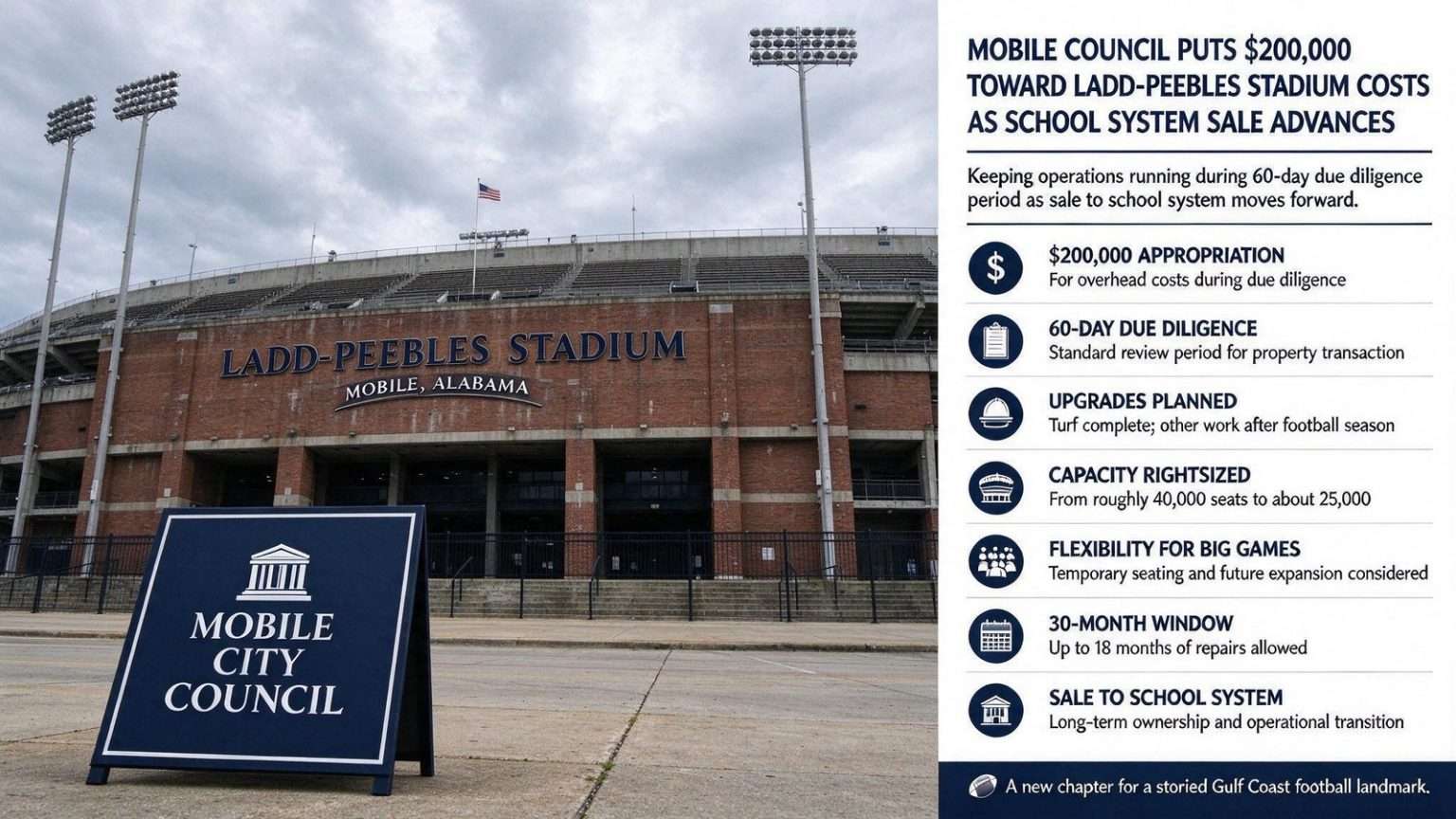
The Mobile City Council has approved $200,000 to cover overhead costs at Ladd-Peebles Stadium while the city and the Mobile County Public School System move through the halfway mark of a 60-day due diligence period on the facility’s sale. The expenditure, approved while the stadium remains in city hands, underscores the transitional nature of the moment: a venue that has anchored football on the Gulf Coast for generations is changing stewardship, and someone has to keep the lights on and the grounds maintained while the paperwork clears.
Although both sides have agreed to an intergovernmental agreement and a sale agreement, the stadium remains in city hands until the two-month evaluation window closes. That due diligence period is standard practice for a property transaction of this scale, giving the school system time to inspect the aging facility’s structures, utilities and grounds before taking title. But the intervening weeks create real operating costs — insurance, maintenance, staffing — and the $200,000 appropriation ensures those obligations are met without interruption.
Chief of Staff James Barber said the money is meant to keep operations running in the meantime. The framing matters: the city is not investing in new improvements during the transition, merely maintaining the status quo so that the facility passes to the school system in working order. For a stadium of Ladd-Peebles’ size and age, that baseline upkeep is not a trivial expense, and city officials have been explicit that the sale itself is intended to end the city’s long-running financial exposure to a venue that has required public support year after year.
The $200,000 appropriation also buys the city something less tangible during the transition: credibility. Handing over a stadium that has been allowed to slip into disrepair would sour negotiations and leave the district with immediate costs on day one. By covering overhead through the due diligence window, the city signals that it intends to deliver the property in the condition promised, with the transfer treated as a partnership between two public institutions rather than a distress sale. Officials have emphasized throughout the process that the deal’s success depends on both sides entering the new arrangement with their obligations met.
The move toward sale follows years of debate over the stadium’s future, with city leaders weighing the facility’s operating losses against its history and its role in the community. Ladd-Peebles has hosted high school championships, college games, bowl games and community events for decades, and its condition has deteriorated even as its sentimental value has remained high. Transferring the property to the school system — whose teams and students are among its most consistent users — represents the latest attempt to find a sustainable model for a landmark whose upkeep has outpaced what any single owner wanted to keep paying.
Renovation plans take shape
The due diligence period gives the school system time to assess the stadium’s condition and decide what repairs are needed. That assessment will shape everything from the budget to the game schedule, because decades of use — and years of deferred maintenance — have left the facility with a punch list that grows longer the closer anyone looks. School officials have approached the evaluation with a clear-eyed understanding that owning a stadium means owning its problems, from electrical systems and restrooms to the bleachers and press box.
The district has already received $9.2 million from the city for upgrades, and a new artificial turf installation is complete — but no further work is planned until after the 2023 high school football season. The completed turf is the most visible piece of the improvement program, replacing a natural playing surface with a modern synthetic field that can absorb far more use each week. That matters for a stadium that serves multiple high schools: a single grass field hosting several programs’ practices and games wears out fast, while turf can take the load. The pause until after the season reflects both scheduling and financial realities, with the next phase of work awaiting the transfer’s completion.
The city has given the school board a 30-month window during which it may close the stadium for up to 18 months of repairs. That allowance is significant for planning purposes. A closure of that length would push teams, bands and fans to alternate venues for multiple seasons, and it signals that the board is contemplating substantial renovation rather than cosmetic fixes. The 30-month umbrella also gives the district flexibility to sequence the work — tackling the most urgent items first while scheduling the rest around the football calendar.
The consolidation debate also reflects broader pressures on school district budgets. Stadium construction and renovation compete directly with classroom needs, transportation costs and teacher pay, and every dollar directed to athletics draws scrutiny. Redirecting money already earmarked for a Murphy stadium — rather than requesting a new appropriation — allowed the board to fund the Ladd-Peebles work without tapping its general operations, a distinction officials pointed to when defending the plan. It also settles a long-running question about Murphy’s athletic future, redirecting a dormant project’s funds to a facility the whole district uses.
Board estimates put an additional $5.2 million toward that work, using funds originally earmarked to build Murphy High School a new football stadium. Redirecting those funds to Ladd-Peebles represents a strategic consolidation: rather than building a second modern facility, the district would concentrate its resources on one major stadium that all its programs share. The decision carries practical advantages — one facility to maintain, one scoreboard, one concession operation — but it also concentrates risk in a single venue, which is why the renovation scope has drawn such close attention.
Capacity question draws the most attention
Among the most closely watched changes: capacity will drop from roughly 40,000 seats to about 25,000. The reduction reflects both the renovation budget and the realities of modern use. Ladd-Peebles was built in an era when college football drew crowds that filled every section, but recent decades have seen attendance shrink for most events short of the biggest championship games. A 25,000-seat venue would be more appropriate for the high school schedule that will be its primary mission, and smaller grandstands mean less structure to inspect, maintain and eventually replace.
That figure had worried supporters of HBCU football, who feared games might not survive a deal unless seating stayed above 30,000. Historically Black college and university matchups have been among the stadium’s marquee attractions, drawing alumni, marching bands and traveling fans from across the region for games that double as cultural events. Those games bring significant visitor spending into Mobile, and community advocates argued that any capacity reduction below the 30,000 threshold could jeopardize the flagship matchups that depend on large crowds. The concern turned the seat count into the deal’s most debated number.
Under the agreement, the school system’s upgrades must accommodate temporary seating and future expansion. That provision is the compromise that made the capacity reduction acceptable to the game’s supporters: the permanent grandstands may shrink, but the design must leave room to add temporary seats for major events and to expand permanently if demand and funding ever justify it. For HBCU game promoters, the promise means a championship or rivalry matchup would not be lost to a seat count alone; for the school board, it preserves flexibility without forcing the district to build seats it cannot fill 52 weeks a year.
Transition timeline
Four weeks of high school football will be played before the school system takes full ownership, at which point the board becomes responsible for game functions such as security and assumes the stadium’s ongoing overhead costs. The staggered handoff is designed to let the 2023 season start on schedule under city management, then shift the full weight of operation to the district once the calendar reaches a natural break. From that point forward, every dollar of expense — from security contracts to utility bills — moves onto the school system’s books, making the $200,000 the city council approved this month effectively the final chapter of municipal operating support.
Stadium economics in the 2020s reward exactly the kind of rightsizing the agreement contemplates. Large venues carry large fixed costs — insurance, utilities, staffing, insurance again — whether 40,000 fans show up or 12,000. A smaller facility matched to actual attendance turns those fixed costs into a manageable share of the board’s budget, and the turf already in place reduces the ongoing expense of field maintenance. The risk, as supporters of the big games have noted, is that a venue sized for the average Friday night can strain to host the exceptional Saturday; that is precisely the gap the temporary-seating and expansion provisions are written to close.
For Mobile’s high school football community, the transfer closes one era and opens another. The stadium where generations of players have won championships will now belong to the schools it serves, with the district accountable for its upkeep and its future. Whether the 30-month renovation window produces a leaner, modern venue that serves the next fifty years of Friday nights remains the question fans, coaches and HBCU game supporters will be watching closely.


