
Mobile Councilwoman Bess Rich Responds on the Uber Legislation Controversy
Mobile City Councilwoman Bess Rich answered questions about her role in the 2015 debate over Uber ride-sharing regulations and a contested insurance.
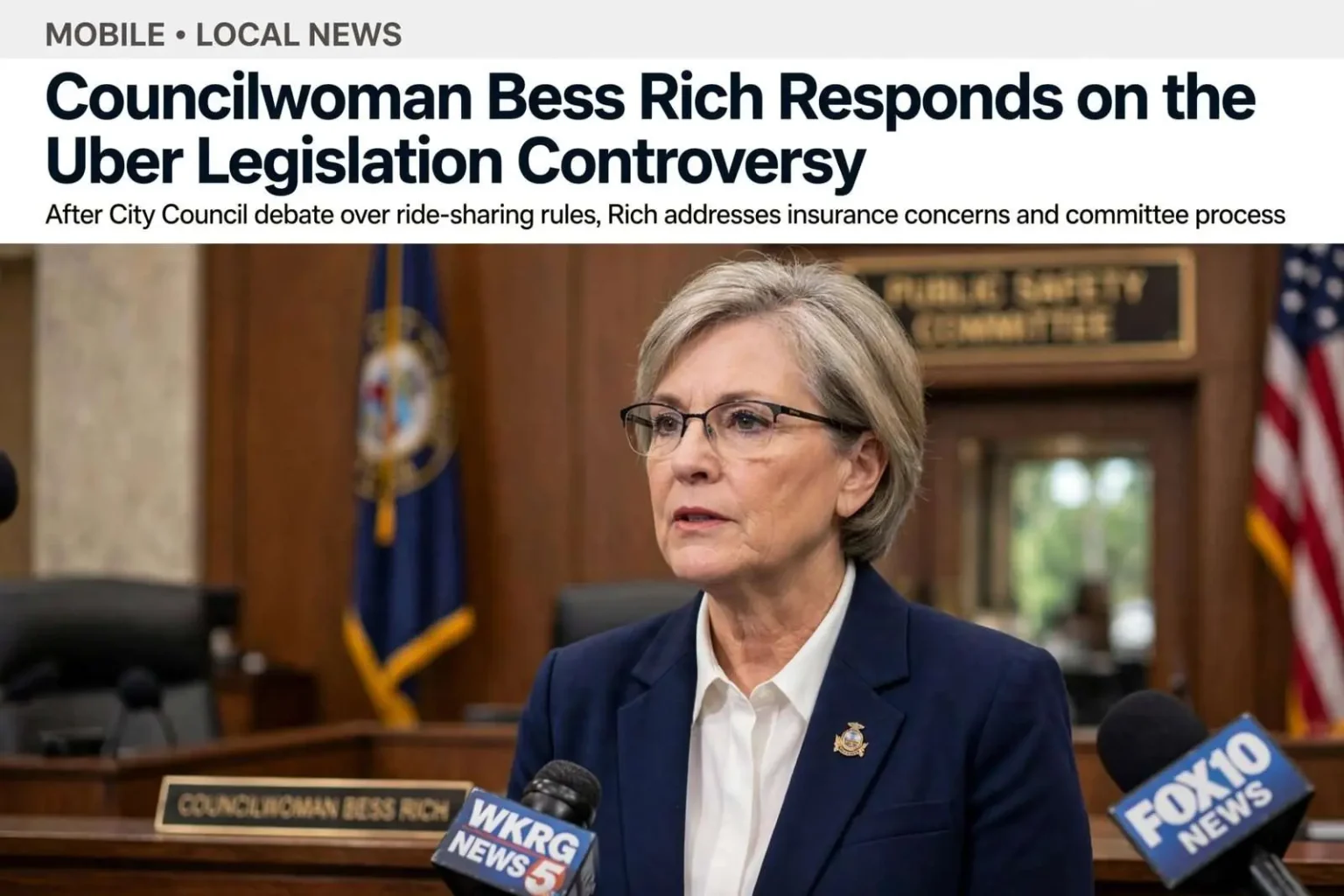
After the Mobile City Council’s debate over ride-sharing rules drew intense public attention, Councilwoman Bess Rich offered a detailed response to questions about her role in the controversy.
The dispute centered on a proposed amendment that would have required Uber drivers to carry commercial insurance on their private vehicles around the clock, even when not working. Rich and the site that published this exchange had earlier described the amendment as a potential anti-competitive move, and Rich said she wanted to set the record straight about what she had actually done and why.
The fight over ride-sharing had become one of the most closely watched local government disputes in Mobile, playing out on social media and in public comment periods as residents weighed the convenience of the app-based service against the city’s long-standing regulations for taxis and other vehicles for hire.
Rich’s account of the process
As chairman of the council’s Public Safety Committee, Rich said her priority was bringing all interested parties together to work through amendments to Chapter 59, the city code governing vehicles for hire. “It was very important to me to bring all interested parties together to discuss the amendments as originally proposed by the Administration. I always find it necessary to research and ask questions, also to listen and learn from individuals who will be affected by any changes to any code,” Rich said.
Uber maintains it is a technology company rather than a taxi operator, but the city attorney advised that any ride arranged through the app is still a “vehicle for hire” under the code — a legal determination that put the service squarely within Chapter 59’s reach regardless of how the company characterizes itself.
Rich said the committee ultimately worked toward parity between the two types of services, with one taxi-company attorney describing the result as roughly 95 to 98 percent aligned. That near-alignment, she argued, undercut claims that the process had been rigged to protect taxi companies at Uber’s expense.
Insurance concerns
Rich said she became aware of a gap in coverage: drivers’ personal insurers may deny claims once they learn the vehicle is also used for paid rides. Standard personal auto policies, she noted, were not designed to cover commercial activity, and a driver involved in a crash while working could find a claim denied — leaving victims and the driver exposed.
She said she raised those concerns with colleagues and the administration. “My intent was never to ‘Kill Uber.’ I would be remiss if I didn’t try my best to have the most protections for our citizens and visitors,” Rich said.
The insurance question was not unique to Mobile. Cities and states across the country were wrestling with the same issue as ride-sharing expanded, and the industry eventually developed layered coverage products — policies that activate when a driver is logged into the app and carrying passengers — precisely because of the gap Rich described.
Responding to the social-media attack
Rich also addressed a social-media post from Colby Cooper suggesting she would be responsible for driving Uber out of Mobile, which she said she did not appreciate given the record of the committee’s work. The post inflamed the online debate, casting her insurance-focused questions as a hostile act against the company rather than a legitimate legislative concern.
Rich’s response laid out the timeline as she saw it: the administration proposed amendments to Chapter 59, her committee convened the interested parties — Uber representatives, taxi company owners and attorneys, and city staff — and the group worked through the provisions line by line. She rejected the characterization of that deliberation as obstruction, arguing that a council that rewrites its vehicles-for-hire code owes the affected industries and the public a careful process.
The dispute also touched on a broader tension in local government: how quickly a city should adapt its ordinances to new technology. Supporters of Uber argued that every month of delay kept a popular service on uncertain legal footing, while Rich and others countered that the council’s duty was to get the rules right, not merely to adopt them quickly.
Why the code mattered
Chapter 59 is the section of Mobile’s city code that governs vehicles for hire — taxis, limousines and similar services. It spells out licensing, insurance requirements, vehicle standards and the fees operators must pay. Any company arranging rides for compensation in the city falls under it, and amendments to it require the full council’s approval after committee review.
For decades that framework was uncontroversial because the industry it covered changed little. The arrival of app-based ride-sharing upended it: Uber operates without a dispatch office, uses drivers’ personal vehicles and sets prices by algorithm, making several provisions of a taxi-era code a poor fit. Cities across Alabama and the nation faced the same mismatch, and each had to decide whether to amend existing codes or write new ones.
Parity as the goal
The parity standard Rich described — treating Uber and taxis alike under the law — was the framework around which the committee worked. Taxi companies had long argued that any new entrant should bear the same insurance and licensing costs they did, while Uber argued that its model, in which the company carries contingent coverage for rides arranged through the app, made some requirements redundant.
The result, by the taxi attorney’s own description, left the industries roughly 95 to 98 percent aligned, with the remaining differences concentrated in the details that mattered most to each side — principally how insurance coverage attaches to a driver’s vehicle and what background-check requirements apply.
For riders, the practical questions were simpler: whether they could open an app and get a ride in Mobile, whether the driver behind the wheel was insured if something went wrong, and whether the city’s rules treated every driver on the road by the same standard. Rich’s answers to those questions — more protections, applied evenly — formed the core of her defense.
The public safety committee’s role
The Public Safety Committee is one of the council’s standing committees, charged with reviewing legislation that touches police, fire and related regulatory matters before it reaches the full council. Committee chairmen hold real power in that process: they decide what gets a hearing, who is invited to speak and how long deliberation lasts. Rich, one of the council’s longest-serving members, was known for exactly the kind of line-by-line review this dispute showcased.
Her critics saw the pace as a stalling tactic on behalf of the taxi industry; her defenders saw it as the committee doing its job on an ordinance that would affect thousands of rides. The exchange she gave laid out her side of that argument in detail — including her insistence that she had never sought to block Uber from operating, only to make sure the code it operated under protected the public.
What ride-sharing regulation looks like elsewhere
Mobile’s debate paralleled a national one. State legislatures eventually stepped in across much of the country to set uniform ride-sharing insurance standards, preempting city ordinances and giving companies a single statewide framework. In Alabama, statewide ride-sharing legislation followed in subsequent years, standardizing requirements such as background checks and insurance coverage that activates while a driver is logged into a ride-sharing network.
Those developments vindicated, in broad outline, the concern Rich had raised: that the gap between personal and commercial insurance was real and needed a legal fix. The shape of that fix — statewide rules rather than city-by-city amendments — settled the kind of local dispute Mobile had experienced, in which a council committee’s careful review could be painted as hostility toward a company residents wanted to use.
Setting the record straight
Rich’s closing argument was procedural and personal at once. She said the record should reflect that the committee process was open, that the taxi industry’s own attorney judged the outcome nearly aligned, and that her questions about insurance were raised out of responsibility to residents and visitors rather than any allegiance to incumbent taxi operators.
Whether the public accepted that account or the sharper version circulating on social media, the episode became a case study in how local technology regulation now unfolds: a dispute over ordinance language escalates into a public-relations fight, amplified by social media, before the legislative text itself is even finalized.
For Mobile, the ride-sharing debate marked a turning point in how the city regulated transportation. The vehicles-for-hire code was modernized, Uber operated openly in the city, and the arguments that once filled committee rooms and comment sections moved on to other subjects — leaving behind a record of how one councilwoman said the process actually worked, in her own words.
Her account also preserved a lesson for future councils facing the next disruptive service, whatever it turns out to be: convene everyone early, put the legal questions in writing, and answer the public’s enthusiasm with diligence rather than defiance — because in the smartphone era, the difference between scrutiny and sabotage is judged by an audience watching in real time.


