Mobile County and City of Mobile Formally Recognize 911 Dispatchers as First Responders
Mobile County Commission and City of Mobile recognize 911 dispatchers as first responders, joining Baldwin County and a national reclassification push.
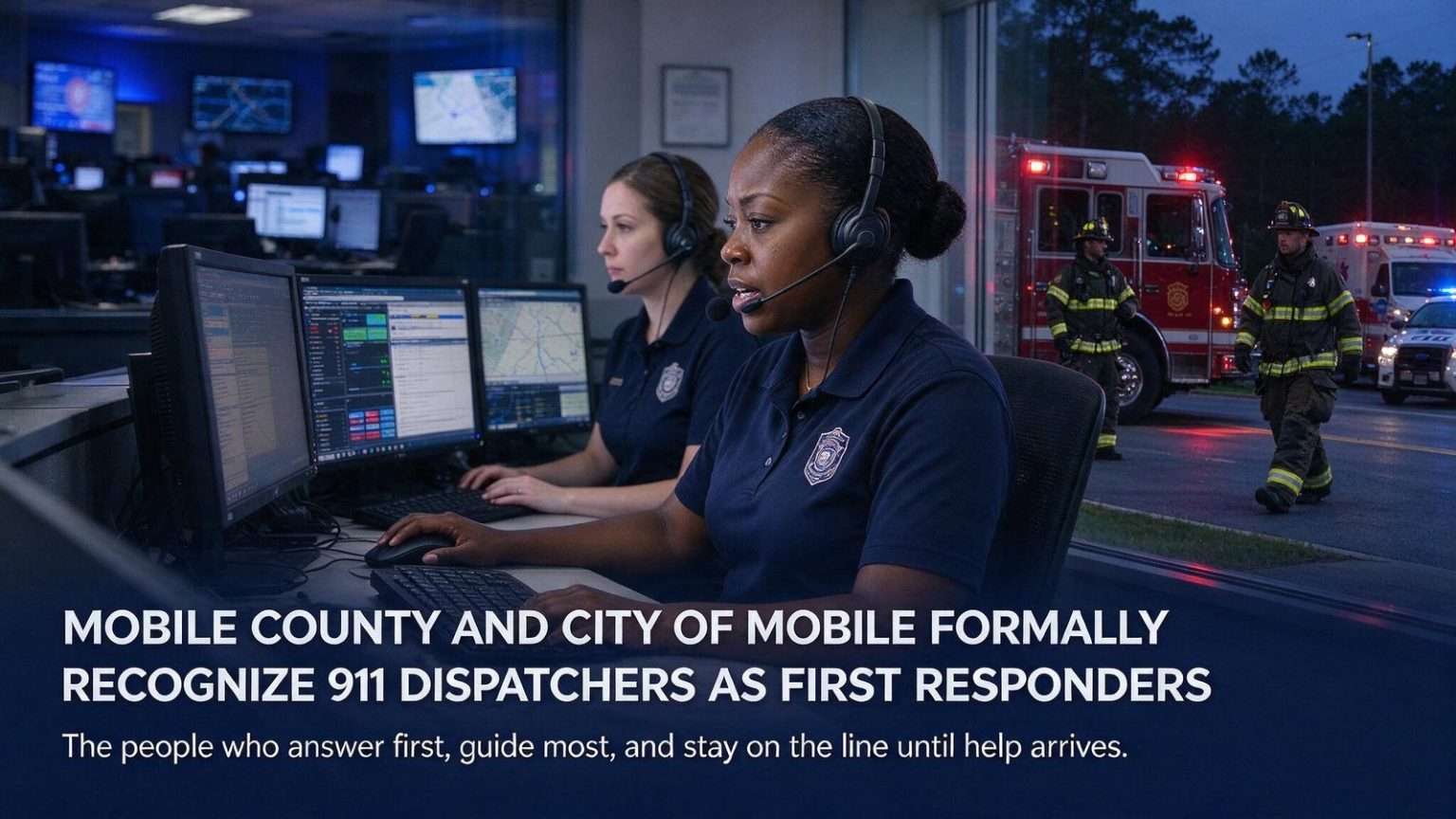
The Mobile County Commission and the City of Mobile have both passed recognitions designating 911 dispatchers as first responders, adding local momentum to a nationwide push to reclassify the people who answer emergency calls.
The honors cover telecommunications officers at the county’s 911 call center as well as Mobile police and fire public safety dispatchers — the men and women who sit between a caller in crisis and the help that caller needs, taking the information, dispatching the units and staying on the line until the scene is under control.
The dual recognition is notable for the weight it carries locally. Together, the county commission and the city council govern the funding and oversight of the emergency communications system that serves Alabama’s second-largest metro area, and their declarations amount to the system’s own employers saying formally what dispatchers have argued for years: the work is emergency response, not clerical support.
“The First of the First Responders”
Lin Casoria-Scott, a team supervisor with the Mobile County Communications District, has spent more than 12 years on the headset. She described a job that begins at full speed — there is no warm-up call — and ranges from minor traffic accidents to domestic violence situations with highly distressed callers who may struggle to give their location.
That range is the core difficulty of the profession. A dispatcher’s shift can move from a fender-bender to a cardiac arrest to an armed confrontation in a single hour, and each call demands a different interview technique: calm questions for a panic-stricken caller, step-by-step instructions for CPR, careful verification for a report that could put officers in danger.
On paper, though, dispatchers are still classified as clerks under the federal system. The occupational classification that governs how the Bureau of Labor Statistics counts them — and how many federal programs treat them — places public safety telecommunicators in the same broad administrative category as office support staff.
Casoria-Scott said that label fails to capture the specialized training required to process emergency calls. Dispatchers in Alabama complete certification coursework in emergency telecommunication, learn structured call-taking protocols, train on CPR and pre-arrival instructions, and rehearse scenarios that most professionals never face — all before their first solo shift, and continuously afterward.
Communications District Director Charlie McNichol agreed, calling dispatchers “the first of the first responders” because they set a response in motion and often manage the scene until field crews arrive.
McNichol’s phrase captures the argument in a single image: before any patrol car, engine company or ambulance is moving, a dispatcher has already taken the call, drawn out the details, chosen the units and started the response. In a very real sense, the scene is being managed — reassured, instructed, updated — from the moment the phone rings, long before the first responder reaches the door.
Inside the Communications District
The Mobile County Communications District operates the county’s 911 system, the consolidated dispatch center that routes calls from across the county to police, fire and medical response. Behind its consoles sits the infrastructure that modern emergency response runs on: address databases that pinpoint wireless callers, mapping systems that guide units, and recording systems that document every second of every call.
The center’s telecommunications officers rotate through police, fire and emergency medical dispatch, and the work never pauses. Nights, holidays, hurricanes — the consoles are staffed around the clock, because emergencies do not keep business hours. During Gulf storms, the call center becomes the county’s information backbone, logging road damage, rescue requests and fire alarms while field units are pulled off the road by wind and water.
The job’s demands carry a well-documented cost. Dispatchers hear the worst moments of strangers’ lives in back-to-back shifts, bear responsibility for split-second decisions, and rarely learn how the stories they managed ended. Emergency communications professionals have increasingly spoken about the cumulative toll, and centers across the country have added peer support and counseling resources in response.
Turnover and recruitment are the practical stakes behind the reclassification argument. Dispatchers who feel classified as clerks — with the pay grades and career ladders that can follow from that label — have reason to look elsewhere, and centers that cannot retain experienced call-takers lose the institutional knowledge that makes a good dispatcher great.
A Statewide and National Movement
Baldwin County has approved a similar resolution, and comparable efforts are underway across Alabama. Supporters hope the local recognitions build toward a federal reclassification that would formally place dispatchers within the first responder category nationwide.
Why the Classification Matters
The push for federal reclassification is not symbolic aesthetics. The occupational category a profession occupies reaches into grant eligibility, workforce data, training funding and the way agencies justify staffing and pay. Dispatchers grouped with administrative staff can find themselves excluded from programs built for first responders — the benefits, the research and the resources that flow to those who answer emergencies in person.
Advocacy organizations in the emergency communications field have carried the reclassification case to Congress for years, arguing that the job has been transformed since the categories were written. A modern dispatcher operates computer-aided dispatch systems, interprets GPS coordinates from a caller’s phone, delivers medical instructions that can save a life before the ambulance arrives and coordinates multi-agency responses during disasters.
Local resolutions like the ones passed in Mobile and Baldwin County function as building blocks in that campaign. Federal reclassification begins with the record: county commissions and city councils documenting, one by one, that the people answering 911 in their jurisdictions are emergency responders in every sense the job description requires.
For the dispatchers themselves, the recognition lands differently. Veterans of the headset describe years of being asked, at parties and in paperwork, what they do — and struggling to convey the difference between answering phones and running an emergency. A formal declaration from the county and the city settles the question in print.
What Comes Next
The recognitions do not by themselves change pay scales or federal law, and supporters are candid about the distance between a county resolution and a national reclassification. But the sequence — Baldwin County, Mobile County, the City of Mobile, with efforts building across Alabama — is how the movement is designed to work, accumulating official declarations until state and federal bodies follow.
In the meantime, the people the honors describe keep working the consoles. Calls will come in tonight as they always do — no warm-up, no pause between emergencies — and the telecommunications officers of the Mobile County Communications District and the city’s police and fire dispatch desks will do what they have always done: take the information, send the help and stay on the line until it arrives.
What has changed, as of the commission and council votes, is what the community calls them. First responders, in Mobile County, now officially includes the people who are first of all — the ones who answer.
The daily texture of the job, as Casoria-Scott described it, is worth dwelling on because it explains the training gap she cited. A dispatcher handling a domestic violence call must extract an address from a caller who may be whispering, hiding or in fear of being overheard — while simultaneously entering the call, alerting officers to the danger and keeping the caller engaged. A dispatcher handling a cardiac arrest must deliver compressions instructions calmly enough that a terrified spouse can follow them. Neither skill is clerical; both are clinical in their precision and consequential in their outcomes.
The Mobile County center’s veterans carry that skill set quietly, but its dimensions are measurable: months of initial training before solo work, continuing education through their careers and recertification in the protocols that govern emergency medical and fire dispatch. When budgets are debated, center directors like McNichol point to that pipeline as the reason the county’s response times hold up under load.
The national movement has also begun to change how the next generation sees the job. Emergency communications courses at community colleges, high school career programs and citizen academies now present dispatch as a public safety career rather than a desk job, and centers that recruit from those pipelines report applicants who arrive understanding the work’s true nature.
Mobile’s recognition declarations will be filed alongside those from Baldwin County and communities across Alabama — a growing stack of official paper that says the same thing in each jurisdiction’s own words. For a profession that has spent decades answering everyone else’s emergencies, the accumulating documents amount to the state answering back: the people on the headset count as what they are.
Supporters of the reclassification effort also note that the honors arrived during a period of rapid change in emergency communications themselves. Next-generation 911 systems are bringing text, photos and video into call centers, adding skills that the original clerk classifications never anticipated, and Alabama centers are among those upgrading their technology to receive it.
Each addition widens the gap between what dispatchers do and what the old categories assume. A telecommunications officer of a generation ago took a voice call and wrote down an address; the dispatcher of today may be triaging texts from a caller who cannot speak, guiding officers to a phone location on a live map and relaying medical instructions at the same time — all while the next call rings in.
That is the reality Mobile County’s elected bodies have now written into their official record, and it is the record reclassification advocates intend to keep building, county by county, until the federal categories catch up with the job.