An $8,500 Check Nobody Voted On: Mobile County Democrats Demand Answers on a ‘Pass-Through’ Donation
Two members of the Mobile County Democratic Executive Committee wrote to say a late-campaign $8,500 'pass-through' from the state party should never have moved without a committee vote.
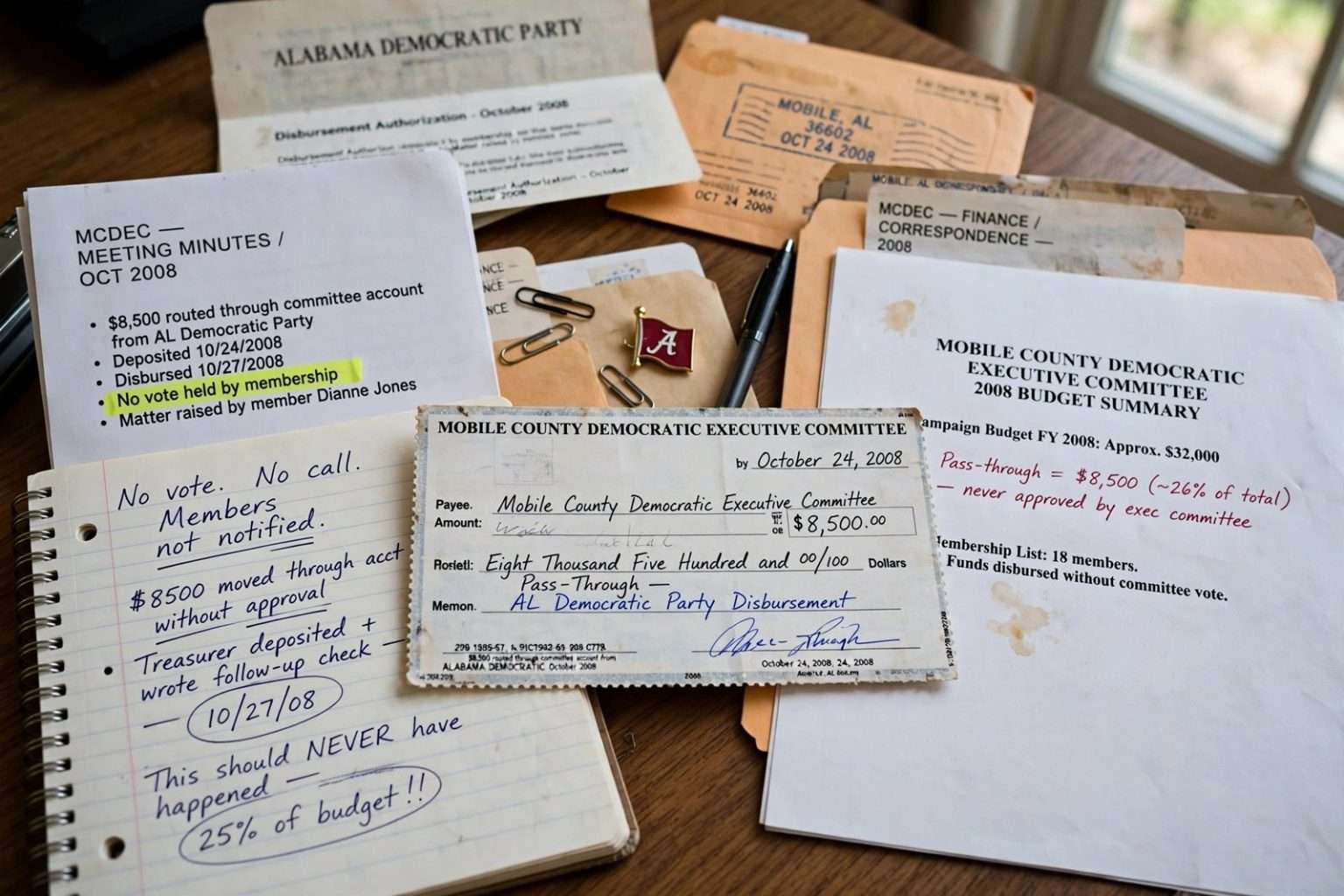
A quarrel that began as an accounting footnote has hardened into a question of who controls the money — and the mailing list — of the Mobile County Democratic Executive Committee. At issue is $8,500 that the Alabama Democratic Party routed through the county committee’s bank account late in the 2008 campaign, to be passed along to an intended recipient. The committee’s treasurer deposited the check and wrote another; the money was spent. What did not happen, according to the committee’s chairman and at least one of its members, is a vote — or even a phone call.
For a volunteer committee whose members take pride in debating the smallest line items, the discovery that a five-figure sum had moved through their account without their knowledge landed less as a bookkeeping quirk than as a question of ownership — of the account, of the committee’s name, and of its membership list, which the pass-through raised the possibility of being used without consent.
‘This Should Never Have Happened’
Committee member Dianne Jones wrote that for her and others on the MCDEC, the matter is not complicated. The state party, she wrote, decided at a very late date in the election to send $8,500 — “we are not talking chump change here or coffee money” — to a local committee without speaking directly to its chairman. That, she argued, reflects less on the chairman’s inexperience than on the judgment of everyone who handled the check: the state officials who sent it, the treasurer who deposited it, the person who wrote the follow-up check, and those who spent the proceeds.
“The ultimate decision on spending money and, yes, agreeing to ‘pass through money’ should rely with the members of the MCDEC and not with the officers, nor the State Party officers,” Jones wrote. Her framing drew a bright line between the officers of a committee and its members — a distinction that matters in county party organizations, where the executive committee is the governing body and officers are, in principle, its administrators rather than its decision-makers.
Her point of comparison was the committee’s own routine. Members vote on nearly every expenditure the group makes, she wrote — fundraisers, operating costs, purchases — with only trivia such as postage handled without approval. Why, then, would a five-figure sum move through the account with no notice to the membership? The contrast between the committee’s practiced frugality and the ease with which the pass-through occurred is what gave the episode its sting.
The excuse that the election was too close at hand does not persuade her. “To say it was so late in the election and that there was no time to bring before the committee is not an acceptable excuse in the world of the telephone and email addresses,” she wrote. One officer resigned over the episode, she noted, which she read as a signal that the arrangement was not above board. “This should NEVER have happened and should NEVER happen again.”
The Chairman Answers His Critics
MCDEC Chairman Brad Warren, who had been described in earlier coverage of the dispute as politically naive, pushed back on both the characterization and the suggestion that $8,500 is a rounding error. He said he contacted 10 other Alabama county chairs and had yet to find one where pass-through money moved without the knowledge of the chair and the full body. “The assertion of my political naivete is unfounded,” he wrote.
The survey of fellow county chairs was Warren’s way of establishing a baseline: if pass-through money everywhere else in Alabama moved with the local committee’s knowledge and consent, then the Mobile episode was not a normal operating procedure but a departure from it — one that reflected on how the state party conducted its business with its own county organizations.
As for the size of the sum: measured against everything spent nationally in 2008, he conceded, $8,500 is small. Measured against the Mobile County committee’s own resources, it is not. The amount represented more than 25 percent of the committee’s budget for that campaign season. A quarter of a county committee’s operating money passing through its account in a single transaction is, by any local standard, a major financial event — whatever it looks like from a national campaign headquarters.
A Fight About Results as Much as Receipts
Underneath the bookkeeping dispute is a harder argument about performance. Democrats grew their Mobile County vote totals by about 5 percent in 2008 — a figure Warren called “anemic at best” given the circumstances. It was a year, he wrote, that featured an unpopular Republican administration, a financial system coming apart, and a “change” candidate at the top of the ticket at a moment when voters were hungry for change. And still, he noted, “we lost every single race in this county.”
The context matters for understanding why the pass-through fight cut so deeply. County party organizations across Alabama measure themselves against the tide of the presidential year, and 2008 was about as favorable a tide as Democrats could ask for — an energized national electorate, record fundraising, and unprecedented organizing infrastructure on the ground. In counties with demographics similar to Mobile’s, Warren pointed to Democratic candidates faring considerably better. Against that backdrop, a 5 percent improvement read less like progress than like underperformance.
His conclusion was less about blame than method: the party must fundamentally change how it delivers its message in Alabama, using the 2008 presidential campaign’s organizing model. The Obama campaign’s approach — neighbor-to-neighbor contact, extensive volunteer networks, data-driven targeting — was, in Warren’s view, the template the state party should carry into future cycles rather than an anomaly to be discarded the moment Election Day passed.
Alabama, he wrote, is at heart a populist state, and Democrats should speak to what the average Alabamian is actually living through. That argument has a long lineage in the state’s politics, which has historically rewarded candidates of both parties who framed their appeals around ordinary people against concentrated power. For Warren, the lesson of the 2008 returns was not that Mobile County was unreachable for Democrats, but that the message being delivered there was not built for the audience.
Warren was careful to say the dispute is not personal, and specifically not a duel between himself and state party figure Janetta Whitt-Mitchell. His job, as he described it, was to put potential problems in front of the committee. “It is in the Committee’s hands to act, or not act, upon the information.”
Why It Matters
Pass-through donations — money routed through one committee’s account on its way to another destination — are legal and common in campaign finance, and they are often used to satisfy contribution limits or reporting conventions. Political parties at every level move money this way: a state party may route a contribution through a county committee to reach a legislative candidate, or a donor’s check may be laundered through an intermediary committee for compliance reasons. Nothing about the mechanics, in themselves, is unusual.
What made this one combustible in Mobile was not legality but consent: a volunteer committee discovering after the fact that its own bank account had been used as a conduit, and that the decision had been made somewhere else. The episode raised practical questions that any county committee would want answered — whether its account had been used for anything else without notice, who authorized the transactions, and what its officers’ responsibilities are when money arrives from the state party with instructions attached.
It also raised the mailing-list question that has kept the dispute alive. A county executive committee’s membership list is one of its most valuable assets, built over years of recruitment and maintained through personal contact. If money — or campaign material, or solicitation — can flow through the committee’s name and account without its members’ knowledge, the committee’s control over its own identity and its own contacts is what is actually at stake.
County executive committees occupy an unusual place in Alabama politics. They are the permanent county-level organizations of the state’s political parties, made up of members elected in party primaries, and they are responsible for everything from qualifying candidates for local offices to running county headquarters and turning out the vote in November. Most operate on thin budgets assembled from member dues, fish fry fundraisers and small donations, which is precisely why an unannounced transaction worth a quarter of the year’s budget is not a detail that can be waved away. In a committee where the members personally vote on what to spend at the next fundraiser, the idea that the state party could push five figures through the account overnight — with the treasurer’s cooperation and the chairman left out of the conversation — struck members as a reversal of how their organization is supposed to work.
For now, the matter rests where Warren said it did: in the committee’s hands to act, or not act, upon the information. Whatever the MCDEC decides, the episode has already produced one concrete result — a clearer statement, from its own members, of how a county party expects its money and its name to be handled: by vote of the membership, not by officers alone, and not by officials in Montgomery acting at the last minute without a phone call.