Mobile County Democrats Hold a Campaign Workshop With Eyes on 2020
With qualifying a year away, Mobile County Democratic leaders ran a hands-on workshop on recruiting candidates, raising money and organizing communities early.
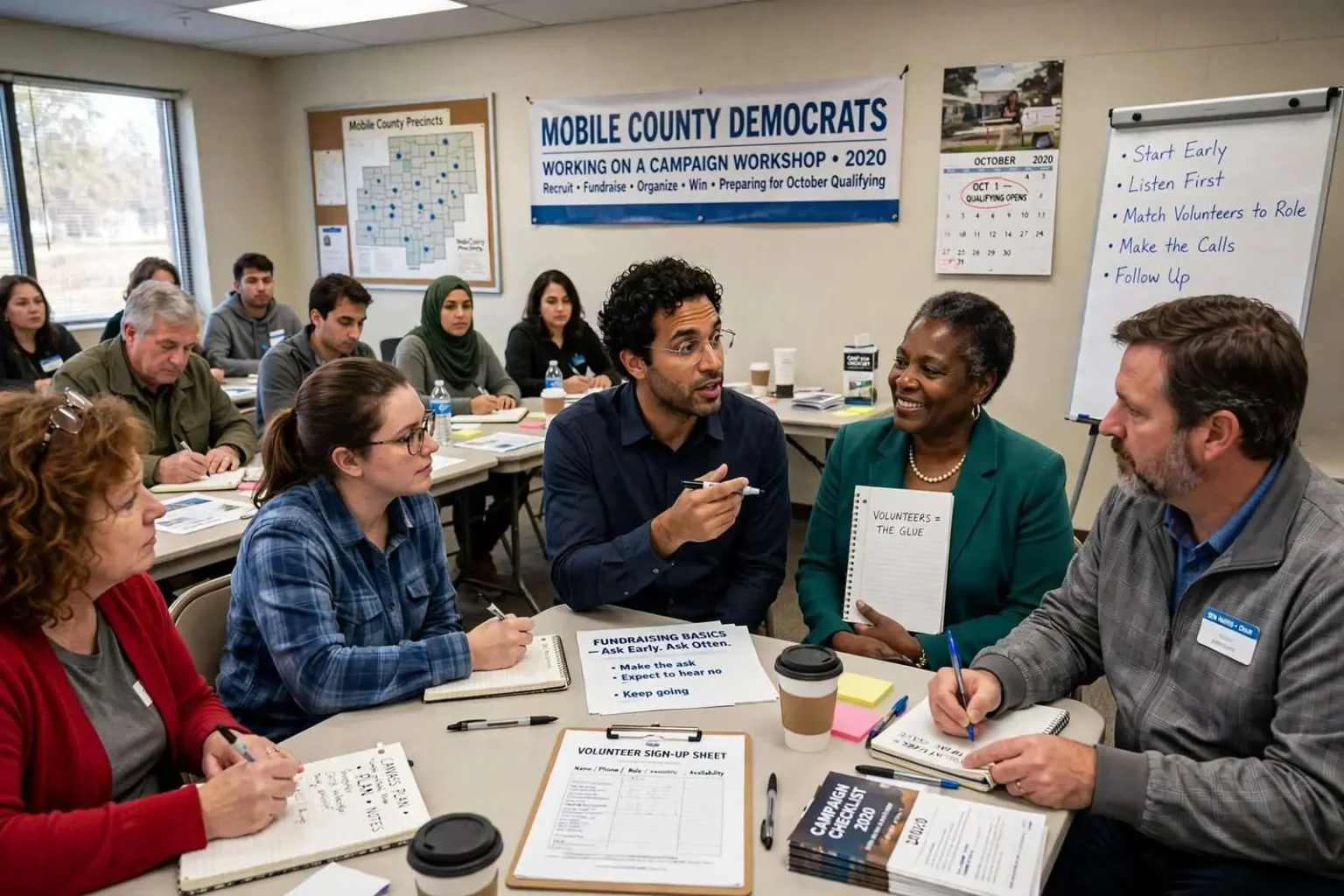
With party primaries a year away, Mobile County Democratic leaders convened a “Working on a Campaign” workshop aimed at the unglamorous fundamentals of winning elections: recruiting candidates, raising money and organizing communities long before the ballots print. The Saturday session, led in part by Christian Smith, who ran for Mobile County Treasurer in 2012, and party veteran Diane Jones, treated fundraising as the steepest hill for most first-time candidates to climb.
The timing was deliberate. County offices, legislative seats and national races would all appear on Alabama’s 2020 ballots, and candidate qualifying was set to open that October, leaving prospective contenders only a narrow window to decide, organize and file. Workshops of this kind are a fixture of party politics in Alabama, where the Democratic and Republican organizations alike work to build benches in a state that has grown increasingly competitive for Democrats at the local level, and the Mobile County party has historically used such sessions to turn interested citizens into actual candidates and campaign staff.
The emphasis on fundamentals reflected a candid reading of what goes wrong in first campaigns. Candidates, the presenters suggested, rarely lose because they lack positions on the issues; they lose because they start too late, ask too little, and arrive in neighborhoods only when the election is close enough to see. The workshop was organized around correcting each of those failures in turn, starting with the one that stops most campaigns before they begin.
Learning to ask
Fundraising, Smith told the group, begins with learning to ask “What’s the worst that could happen” when you ask for a contribution. “You could be told ‘no.'” The reframing is a staple of campaign training for a reason: the fear of rejection keeps more candidates from raising money than any lack of donors does, and the only way past it is to treat each request as a conversation rather than a verdict. Smith’s 2012 race for county treasurer, though unsuccessful, gave the advice the weight of experience, since he had made the calls himself and knew the reluctance firsthand.
Jones agreed: “You have to be willing to ask for money and smile when they say ‘no,'” then simply move on to the next person. The counsel sounds simple and is not. Asking for money requires a candidate to put a price on his or her own candidacy, face a neighbor across a kitchen table and accept that many conversations will end in refusal. Veterans of Alabama politics often note that a candidate who cannot ask for money will struggle to ask for votes, and the two skills draw on the same willingness to be seen asking.
Party chairman Ben Harris called fundraising “the hardest part” of any race. “A candidate asking for money for yourself is hard. How do you get over that hump? You just have to,” he said. “There is no limit to the calls you can make. It’s harder to make the call than it is to receive it.” His point about volume was the practical takeaway: fundraising is arithmetic, and the candidates who make the most requests raise the most money, because the discomfort of each call is finite while the list of prospects is not.
Start early, listen first
Leaders stressed that organization must begin sooner than tradition allowed. Too often, they said, campaign workers appeared in a neighborhood around Labor Day and were met with the pointed question of why they were seen only at election time. The rebuke stings because it is accurate: door-knocking that begins with the general election visible on the calendar reads to residents as interest in their votes rather than interest in their lives, and the most organized communities notice the difference immediately.
The remedy was to canvass early, learn what mattered in each community, and build a platform around what residents actually said, since priorities in one neighborhood might differ sharply from the next. Mobile County is a large and varied territory for campaigners, taking in the historic neighborhoods of the city of Mobile, the working-class communities of Prichard and Chickasaw, the fast-growing suburbs along the eastern shore and Interstate 10, and the rural reaches of the county to the north and west. A message built for one of those places can miss entirely in another, which is why the presenters urged candidates to treat the first months of a campaign as listening months rather than speaking ones.
Candidate qualifying was set to open that October, leaving little time to recruit viable contenders. Harris urged the party to begin at once, arguing that Democrats could reach parity with, or overtake, local Republicans in 2020 by lifting turnout in precincts that had lagged the county average. The arithmetic behind that hope was straightforward: Mobile County’s Democratic-leaning precincts contained voters who stayed home in years without a marquee race, and a coordinated effort to reach them, built on the year of organizing the workshop was advocating, could change the county’s margins without changing a single mind elsewhere.
Volunteers as glue
Jones described volunteers, whether party regulars or a candidate’s own friends, as the “glue” that holds a campaign together, with a role for every temperament. The image is apt: paid staff are scarce in county-level Alabama campaigns, and what a candidate can build depends almost entirely on people willing to work without pay, from the phone banker who makes calls every Tuesday to the neighbor who hosts a coffee, to the retiree who staffs the headquarters during the day.
She and Smith agreed that matching the right volunteer to the right job was part of the organizer’s craft. Some people will canvass door to door and love it; others will never knock but will write postcards, keep the spreadsheet, or drive voters to the polls. A campaign that treats volunteers as interchangeable loses most of them; one that asks each person for what he or she actually enjoys doing builds the durable network that the Labor Day arrivals never have. The workshop’s message to prospective campaign workers was that no particular skill was required to start, only a willingness to be assigned something real.
For the Democratic organizers in the room, the stakes of all this groundwork extended beyond any single race. County commissions, school boards, revenue commissioner and judicial seats shape daily life in Mobile County regardless of what happens in Montgomery or Washington, and the party that fields prepared candidates for those offices, funded early and organized in every precinct, competes for them. The 2020 cycle, with qualifying opening that October and primaries the following spring, was the deadline the workshop was built around, and the leaders left the room with a to-do list they meant to start on before the week was out.
The 2020 landscape in Mobile County
The year ahead gave Alabama Democrats reasons for both ambition and realism. The party held one of the state’s United States Senate seats, won in a 2017 special election, and that seat would be on the 2020 ballot, drawing national attention and money to the state. At the local level, the Democratic organizations in Alabama’s urban counties, Mobile and Jefferson above all, continued to argue that their electorates were changing faster than the state’s overall reputation suggested, with shifting populations in the cities and suburbs creating precincts where competitive races were possible for candidates willing to work them.
The workshop’s practical agenda fit that theory. Recruiting candidates matters because uncontested seats are never won; fundraising matters because a county race can be decided by whether a candidate can afford the mail, signs and staff to be known; early organizing matters because turnout in lagging precincts is built through relationships, not election-eve robo-calls. None of it is glamorous, which was the point the presenters kept returning to: campaigns are won by people who do the boring work early.
The presenters themselves modeled the advice. Christian Smith’s 2012 run for Mobile County Treasurer had given him the full education of a first-time candidate, from qualifying paperwork to the fundraising calls that Harris described as the hardest part of the job. Diane Jones’s years in party organization gave the session its institutional memory, the accumulated knowledge of which precincts answer, which volunteers return cycle after cycle and where past campaigns had foundered. Between the two of them, the room heard both the candidate’s perspective and the party’s, which is the combination a recruiting workshop needs.
What comes before the ballots
The months the workshop covered are the ones voters never see. Before a single ballot is printed, a campaign must qualify with the party, assemble a finance operation, order absentee applications, walk precincts, train volunteers and build the lists that will drive every get-out-the-vote effort in the final week. In Alabama, where the presidential primary and county races head to voters in the spring, the effective campaign year begins the previous summer, which is why a session held a year out was described as starting on time rather than early.
Harris’s challenge to the party, to begin at once, framed the workshop as a first step rather than a finished plan. The leaders who attended were being asked to go home and do three things immediately: identify people willing to run, attach fundraisers and volunteer captains to them, and start the precinct-level conversations that would later become the campaign’s platform. If the party did that across Mobile County’s lagging precincts, the chairman argued, 2020 could be the year the local margin closed; if it waited for the season of yard signs, the opportunity would pass as it had before.
The Saturday session closed with the practical essentials on the table: a fundraising script that begins with the worst that can happen, a calendar that starts a year out, and a volunteer corps treated as the glue that holds everything together. For candidates, would-be campaign workers and precinct organizers in the room, the path from that room to the 2020 primary ballot ran directly through the work the presenters had described, and the qualifying deadline that October was now circled on the party’s calendar.