An $8,500 Pass-Through Splits Mobile County’s Democrats: Outrage or Politics as Usual?
Mobile County's Democratic leaders were divided over $8,500 in state party money that moved through their committee to a get-out-the-vote group. The chairman called it laundering. Others called it Tuesday.
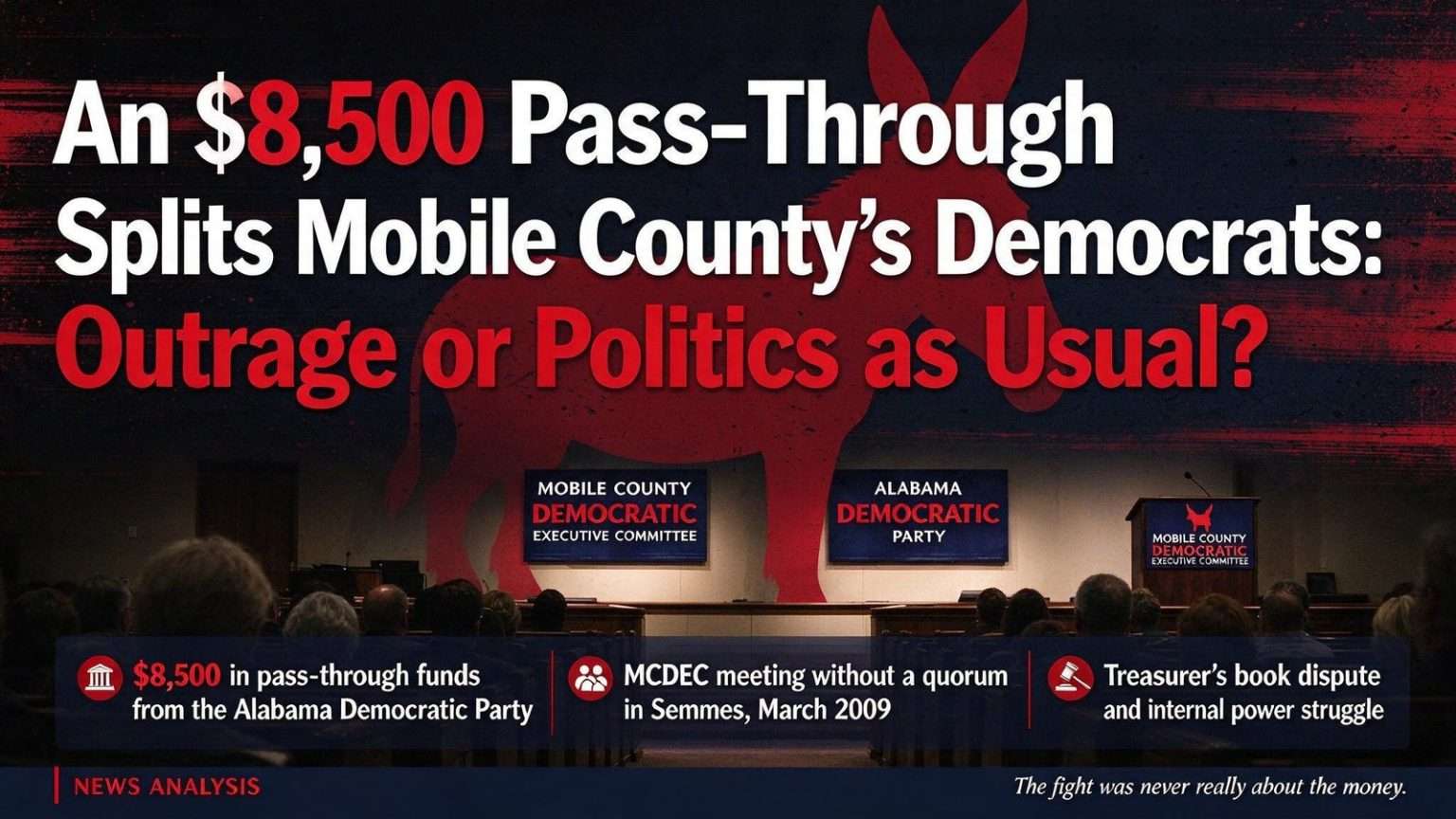
The Mobile County Democratic Executive Committee spent the early part of March 2009 arguing about $8,500, and the argument was never really about the money. Two checks from the Alabama Democratic Party — one for $2,500 dated Oct. 22, another for $6,000 dated Oct. 29 — passed through the county committee's bank account during the 2008 election season and continued on, in three checks, to the Mobile chapter of the New South Coalition for a get-out-the-vote effort.
To county Chairman Brad Warren, the committee had been used as "a laundromat." To a good many party veterans, it was an unremarkable maneuver in an ordinary election year. The committee could not settle the question, in part because it could not assemble a quorum to try.
A meeting without a quorum
Members gathered in Semmes for what became an "informational" discussion rather than a decision. The MCDEC had 52 members against a maximum of 135, and a quorum required 35. Roughly 40 to 45 people attended, split about evenly between members and visitors.
The matter was carried over to a meeting whose date and location had not been set. Warren said he would not schedule one until a quorum was assured.
Compounding the disorder, the committee's treasurer, Betty Gartman, had submitted a resignation in November, effective Jan. 31, which Warren had accepted — and then rescinded it. "Please be advised that I am rescinding my letter of tentative resignation dated November 15, 2008," she wrote. "Many MCDEC committee members have spoken to me and expressed to me that they want me to continue to serve as treasurer." Gartman still held the party's books.
Warren set a deadline of noon on Friday, March 13, for her to surrender them, saying he hoped to avoid involving the Sheriff's Department. When the deadline passed, he said he would seek a court order.
The chairman's account
Warren said he learned of the transfers only well after the fact. He believed vice chair Janetta Whitt-Mitchell had accepted the first check in Montgomery; Whitt-Mitchell said Warren knew as much, because the two had spoken by phone while she was in state party Chairman Joe Turnham's office. The three checks to the New South Coalition carried Warren's signature alongside Gartman's.
He explained that he and the treasurer met periodically to jointly sign blank checks so that routine business would not bog down — an arrangement that, as he acknowledged with a "shame on me," defeated the entire purpose of requiring two signatures. "The only money I knew about was the first $2,500" that the committee itself had voted to donate, Warren said. "I got a call from Turnham and he said the state party would be funding air time on African-American radio, but nothing about the New South Coalition. I had no idea money was going to be laundered through us."
Why not write the check directly?
The question members kept returning to was the simplest one available: if the state party wanted the New South Coalition to have the money, why not send it there? The explanation offered repeatedly was that a direct payment risked arousing jealousy among other New South chapters around Alabama, and among the group's larger rival, the Alabama Democratic Caucus. It did not satisfy everyone.
"MCDEC does not need to get in the middle of organizations vying for monies from sources who want to use our checking account to funnel funds to anywhere," said Vivian Beckerle, a former Democratic congressional nominee. "The check or checks could have too easily been written directly from the source to NSC, so WHY were we used? What was the need?"
Whitt-Mitchell and her husband, state Rep. Joseph Mitchell, are active in the Mobile chapter of the coalition, which was founded in 1986 to advocate cultural awareness, economic development, education, peace and justice.
She said New South had a get-out-the-vote plan costing about $10,000, that Turnham liked it, and that he wanted to support it.
The shrug caucus
A substantial share of the committee regarded the entire controversy as a self-inflicted wound. "As for the New South issue, sounds like normal GOTV work in Alabama politics," said one longtime state politico with no ties to the committee. "The money goes as cash to folks to walk the streets, provide rides, make calls, etc. I doubt there is any there there."
Others were blunter about their chairman.
"Warren is a political novice who lacks any understanding of how campaigns are funded in Alabama," one member said. "Democrats in Mobile County are being greatly hurt by this infighting. It's a good time for Republicans in Mobile County."
Attorney Rose McPhillips, a part-time municipal judge in Mobile, argued the accountability was pointed in the wrong direction. "To make Janetta the scapegoat is ridiculous," she said. "The money went where Joe Turnham wanted it to go. The means to stop that or object to it were with Brad and Betty Gartman who both signed the check."
She also rejected the claim that the committee was not the sort of entity that could legally move money this way. The MCDEC is a political action committee, she noted — it checks the PAC box on its own filings. "Regardless of my personal feelings, whether or not this was the proper way to do this, there seems to be no illegality."
Those who wanted an accounting
Warren was not alone.
Parliamentarian John Paul Jones sided with him on procedure and principle, noting that committee rules require the chairman to receive funds and turn them over to the treasurer with a receipt. "The committee itself was also unaware of the receipt and disbursement of these funds and I find that objectionable," Jones said.
Milton Morrow, the unsuccessful nominee for county treasurer, demanded receipts from the coalition and said poll workers had been misled about the support they would receive. He threatened to send everything to the U.S. Attorney and the Attorney General, though he softened the next day, calling it possibly more an impropriety than an illegality.
Renee Williams, who had run for county tax assessor, framed the concern in terms of the volunteers. "As one who worked to raise money for this committee, I want to know where that money went," she said. "I do not want to work to sell tickets and do all the other work and not have a true accounting."
Committee secretary Jenny Parker took the middle path, calling loose campaign finance law the real culprit while insisting this particular transfer was "not Watergate stuff." The money went to turnout, not policy, she said, and the committee needed to move on and prepare for 2010.
Where it stood
Warren's demand, in the end, was narrow. "I want to eliminate a situation where someone has the power to circumvent this committee with $8,500," he said. "No more pass through's."
Joseph Mitchell offered the sharpest summary of what the fight had actually been about. "Money is not the issue," he said. "Power and influence is." And afterward, one attendee who had said nothing all evening supplied the line that fit the occasion best: "I don't belong to any organized political party. I'm a Democrat."
How county party committees work
In Alabama, county executive committees like the MCDEC are the local arm of each political party. Their members are chosen by the party’s voters in the primary, and the committee conducts party business at the county level, such as qualifying candidates who want to run in the party’s primary for county offices.